
Americans now spend more on e-commerce than the GDP of Denmark and these 5 innovative companies are cashing in. Forget Amazon clones. These disruptors are creating entirely new ways to shop.
- 1. Whatnot – Livestream Shopping Marketplace
- 2. ShopMy – Creator-Affiliate Commerce Platform
- 3. Little Spoon – Direct-to-Consumer Baby and Kids’ Food
- 4. Market Wagon – Online Farmers Market
- 5. The Woobles – DIY Crochet Kits
- What These Companies Teach Us
- Frequently Asked Questions
1. Whatnot – Livestream Shopping Marketplace
Imagine scrolling through TikTok, but instead of just watching, you can instantly buy what you see. That is Whatnot. This platform brings the thrill of live auctions to your phone, where sellers host real-time video streams to showcase everything from rare Pokémon cards to sneakers, vintage toys, and luxury handbags.
Unlike traditional marketplaces like eBay or Facebook Marketplace, Whatnot makes shopping entertaining. Sellers hype up their products like game show hosts, buyers chat and bid in real time, and rare items can sell for thousands in minutes. It is QVC meets social media and it is no longer just for collectors.
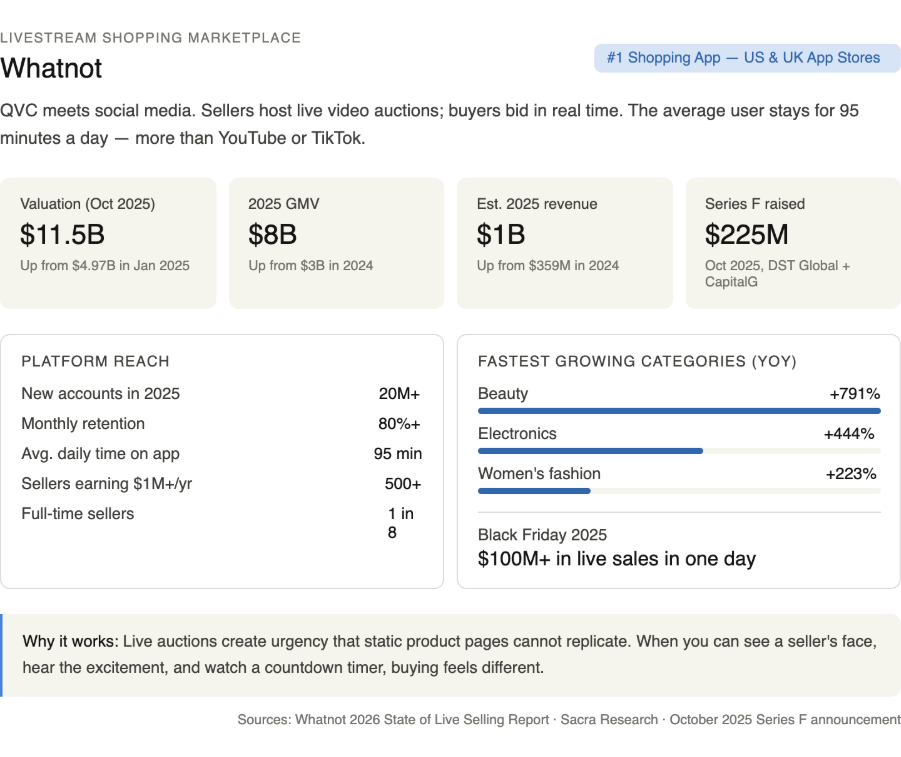
Think about that for a second. The average Whatnot user spends 95 minutes per day on the app. That is more than YouTube. More than TikTok. When people stay that long, they buy things.
In October 2025, Whatnot raised $225 million in a Series F round, more than doubling its valuation from $5 billion at the start of the year to $11.5 billion by the end of it. Platform GMV hit $8 billion for the full year, up from $3 billion in 2024. Revenue reached an estimated $1 billion. The company ranked as the number one Shopping app in both the U.S. and U.K. App Stores, and generated over $100 million in live sales on Black Friday 2025 alone.
The platform is also expanding fast into new categories. Beauty grew 791% year-over-year. Electronics grew 444%. Women’s fashion grew 223%. This is no longer a niche collectibles site; it is becoming a mainstream shopping destination built around entertainment.
Key Figures:
- Valuation: $11.5 billion (October 2025)
- 2025 GMV: $8 billion (up from $3 billion in 2024)
- Estimated 2025 revenue: $1 billion
- Monthly customer retention: over 80%
- Over 500 sellers have achieved $1M+ in annualised sales
- 1 in 8 sellers are now full-time on the platform
- 20 million+ new accounts created in 2025
- Average user spends 95 minutes per day on the app
Why it works: Live auctions create urgency that static product pages simply cannot replicate. When you can see a seller’s face, hear the excitement in the room, and watch a countdown timer, buying feels different. That psychology drives conversion rates that traditional ecommerce can only dream about.
2. ShopMy – Creator-Affiliate Commerce Platform
Ever click an Instagram link to buy a product? There is a good chance ShopMy powered it. This platform helps influencers monetise their audiences by turning their posts into shoppable storefronts.
Brands like Nike, Lululemon, Gucci, and Sephora use ShopMy to track which creators actually drive sales, not just likes. Meanwhile, creators get a commission on every purchase without needing a clunky Shopify store. It is a clean arrangement: brands pay for performance, creators get rewarded for taste, and shoppers discover products through people they actually trust.
What makes ShopMy different from older affiliate platforms is the quality filter. This is not a platform for any influencer with a discount code. It is built around vetted tastemakers, which keeps the product recommendations credible and the conversion rates high. Brands on the premium end of the market, the ones that would run a mile from a generic influencer campaign, are lining up to use it.
As affiliate revenue scales, creators must treat this income like a true business. If you are monetising your audience, our guide to tax deductions for independent professionals can help you protect those earnings.
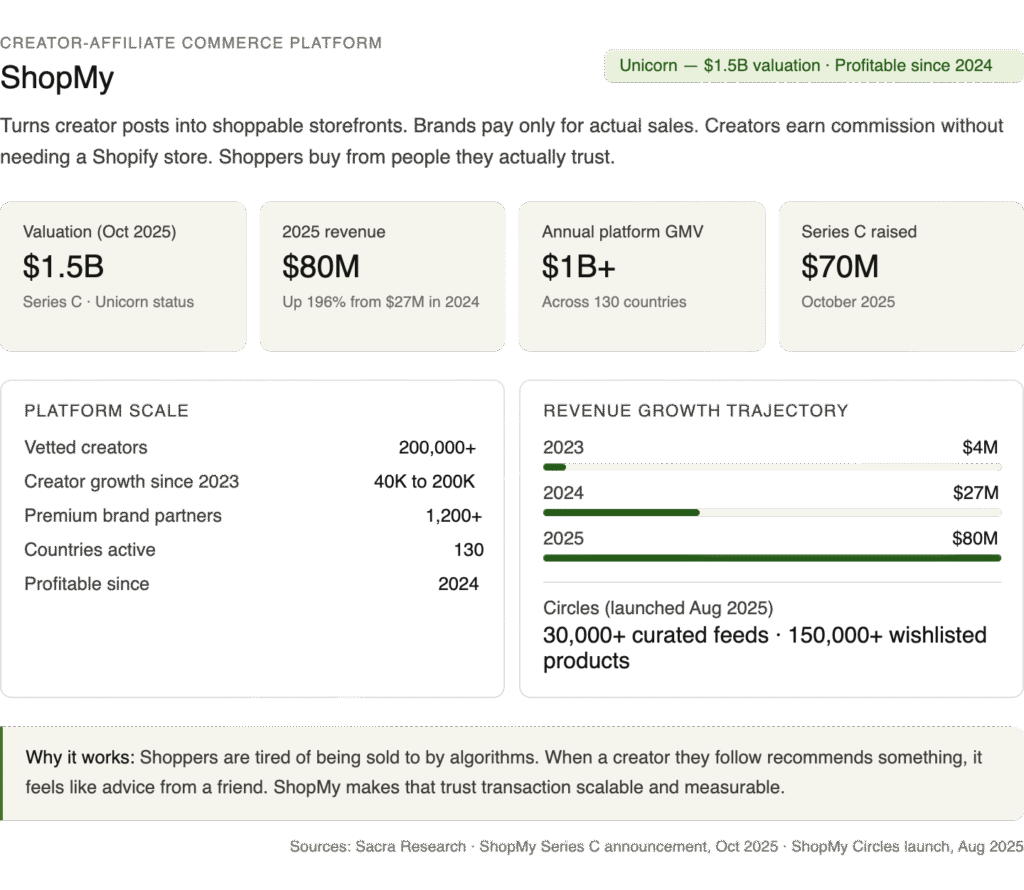
ShopMy raised $70 million in a Series C round in October 2025 at a $1.5 billion valuation, officially becoming a unicorn five years after founding. Revenue grew 200% year-over-year to $80 million, up from $27 million in 2024 and just $4 million in 2023. The platform now facilitates over $1 billion in annual sales across 185,000+ vetted creators and 1,200+ brand partners.
In August 2025, ShopMy launched Circles, a consumer-facing shopping app built around curated product feeds. Within months, users had created 30,000+ Circles and wishlisted over 150,000 products. The company is no longer just a backend tool for brands; it is becoming a shopping destination in its own right.
Key Figures:
- Valuation: $1.5 billion (October 2025)
- 2025 revenue: $80 million (up 200% year-over-year)
- Annual platform GMV: over $1 billion
- 185,000+ vetted creators on the platform
- 1,200+ premium brand partners including Gucci, Rhode, and Net-a-Porter
- Profitable since 2024
Why it works: Shoppers are tired of being sold to by algorithms. When a creator they follow and trust recommends a product, it feels like advice from a friend, not an ad. ShopMy has built the infrastructure that makes that trust transaction scalable, measurable, and profitable for everyone involved.
3. Little Spoon – Direct-to-Consumer Baby and Kids’ Food
Parents are tired of processed baby food filled with preservatives. Little Spoon delivers fresh, organic meals for babies and toddlers, shipped cold and ready to eat.
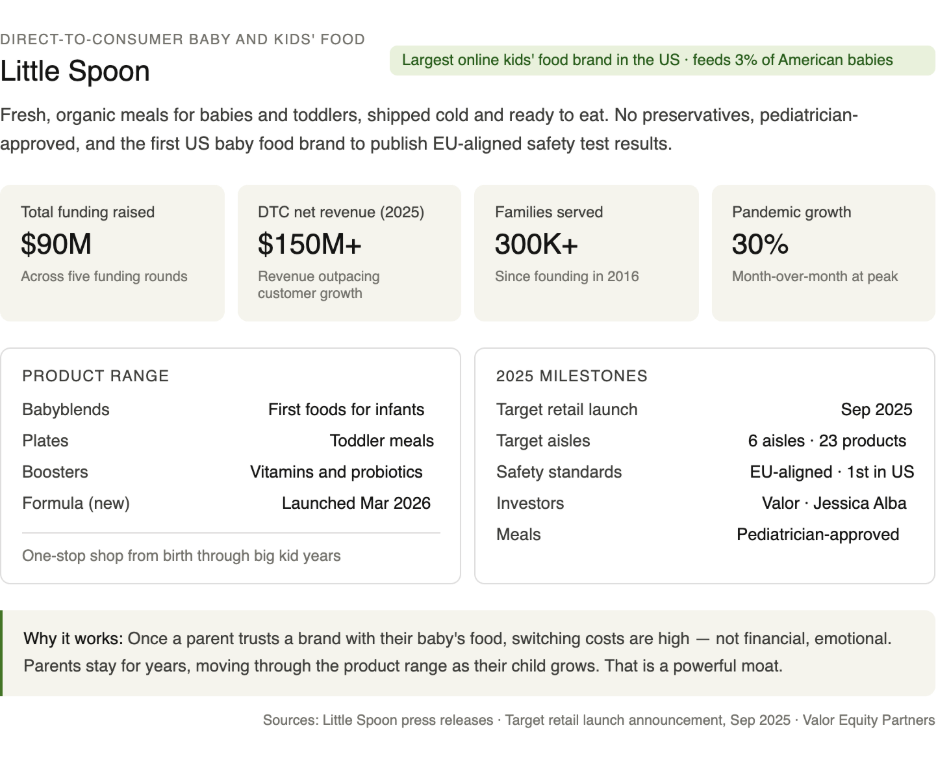
Their Babyblends line covers first foods for infants, while their Plates range for toddlers includes meals like turkey meatballs and quinoa bowls. They also offer vitamins and probiotics under their Boosters line. In March 2026, they launched organic infant formula, making them a genuine one-stop shop for children’s nutrition from birth through the big kid years.
Here is what the traditional baby food industry never figured out: millennial parents do not trust what they cannot read on the label. They grew up Googling ingredients and questioning everything. Little Spoon built its entire brand around that scepticism, making transparency a feature rather than a legal requirement.
Little Spoon has raised $90 million in total funding across five rounds and has delivered meals to over 300,000 families since launch. In 2025, the company became the first and only baby food maker in the U.S. to publicly set EU-aligned safety standards and share test results for heavy metals, pesticides, and plasticisers. That is an unusually bold move in a category where most brands stay quiet on ingredient testing. It paid off in brand trust.
The subscription model is the engine behind the business. Parents who sign up once tend to stay for years, moving from Babyblends to Plates to the Boosters vitamin line as their children grow. That lifetime value per customer is what makes the unit economics work.
Key Figures:
- $90 million raised in total funding
- Over 300,000 families served since 2016
- 30% month-over-month growth during the pandemic
- Investors include Valor Equity Partners and celebrity backers including Jessica Alba
- Pediatrician-approved meals with no preservatives
- First U.S. baby food brand to publish EU-aligned heavy metals and pesticide test results
- Launched organic infant formula in March 2026, completing the nutrition lifecycle from birth
Why it works: The subscription model creates predictable revenue and deep customer loyalty. Once a parent trusts a brand with their baby’s food, switching costs are high. Not financial switching costs, emotional ones. That is a powerful moat.
4. Market Wagon – Online Farmers Market
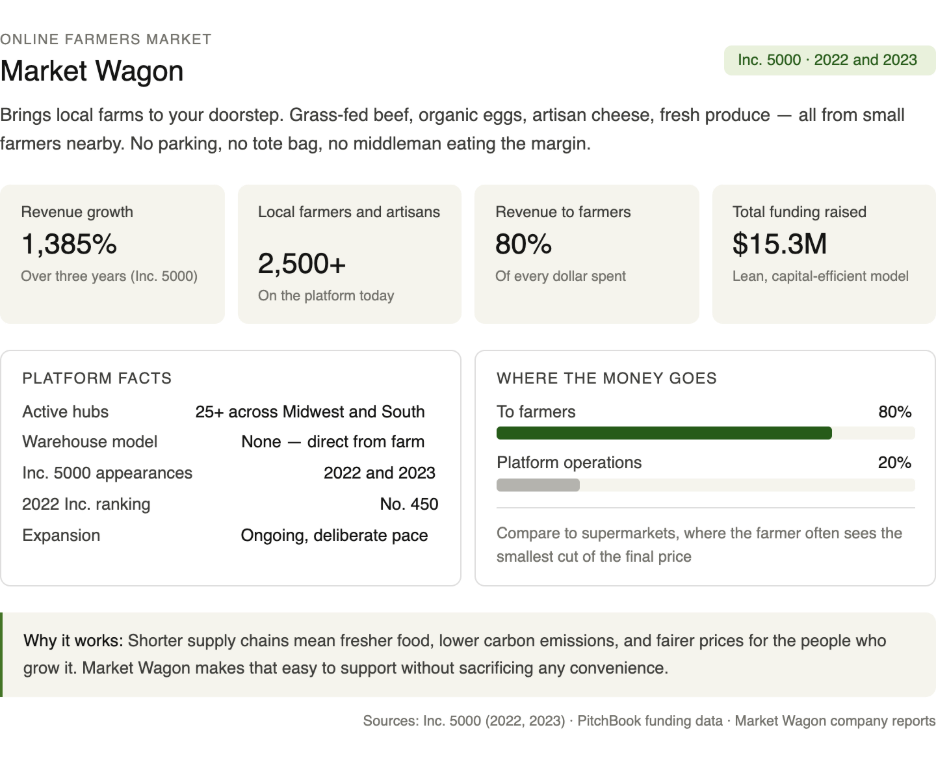
Farmers markets are amazing, but who has time to go every weekend? Market Wagon brings local farms to your doorstep.
You can order grass-fed beef, organic eggs, artisan cheese, and fresh-picked produce, all from small farmers in your area. They handle delivery, so you get farm-fresh food without the Saturday morning hassle. No parking, no tote bag, no queuing for the good cheese.
What separates Market Wagon from a regular grocery delivery service is who gets paid. When you buy through Market Wagon, 80 cents of every dollar goes directly to the farmer. That is the opposite of a supermarket supply chain, where the farmer is typically the last to see any meaningful margin.
Market Wagon achieved 1,385% revenue growth over a three-year period, landing at No. 450 on the 2022 Inc. 5000 list and returning to the list in 2023. The company now collaborates with over 2,500 local farmers and food artisans across more than 30 cities, with ongoing geographic expansion across the Midwest and South. Total funding raised stands at $15.3 million.
The model works because it solves a real logistics problem, not just a marketing one. Local farmers have always had great products and almost no efficient way to reach the people who would pay premium prices for them. Market Wagon built the last-mile infrastructure that connects the two, without the expensive warehousing that kills margins for most grocery delivery businesses.
Key Figures:
- 1,385% revenue growth over three years (Inc. 5000, 2022)
- Named to Inc. 5000 list in both 2022 and 2023
- Over 2,500 local farmers and food artisans on the platform
- Operates across 30+ cities with ongoing expansion
- 80% of revenue goes directly to farmers
- $15.3 million raised in total funding
- No centralised warehouse model, reducing costs and food miles
Why it works: Shorter supply chains mean fresher food, lower carbon emissions, and fairer prices for the people who actually grow the food. That is a story consumers want to support, and Market Wagon makes it easy for them to do so without any sacrifice in convenience.
5. The Woobles – DIY Crochet Kits
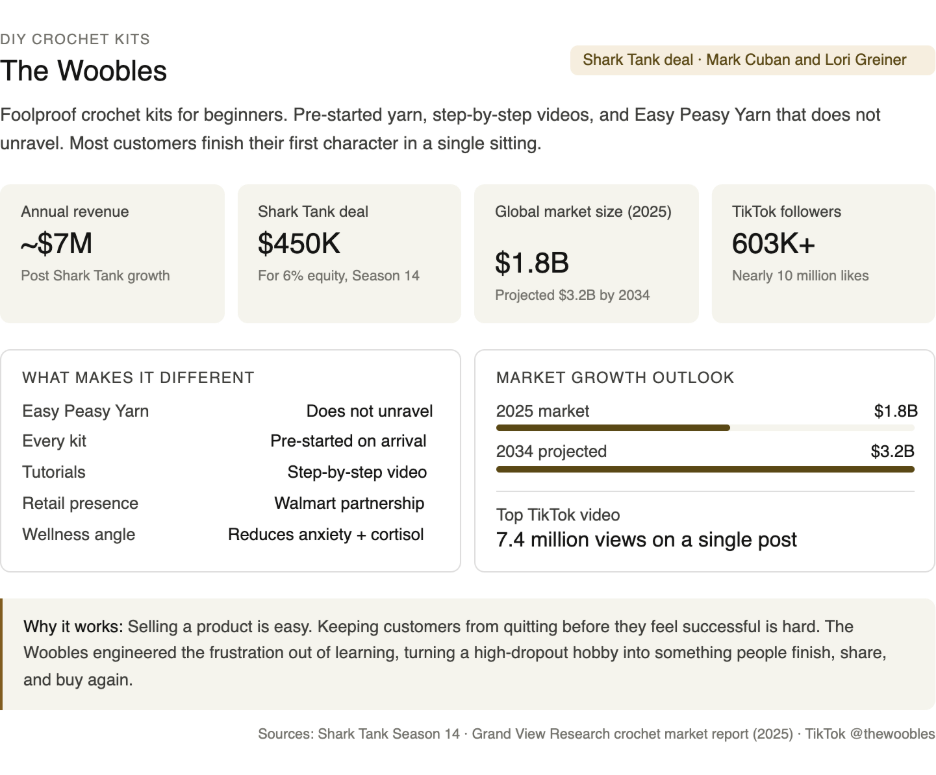
Crochet is having a major moment on TikTok, but most beginners quit because it is too hard. The Woobles fixes that with foolproof kits that include pre-started yarn, step-by-step video tutorials, and adorable patterns like penguins, dinosaurs, and even a tiny Starbucks cup.
Their secret is Easy Peasy Yarn, a specially developed material that does not unravel, so beginners cannot mess up even when they make mistakes. That single design decision removes the frustration that causes most people to quit, which is exactly why the completion rate on Woobles kits is so much higher than anything else in the category.
The crochet market is bigger than most people realise. The global crochet kit market was valued at $1.8 billion in 2025 and is projected to grow to $3.2 billion by 2034. The Woobles and Lion Brand Yarn are the two companies leading that market. For a business that started with two founders and a TikTok account, that is a remarkable position.
The Woobles appeared on Shark Tank Season 14, securing a $450,000 deal from Mark Cuban and Lori Greiner for 6% equity in the company. Since the show, annual revenue has grown to approximately $7 million. The brand has expanded into retail partnerships including Walmart, which gives it physical shelf presence alongside its direct-to-consumer base. On TikTok, the brand has 1million followers and 14 million likes, with one video reaching 744K views.
Key Figures:
- Secured $450,000 deal on Shark Tank with Mark Cuban and Lori Greiner
- Annual revenue approximately $7 million
- The crochet kit market is valued at $1.8 billion globally
- 1 million TikTok followers, 14 million likes
- Retail expansion including Walmart partnership
- Easy Peasy Yarn design dramatically reduces beginner dropout rate
- Mental health angle is real: crocheting is documented to reduce anxiety and cortisol levels
Why it works: The Woobles understood something most craft companies miss. Selling a product is the easy part. The hard part is keeping customers from quitting before they feel successful. By engineering the frustration out of the learning curve, they turned a traditionally high-dropout hobby into something people actually finish, share, and come back to buy again.
What These Companies Teach Us
None of them tried to out-Amazon Amazon. Each picked a frustration the mainstream market had given up on fixing: scammy resale platforms, hollow influencer promotions, processed baby food, inaccessible local farms, crafts that defeat beginners before they start. Then they solved it properly.
What keeps these businesses growing is not just the product. It is the community built around it. A Whatnot buyer who knows their favourite seller by name will not switch to a cheaper platform. A Little Spoon parent who trusts the brand with their baby’s first meal is not going back to a supermarket jar. Loyalty built on genuine usefulness is something a bigger competitor cannot simply buy its way into.
If your own niche business is growing and starting to outpace your financial infrastructure, our guide on when to transition your business structure to save on self-employment taxes is worth reading before you hit the next growth milestone.
Frequently Asked Questions
Can small sellers actually make a living on Whatnot?
More than you might expect. Over 500 sellers have crossed $1 million in annualised sales, and 1 in 8 now sell full-time. The key difference from a platform like eBay is that Whatnot rewards entertainment as much as inventory. A charismatic seller with 200 items can outperform a silent seller with 2,000. Most successful sellers recommend going live consistently for 90 days before judging results, since audience-building takes time but retention once established is unusually strong.
Is ShopMy only for big influencers?
Not anymore. The platform has expanded into nano-influencers and expertise-driven creators: dermatologists, chefs, trainers, and nutritionists now sit alongside fashion bloggers. The creator base grew from 40,000 in 2023 to 200,000 in 2025. If you have a genuinely engaged audience in any niche and can recommend products with real authority, the platform is worth exploring.
Is Little Spoon available in stores or only online?
Both, as of late 2025. Little Spoon launched at Target nationwide in September 2025, spanning six aisles and 23 products in the largest food and beverage rollout in the retailer’s history. The subscription service remains the core product, but the retail partnership is designed to introduce the brand to parents who have not yet discovered it online.
Is Market Wagon available outside the Midwest?
Market Wagon operates 25+ hubs primarily across the Midwest and parts of the South as of 2026. Expansion has been deliberate rather than rapid, because the local supply chain model only works when the farms are genuinely nearby. The company’s website shows a map of active hubs for anyone checking coverage in their area.
Do you need experience to use The Woobles kits?
None at all. The kits are engineered specifically for people who have never crocheted. The Easy Peasy Yarn does not unravel when you make mistakes, and every kit arrives pre-started so you skip the hardest part of learning any new craft. Most customers finish their first character in a single sitting, which is entirely intentional.
Note: Company valuations and figures reflect the most current publicly available data as of June 2026. For the most current statistics, refer to official company announcements and reputable financial reporting.
About the Author
Isabella Jones started her career at Deloitte, where she worked on tax compliance for some of the country’s fastest-growing companies. She later joined Fynlo as Senior Financial Strategist, bringing that experience to freelancers and small business owners who need practical financial guidance without the corporate complexity.
With an Accounting degree from Villanova University, Isabella focuses on making financial planning easier to understand and apply in day-to-day business. She works closely with freelancers and small businesses on areas like taxes, cash flow, and building more stable financial systems.