
5 Fastest Growing Ecommerce Companies in 2026
Americans now spend more on e-commerce than the GDP of Denmark and these 5 innovative companies are cashing in. Forget Amazon clones. These disruptors are creating entirely new ways to shop. 1. Whatnot – Livestream Shopping Marketplace Imagine scrolling through TikTok, but instead of just watching, you can instantly buy what you see. That is Whatnot. This platform brings the thrill of live auctions to your phone, where sellers host real-time video streams to showcase everything from rare Pokémon cards to sneakers, vintage toys, and luxury handbags. Unlike traditional marketplaces like eBay or Facebook Marketplace, Whatnot makes shopping entertaining. Sellers hype up their products like game show hosts, buyers chat and bid in real time, and rare items can sell for thousands in minutes. It is QVC meets social media and it is no longer just for collectors. Think about that for a second. The average Whatnot user spends 95 minutes per day on the app. That is more than YouTube. More than TikTok. When people stay that long, they buy things. In October 2025, Whatnot raised $225 million in a Series F round, more than doubling its valuation from $5 billion at the start of the year to $11.5 billion by the end of it. Platform GMV hit $8 billion for the full year, up from $3 billion in 2024. Revenue reached an estimated $1 billion. The company ranked as the number one Shopping app in both the U.S. and U.K. App Stores, and generated over $100 million in live sales on Black Friday 2025 alone. The platform is also expanding fast into new categories. Beauty grew 791% year-over-year. Electronics grew 444%. Women’s fashion grew 223%. This is no longer a niche collectibles site; it is becoming a mainstream shopping destination built around entertainment. Key Figures: Why it works: Live auctions create urgency that static product pages simply cannot replicate. When you can see a seller’s face, hear the excitement in the room, and watch a countdown timer, buying feels different. That psychology drives conversion rates that traditional ecommerce can only dream about. 2. ShopMy – Creator-Affiliate Commerce Platform Ever click an Instagram link to buy a product? There is a good chance ShopMy powered it. This platform helps influencers monetise their audiences by turning their posts into shoppable storefronts. Brands like Nike, Lululemon, Gucci, and Sephora use ShopMy to track which creators actually drive sales, not just likes. Meanwhile, creators get a commission on every purchase without needing a clunky Shopify store. It is a clean arrangement: brands pay for performance, creators get rewarded for taste, and shoppers discover products through people they actually trust. What makes ShopMy different from older affiliate platforms is the quality filter. This is not a platform for any influencer with a discount code. It is built around vetted tastemakers, which keeps the product recommendations credible and the conversion rates high. Brands on the premium end of the market, the ones that would run a mile from a generic influencer campaign, are lining up to use it. As affiliate revenue scales, creators must treat this income like a true business. If you are monetising your audience, our guide to tax deductions for independent professionals can help you protect those earnings. ShopMy raised $70 million in a Series C round in October 2025 at a $1.5 billion valuation, officially becoming a unicorn five years after founding. Revenue grew 200% year-over-year to $80 million, up from $27 million in 2024 and just $4 million in 2023. The platform now facilitates over $1 billion in annual sales across 185,000+ vetted creators and 1,200+ brand partners. In August 2025, ShopMy launched Circles, a consumer-facing shopping app built around curated product feeds. Within months, users had created 30,000+ Circles and wishlisted over 150,000 products. The company is no longer just a backend tool for brands; it is becoming a shopping destination in its own right. Key Figures: Why it works: Shoppers are tired of being sold to by algorithms. When a creator they follow and trust recommends a product, it feels like advice from a friend, not an ad. ShopMy has built the infrastructure that makes that trust transaction scalable, measurable, and profitable for everyone involved. 3. Little Spoon – Direct-to-Consumer Baby and Kids’ Food Parents are tired of processed baby food filled with preservatives. Little Spoon delivers fresh, organic meals for babies and toddlers, shipped cold and ready to eat. Their Babyblends line covers first foods for infants, while their Plates range for toddlers includes meals like turkey meatballs and quinoa bowls. They also offer vitamins and probiotics under their Boosters line. In March 2026, they launched organic infant formula, making them a genuine one-stop shop for children’s nutrition from birth through the big kid years. Here is what the traditional baby food industry never figured out: millennial parents do not trust what they cannot read on the label. They grew up Googling ingredients and questioning everything. Little Spoon built its entire brand around that scepticism, making transparency a feature rather than a legal requirement. Little Spoon has raised $90 million in total funding across five rounds and has delivered meals to over 300,000 families since launch. In 2025, the company became the first and only baby food maker in the U.S. to publicly set EU-aligned safety standards and share test results for heavy metals, pesticides, and plasticisers. That is an unusually bold move in a category where most brands stay quiet on ingredient testing. It paid off in brand trust. The subscription model is the engine behind the business. Parents who sign up once tend to stay for years, moving from Babyblends to Plates to the Boosters vitamin line as their children grow. That lifetime value per customer is what makes the unit economics work. Key Figures: Why it works: The subscription model creates predictable revenue and deep customer loyalty. Once a parent trusts a brand with their baby’s food, switching costs are high. Not financial switching costs, emotional ones. That is a powerful moat. 4. Market Wagon – Online Farmers Market Farmers markets are amazing, but who has time to go every weekend? Market Wagon brings local farms to your doorstep. You can order grass-fed beef, organic eggs, artisan cheese, and fresh-picked produce, all from small farmers in your area. They handle delivery, so you get farm-fresh food
5 Best U.S. States to Incorporate In: 2026 Tax & Legal Guide
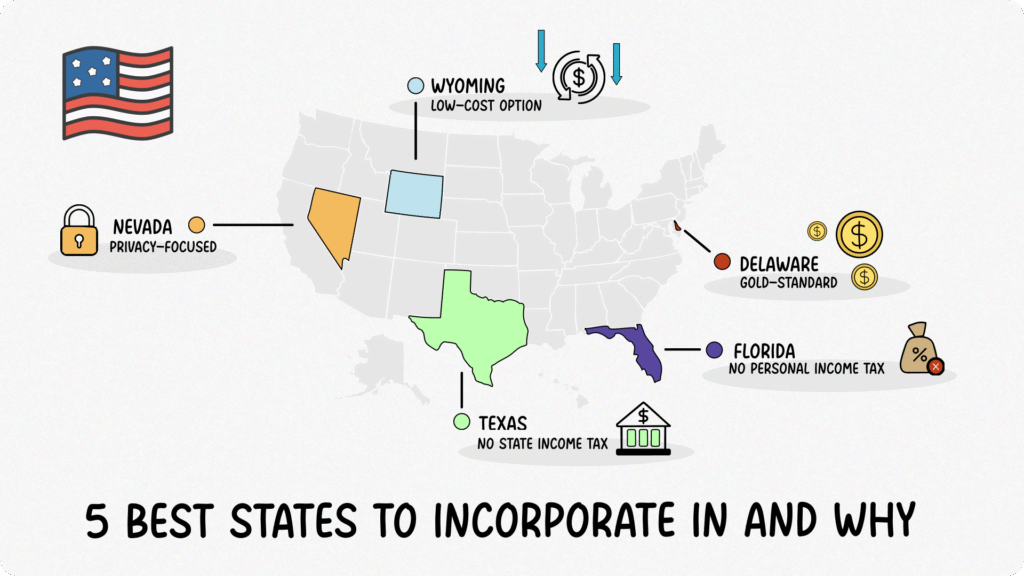
Choosing where to legally anchor your business is a major decision that impacts your tax liabilities, how easily you can manage your company, and your long-term legal protection. Many entrepreneurs default to filing in their home state, only to realize later that their funding strategies or business models would have been better served by a different jurisdiction. There is no single “best” state for every business. The right choice depends entirely on your capital structure, privacy requirements, and where you physically operate. This guide breaks down exactly how Delaware, Wyoming, Nevada, Texas, and Florida offer distinct advantages for corporate formation, looking beyond basic filing fees to examine the underlying legal and tax frameworks that impact your growth. In this Article Key Factors in Selecting a State When evaluating a state for incorporation, you need to look at four primary financial and regulatory angles. The right balance depends entirely on your specific business priorities. Comprehensive State-by-State Analysis Delaware: The Institutional and Venture Capital Standard Delaware differentiates itself not by being cost-effective, but by acting as the universally accepted legal framework for outside investors. While other states pitch low fees, Delaware focuses on corporate flexibility, maximizing options for complex equity structures, and offering unparalleled legal predictability. This is why tech giants like Alphabet (Google), Amazon, Apple, and high-growth scale-ups like Stripe and Airbnb choose Delaware. Note on Delaware LLCs vs. Corporations: If you form an LLC instead of a corporation in Delaware, you owe a flat $300 annual tax due June 1 each year instead of the franchise tax, and you do not need to file an annual report. Wyoming: Low-Cost Maintenance and Administrative Simplicity Wyoming differentiates itself by offering the leanest, most affordable corporate maintenance structure in the country. Where Delaware targets venture-backed corporations, Wyoming targets solopreneurs, digital nomads, and bootstrapped e-commerce brands looking for solid asset protection without ongoing paperwork burdens. Nevada: Premium Privacy and Robust Asset Protection Nevada differentiates itself by actively shielding corporate leadership teams from public visibility. It combines a zero-tax structure with some of the strictest operational privacy rules in the United States. Texas: Scaling Infrastructure and High-Volume Local Markets Texas differentiates itself by being an operational powerhouse rather than a passive filing haven. It is built for growing agencies, technology scale-ups, and companies that intend to establish a physical footprint, hire local talent, and capture market share within a massive domestic economy. Important Compliance Note: Even if your revenue is below the $2.65 million threshold and you owe zero franchise tax, you are still required to file a Public Information Report with the Texas Comptroller by May 15 each year. Skipping this filing triggers a $50 penalty. Florida: Balanced Taxation and Regional Ecosystem Growth Florida differentiates itself by offering an ideal tax environment for business owners who prioritize personal income retention. It strikes a highly attractive balance with a predictable low-rate corporate tax and a completely tax-free landscape for individual income. TL;DR: Summary Matrix State Primary Strategic Advantage Best Suited For Top Operational Priority Delaware Institutional credibility, VC readiness, advanced corporate courts Venture-backed startups, high-growth entities, complex boards Raising Outside Capital / IPO Roadmap Wyoming Maximum affordability, asset shielding, low paperwork Solopreneurs, e-commerce, bootstrapped digital companies Minimizing Upkeep & Protecting Solo Assets Nevada Strict leadership anonymity, asset protection, business courts Privacy-conscious owners, asset managers, mid-size firms Maximum Operational Privacy Texas Massive regional market, zero franchise tax under $2.65M revenue Agencies, regional employers, manufacturing, tech scale-ups Scaling Physical Infrastructure & Local Hiring Florida Balanced founder tax environment, high consumer market access Profitable brands, regional agencies, expanding tech hubs Founder Wealth Maximization & Distribution Critical Questions Before Filing To avoid inadvertently triggering double-compliance obligations, analyze these operational realities prior to registration: Final Thoughts Every entrepreneur starts exactly where you are right now: staring at a blank filing form, weighing numbers, and trying to predict the future layout of their company. If you find yourself stuck in analysis paralysis, simplify your decision by looking at your business model’s immediate 12-month horizon: Once you have identified the state that aligns with your current priorities, your next steps are straightforward: secure a registered agent in that jurisdiction, file your Articles of Organization or Incorporation, and obtain your federal EIN. One final reminder that applies regardless of which state you choose: incorporating in a different state from where you actually live and operate does not eliminate your home state tax obligations. You will almost certainly need to register as a foreign entity in your operating state, meaning you pay fees and meet compliance requirements in both. Factor this into your total cost comparison before making a final decision. By taking the time to match your state selection to your actual operational strategy today, you protect your personal assets and build a clean foundation for wherever your business takes you next. For a visual breakdown of how these specific legal and financial trade-offs operate side-by-side, this Wyoming LLC vs. Delaware LLC video provides a practical analysis of ongoing maintenance fees, asset protections, and exact filing pathways to help you choose the correct entity structure. About the Author Isabella Jones started her career at Deloitte, where she worked on tax compliance for some of the country’s fastest-growing companies. She later joined Fynlo as Senior Financial Strategist, bringing that experience to freelancers and small business owners who need practical financial guidance without the corporate complexity. With an Accounting degree from Villanova University, Isabella focuses on making financial planning easier to understand and apply in day-to-day business. She works closely with freelancers and small businesses on areas like taxes, cash flow, and building more stable financial systems.