
5 Fastest Growing Ecommerce Companies in 2026
Americans now spend more on e-commerce than the GDP of Denmark and these 5 innovative companies are cashing in. Forget Amazon clones. These disruptors are creating entirely new ways to shop. 1. Whatnot – Livestream Shopping Marketplace Imagine scrolling through TikTok, but instead of just watching, you can instantly buy what you see. That is Whatnot. This platform brings the thrill of live auctions to your phone, where sellers host real-time video streams to showcase everything from rare Pokémon cards to sneakers, vintage toys, and luxury handbags. Unlike traditional marketplaces like eBay or Facebook Marketplace, Whatnot makes shopping entertaining. Sellers hype up their products like game show hosts, buyers chat and bid in real time, and rare items can sell for thousands in minutes. It is QVC meets social media and it is no longer just for collectors. Think about that for a second. The average Whatnot user spends 95 minutes per day on the app. That is more than YouTube. More than TikTok. When people stay that long, they buy things. In October 2025, Whatnot raised $225 million in a Series F round, more than doubling its valuation from $5 billion at the start of the year to $11.5 billion by the end of it. Platform GMV hit $8 billion for the full year, up from $3 billion in 2024. Revenue reached an estimated $1 billion. The company ranked as the number one Shopping app in both the U.S. and U.K. App Stores, and generated over $100 million in live sales on Black Friday 2025 alone. The platform is also expanding fast into new categories. Beauty grew 791% year-over-year. Electronics grew 444%. Women’s fashion grew 223%. This is no longer a niche collectibles site; it is becoming a mainstream shopping destination built around entertainment. Key Figures: Why it works: Live auctions create urgency that static product pages simply cannot replicate. When you can see a seller’s face, hear the excitement in the room, and watch a countdown timer, buying feels different. That psychology drives conversion rates that traditional ecommerce can only dream about. 2. ShopMy – Creator-Affiliate Commerce Platform Ever click an Instagram link to buy a product? There is a good chance ShopMy powered it. This platform helps influencers monetise their audiences by turning their posts into shoppable storefronts. Brands like Nike, Lululemon, Gucci, and Sephora use ShopMy to track which creators actually drive sales, not just likes. Meanwhile, creators get a commission on every purchase without needing a clunky Shopify store. It is a clean arrangement: brands pay for performance, creators get rewarded for taste, and shoppers discover products through people they actually trust. What makes ShopMy different from older affiliate platforms is the quality filter. This is not a platform for any influencer with a discount code. It is built around vetted tastemakers, which keeps the product recommendations credible and the conversion rates high. Brands on the premium end of the market, the ones that would run a mile from a generic influencer campaign, are lining up to use it. As affiliate revenue scales, creators must treat this income like a true business. If you are monetising your audience, our guide to tax deductions for independent professionals can help you protect those earnings. ShopMy raised $70 million in a Series C round in October 2025 at a $1.5 billion valuation, officially becoming a unicorn five years after founding. Revenue grew 200% year-over-year to $80 million, up from $27 million in 2024 and just $4 million in 2023. The platform now facilitates over $1 billion in annual sales across 185,000+ vetted creators and 1,200+ brand partners. In August 2025, ShopMy launched Circles, a consumer-facing shopping app built around curated product feeds. Within months, users had created 30,000+ Circles and wishlisted over 150,000 products. The company is no longer just a backend tool for brands; it is becoming a shopping destination in its own right. Key Figures: Why it works: Shoppers are tired of being sold to by algorithms. When a creator they follow and trust recommends a product, it feels like advice from a friend, not an ad. ShopMy has built the infrastructure that makes that trust transaction scalable, measurable, and profitable for everyone involved. 3. Little Spoon – Direct-to-Consumer Baby and Kids’ Food Parents are tired of processed baby food filled with preservatives. Little Spoon delivers fresh, organic meals for babies and toddlers, shipped cold and ready to eat. Their Babyblends line covers first foods for infants, while their Plates range for toddlers includes meals like turkey meatballs and quinoa bowls. They also offer vitamins and probiotics under their Boosters line. In March 2026, they launched organic infant formula, making them a genuine one-stop shop for children’s nutrition from birth through the big kid years. Here is what the traditional baby food industry never figured out: millennial parents do not trust what they cannot read on the label. They grew up Googling ingredients and questioning everything. Little Spoon built its entire brand around that scepticism, making transparency a feature rather than a legal requirement. Little Spoon has raised $90 million in total funding across five rounds and has delivered meals to over 300,000 families since launch. In 2025, the company became the first and only baby food maker in the U.S. to publicly set EU-aligned safety standards and share test results for heavy metals, pesticides, and plasticisers. That is an unusually bold move in a category where most brands stay quiet on ingredient testing. It paid off in brand trust. The subscription model is the engine behind the business. Parents who sign up once tend to stay for years, moving from Babyblends to Plates to the Boosters vitamin line as their children grow. That lifetime value per customer is what makes the unit economics work. Key Figures: Why it works: The subscription model creates predictable revenue and deep customer loyalty. Once a parent trusts a brand with their baby’s food, switching costs are high. Not financial switching costs, emotional ones. That is a powerful moat. 4. Market Wagon – Online Farmers Market Farmers markets are amazing, but who has time to go every weekend? Market Wagon brings local farms to your doorstep. You can order grass-fed beef, organic eggs, artisan cheese, and fresh-picked produce, all from small farmers in your area. They handle delivery, so you get farm-fresh food
15 Highest Paying Freelance Jobs in 2026 (With Real Rates, Growth Stats, and Exactly Where to Start)
I was chatting with an ex-FAANG engineer at a co-working space the other day. He had left Big Tech in 2019 to freelance full-time. I assumed he had traded a cushy salary for a bit more freedom, but I was wrong. He is actually out-earning his old salary now, and the real win is that he can trade his standing desk for a surfboard on a Wednesday morning without checking a calendar or asking for permission. Stories like his are not rare anymore. The freelance economy has matured, and companies now view top contractors as mission-critical talent, not budget line items. According to industry research from April 2026, an estimated 70 to 73 million workers, approximately one third of the labour force, engage in independent or gig work in some capacity. At the upper end of the market, highly specialized roles regularly command triple-digit hourly rates. Below are 15 freelance careers that pay exceptionally well and give you the freedom to spend afternoons with family, jet off on a moment’s notice, catch the perfect swell, or whatever your version of freedom looks like. In this Article Is 2026 Actually a Good Time to Go Freelance? The short answer: it depends entirely on what you do. AI is the elephant in the room, and it cuts both ways. On the threat side, entry-level creative and writing work has been hit hard. If you were charging $30/hr for basic blog posts or simple graphic design, that pipeline has thinned considerably. Junior roles that once served as stepping stones into freelance careers are disappearing faster than anyone expected, and that is a genuine problem worth acknowledging. But here is where it gets interesting. The same AI wave that is eroding entry-level work is creating an acute shortage of senior specialists who can work with it. Enterprises can now prototype faster and cheaper than ever before, but someone still needs to validate the output, fix what the model gets wrong, and translate technical results into business decisions. That someone is increasingly a senior freelance specialist brought in on contract. The people building AI pipelines, auditing AI security vulnerabilities, and advising boards on AI strategy are in higher demand today than they were two years ago. There is also a structural tailwind that has nothing to do with AI. Companies are leaner than ever. Hiring a full-time specialist with salary, benefits, equity, and office space is expensive and slow. A freelance expert who parachutes in, solves the problem, and invoices cleanly is increasingly the preferred model for project-based work. The honest summary: if you are early in your career or working in commoditised skills, 2026 is a challenging market. If you are a senior specialist with a track record in a high-demand field, the conditions have rarely been better. The roles on this list belong firmly in the second category. The 15 High-Paying Roles Each role on this list meets three criteria: it commands a meaningful hourly rate (above $40/hr at entry), it has documented demand growth, and it is genuinely accessible to a freelancer without needing to be on-site five days a week. Annual earning estimates are based on 20 billable hours per week, applied consistently across every role in this article. Pressed for time? [Click here to skip to the full rate comparison table.] 1. Blockchain (Web3) Developer Blockchain is no longer a buzzword; it underpins billions of dollars worth of transactions in finance, supply chain, and even gaming. Even though the crypto market has seen its share of volatility, demand for skilled blockchain engineers remains strong because companies still need private ledgers, supply-chain tracking, and secure tokenisation. From writing tamper-proof smart contracts to auditing DeFi protocols for seven-figure exploits, top-tier engineers sit at the crossroads of money and math, and companies happily pay to keep them on speed-dial. Why demand is surging: The global blockchain technology market is projected to grow from $47.96 billion in 2026 to $577.36 billion by 2034, at a compound annual growth rate of 36.5% (Fortune Business Insights, 2025). Enterprises across finance, healthcare, and logistics are actively hiring, and there simply are not enough qualified developers to go around. Typical Rate: $50 – $150/hr Annual Earning Potential: $52,000 – $156,000 2. AI / Machine-Learning Consultant AI is red-hot, and every investor is hunting for the next breakthrough. Enterprises are scrambling to move from “AI pilot” to real ROI, but pre-trained models still need custom data, guardrails, and cost controls. Freelance ML pros step in to fine-tune LLMs, build anomaly-detection pipelines, and translate geek-speak into boardroom slides. When a single algorithm tweak can save or earn millions, these specialists name their price. Why demand is surging: LinkedIn’s 2025 Jobs on the Rise report showed AI Engineer roles growing at 59% year-over-year, the fastest of any role tracked. The median annual salary for full-time AI/ML engineers sits at $145,000 (US Bureau of Labor, 2024), which gives you a sense of what companies are willing to pay for this expertise on a permanent basis, let alone contract. Typical Rate: $120 – $160/hr Annual Earning Potential: $124,800 – $166,400 3. Cloud Architect/Engineer One mis-tagged S3 bucket can leak data, and unoptimized infrastructure wastes over 80% of a company’s container budget on idle resources. Large companies know that poor cloud setup risks both security breaches and massive unexpected bills, so they take cloud architecture very seriously. Architects who tame AWS, Azure, or GCP keep uptime high and costs low, guiding organisations through migrations and DevOps automation. Their invoices cost far less than the cloud horror stories they prevent. If cloud architecture is about building the fortress, the next role on this list is about defending it. The two skills frequently appear on the same enterprise contract. Why demand is surging: (BLS) projects cloud architect roles to grow 13% through 2033, well above the national average of 4%. The average annual salary for a full-time cloud architect sits at $150,000 (Glassdoor), making freelance contracts in this space extremely well-compensated. Typical Rate: $80 – $180/hr Annual Earning Potential: $83,200 – $187,200 4. Cybersecurity Specialist A single breach now averages $4.4M (IBM 2025). High-profile incidents like the Equifax breach and Colonial Pipeline hack have shuttered operations overnight. Ethical hackers and compliance experts harden networks, run red-team drills, and navigate audits. The pitch to clients essentially writes itself: pay me five figures now, or pay ransomware double
Why “Cheap” Bookkeeping is the Most Expensive Risk Your Business Can Take
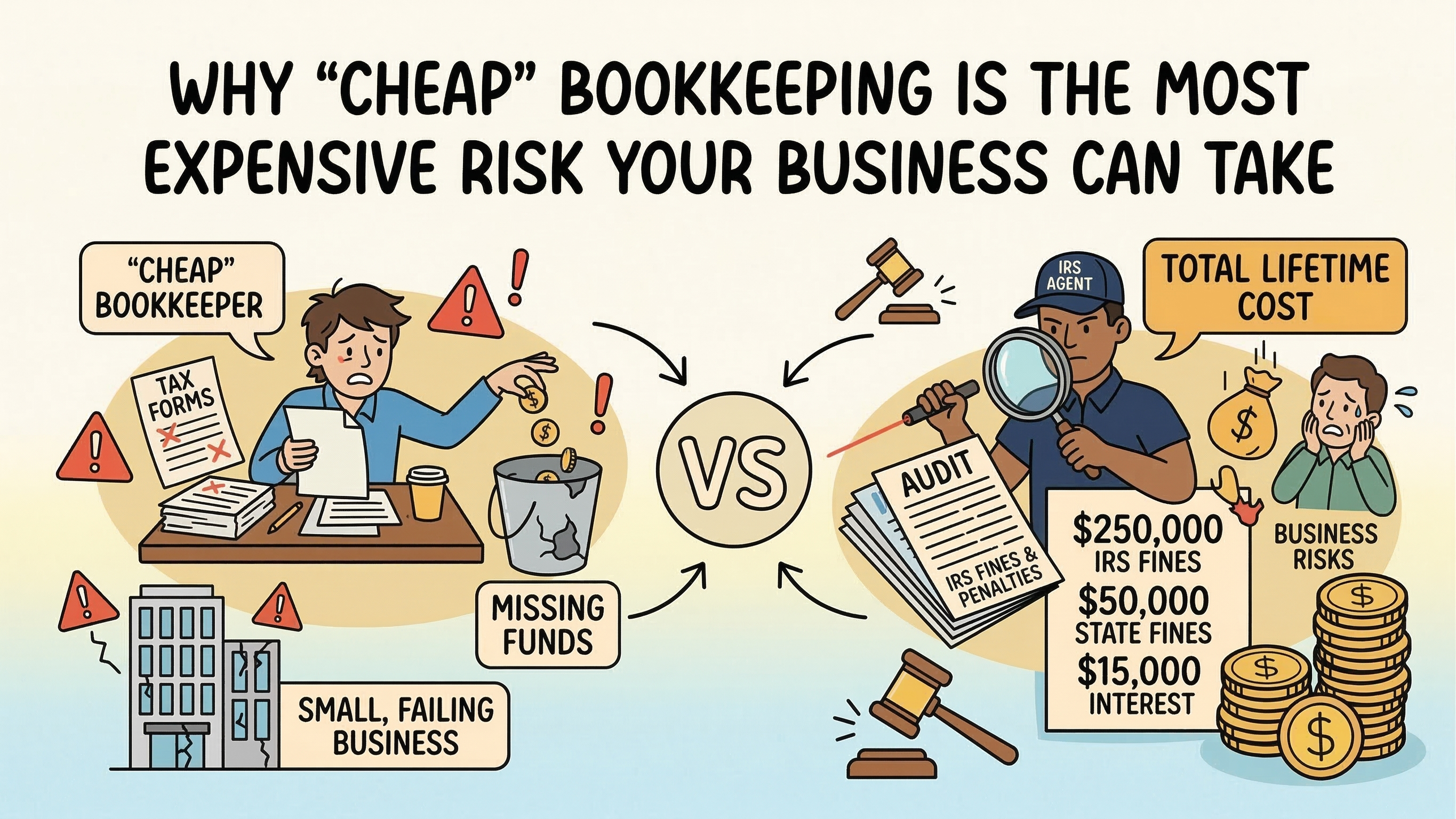
TL;DR: A growing trucking company hired a budget bookkeeper to save on overhead. Two years later, the business was insolvent due to nearly $300,000 in unremitted payroll taxes and IFTA fraud. This post-mortem explores the “Price of Cheap” and the specific red flags that preceded a total business collapse. In this Article Why “saving money” on bookkeeping backfires It started with a simple desire to protect the bottom line. As the owner of a growing trucking service, John knew that every cent was spoken for. Between rising diesel prices, insurance premiums, and constant fleet maintenance, the overhead was suffocating. When he found a local bookkeeper who promised to handle the entire operation for a few hundred dollars a month—roughly a fifth of what established firms quoted—it didn’t feel like a risk. It felt like a win. For the first eighteen months, the “win” seemed real. The reports arrived on time, the bank balances looked healthy, and the bookkeeper was always a friendly voice on the phone. John used the “saved” money to buy a new rig and hire two more drivers. He was scaling. He thought he was safe. The early warning signs John missed The first sign of trouble wasn’t a roar; it was a whisper. John received a notice from the state regarding a discrepancy in his International Fuel Tax Agreement (IFTA) filings. When he questioned his bookkeeper, the answer was smooth: “It’s just state bureaucracy, John. They probably lost a page. I’ll send a corrected copy.” A month later, a second notice arrived—this time from the IRS regarding payroll tax underpayments. Again, the bookkeeper had a plausible explanation. He blamed a software “glitch” and promised it was handled. In the fast-paced world of logistics, where trucks run 24/7, John took him at his word. He had a fleet to manage; he didn’t have time to audit the auditor. When the bookkeeper went radio silent The “glitches” turned into a nightmare when the IRS triggered a formal audit. For the first time, John heard a flicker of panic in his bookkeeper’s voice. Then came the silence. Voicemails went unreturned. Emails began to bounce. When John finally drove to the bookkeeper’s small rented office, he found the lights off and the desk cleared. The “affordable” professional had vanished, leaving behind three years of digital records that were nothing more than a house of cards. What we found when we looked at the books When a reputable accounting firm finally stepped in to perform the forensic cleanup, the reality was horrifying. The “professional” reports John had received every month were complete fabrications. The bookkeeper hadn’t been filing the returns at all. Instead, he was making the bare minimum payments to the IRS—just enough to keep the automated “Final Notice” letters from being triggered—while pocketing the remainder of the tax escrow money. By the time the audit was finished, the bill was staggering: The penalties and interest alone were more than a year’s worth of profit. The business—the dream John had spent a decade building—was legally and financially insolvent. He had to sell his fleet and close his doors. How to spot a bad bookkeeper early If you see these signs, investigate immediately: Comparing budget services vs. professional firms To understand how this happens, we have to look at the math. A “cheap” service is often cheap because it lacks the multi-layer oversight and insurance that protects a business owner. Expense Category Budget “Solo” Bookkeeper Established Professional Firm Typical Monthly Fee $250 – $400 $1,200 – $2,500 Staffing Structure One person (no backup) Team of CPAs & Specialized Staff Internal Controls None (they hold the keys) Multi-person review & verification Compliance Liability High (you are responsible) Low (covered by errors/omissions) Total Cost of Ownership Infinite Risk Predictable Overhead Protecting your business John’s story is a cautionary tale, but it’s one that can be avoided. Before you entrust your life’s work to someone, do your due diligence. Check credentials, call references, and never hand over the reins completely. Maintain oversight by reviewing your financial statements monthly and ensuring you have “view-only” access to your tax accounts. The most expensive service you can buy is the one that doesn’t actually do the job. About the Author Isabella Jones started her career at Deloitte, where she worked on tax compliance for some of the country’s fastest-growing companies. She later joined Fynlo as Senior Financial Strategist, bringing that experience to freelancers and small business owners who need practical financial guidance without the corporate complexity. With an Accounting degree from Villanova University, Isabella focuses on making financial planning easier to understand and apply in day-to-day business. She works closely with freelancers and small businesses on areas like taxes, cash flow, and building more stable financial systems.
Advanced LLC Strategy: How to Structure for Growth and Asset Protection in 2026
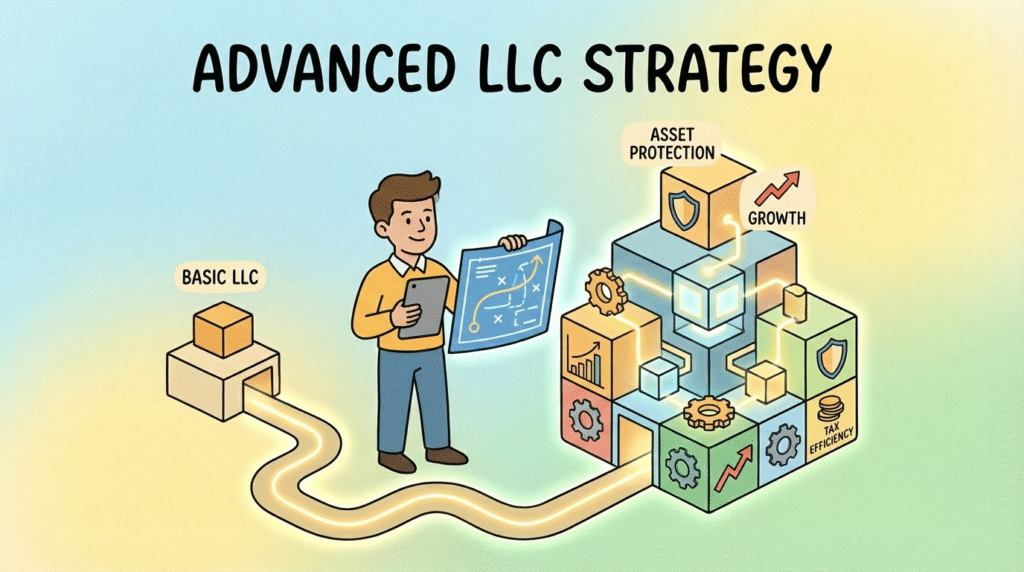
Most founders start with a single LLC because it is the simplest path to getting a tax ID. But as your revenue grows or you begin developing your own products, a single-entity setup may no longer be the most efficient choice. In 2026, the goal is to build a structure that protects your personal assets while remaining flexible enough to scale. Here is how experienced founders structure their businesses to manage risk and optimize for long-term growth. In this article The “Parent & Child” Strategy (Holding Companies) When all your business assets—client contracts, intellectual property (IP), and equipment—live in one LLC, they are all exposed to the same risks. If a client dispute leads to a lawsuit against that LLC, every asset inside it is potentially at risk. The Solution: A Two-Tiered Structure Strategic State Selection: Where to Place Your Entities When choosing where to register your “Parent” or “Child” companies, you can take advantage of specific state rules to manage your tax burden and maximize protection. Wyoming: The Ideal “Parent” Home Wyoming is frequently chosen for the Parent company because it does not require the names of owners to be listed in public records. In 2026, this state-level anonymity provides a layer of data security. Additionally, Wyoming has strong Charging Order laws, meaning if you face a personal lawsuit, it is very difficult for a creditor to seize your business assets. Texas: Scaling the “Child” Company For an Operating Company with a physical presence, Texas offers a significant threshold for small businesses. While Texas has a “Margin Tax,” businesses with total revenue below $2,650,000 in 2026 generally owe $0 in state franchise tax. This allows you to utilize Texas’s vast talent pool and infrastructure without a state-level tax bill until you reach a significant scale. Nevada: High-Level Liability Protection If your business operates in a high-liability field, Nevada is a strong choice for your Operating Company. Nevada law provides an “Exclusive Remedy” protection. This means that a charging order is the only way a creditor can pursue a member’s interest, preventing them from ever seizing business assets or forcing the company to shut down to pay a debt. Tennessee: The “Asset-Light” Advantage Tennessee recently overhauled its tax code, which is highly beneficial for remote agencies and freelancers. In the past, the state taxed businesses based on the value of the physical property they owned (the “property measure”). As of 2026, that rule has been eliminated. Now, the franchise tax is calculated at 0.25% of your apportioned net worth. For example, if your business has a net worth of $200,000 and 50% of your activity is in Tennessee, you are taxed on $100,000 ($250 per year). Additionally, a $50,000 standard deduction now applies to the excise tax, which exempts many small businesses with modest profits from paying that portion of the tax entirely. Planning for an Institutional Exit Even if you do not plan to sell your business immediately, keeping your entity “exit-ready” ensures you don’t lose value during a future sale or funding round. The “Delaware Flip”Most startups begin in Wyoming or their home state to save on costs. Institutional investors, though, almost exclusively require a Delaware entity because of its sophisticated court system. “Flipping” to Delaware involves a legal process called a Statutory Conversion. In this process, you file “Articles of Conversion” in both your current state and Delaware. This legally transforms your existing LLC into a Delaware Corporation while maintaining your business’s history, EIN, and contracts. Doing this 12 months before a planned sale ensures that your legal foundation is already in the format buyers expect, preventing delays in the deal. The Financial Impact of Professional Record-KeepingDuring a sale, buyers perform “due diligence” to verify your business’s health. If your financial records are unorganized or personal and business expenses are blurred, it increases the buyer’s risk. Professionally maintained books signal a mature, low-risk operation, which often results in a higher final valuation for the founder. The Strategic Path Forward Moving beyond a single-entity setup is a clear signal that your business has transitioned from a proof-of-concept to a scaling enterprise. While the administrative weight of managing a “Parent and Child” structure or maintaining multi-state compliance in Wyoming and Delaware can feel significant, it is the most effective way to decouple your hard-earned assets from daily operational risks. Building this legal “firewall” today ensures that when you reach the point of an institutional exit or a major funding round, your foundation is already in the format that sophisticated buyers expect. By prioritizing professional record-keeping and clear entity separation now, you turn your corporate structure into a silent partner that supports your growth instead of a liability that limits it. About the Author Isabella Jones started her career at Deloitte, where she worked on tax compliance for some of the country’s fastest-growing companies. She later joined Fynlo as Senior Financial Strategist, bringing that experience to freelancers and small business owners who need practical financial guidance without the corporate complexity. With an Accounting degree from Villanova University, Isabella focuses on making financial planning easier to understand and apply in day-to-day business. She works closely with freelancers and small businesses on areas like taxes, cash flow, and building more stable financial systems.
The 2026 Profit Guide: 7 States That Help You Retain More Revenue
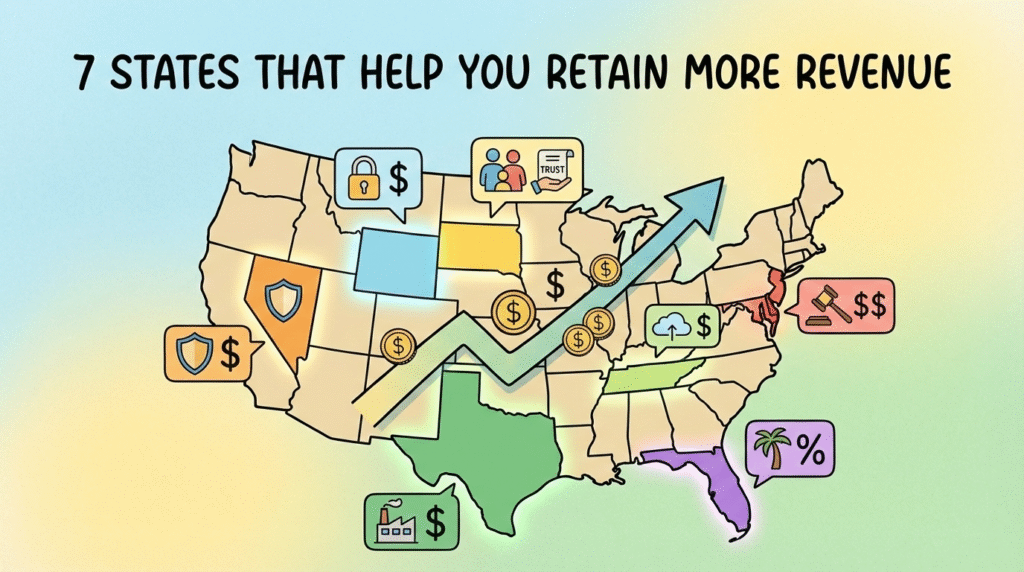
Most founders start their journey with a focus on top-line growth, but as the business matures, the focus shifts to the bottom line. In 2026, where your business “lives” is just as important as what it sells. Between state-level taxes, franchise fees, and administrative overhead, your choice of location can change your net profit by thousands of dollars annually. With the 2026 economy favoring remote-first structures, you have more flexibility than ever to choose a home base that aligns with your financial goals. Here is a detailed look at seven states designed for high retention and low friction. In this article Quick Comparison: 2026 Top Tax-Friendly States Selecting the right home for your business in 2026 requires balancing immediate fees against long-term strategic goals. Use the decision matrix below to identify your path, then verify the technical thresholds in the comparison table. State Annual Base Fee Tax-Exempt Threshold (2026) Privacy & Asset Protection Primary Strategic Advantage Wyoming $60 100% Tax-Free Elite: No member names in public records; strong charging order. The “Lean” Leader: Lowest combined maintenance and setup costs in the U.S. Delaware $300 100% Tax-Free (Non-DE income) Standard: Member names are generally private; expert court system. VC/IPO Ready: The mandatory standard for institutional investment. Texas $0 $2,650,000 (Revenue threshold) Standard: Publicly accessible officer names; stable pro-business courts. Scale Hub: Massive infrastructure and labor pool for large operations. Florida $138.75 100% Tax-Free (Personal income) Moderate: High transparency; aggressive business-first legislation. Growth Epicenter: Top migration destination for tech founders in 2025-2026. Nevada $350 $4,000,000 (Revenue threshold) Ultra: Strongest “Exclusive Remedy” charging order protection in the U.S. Maximum Shield: Preferred for high-liability professional or real estate assets. S. Dakota $55 100% Tax-Free (No income/capital gains) Dynasty Tier: Permanent court seal for trusts; generational privacy. Legacy Focus: Designed for multi-generational wealth and asset management. Tennessee $300+ $50,000 (Excise deduction) Moderate: Standard corporate disclosure; business-friendly climate. Remote Incentive: Asset-light agencies benefit from 2024 franchise tax repeal. 1.Wyoming: The Efficiency Leader Wyoming maintains a regulatory environment centered on administrative simplicity and established legal precedent. As the first state to codify the LLC structure in 1977, it has a long-standing history of prioritizing legislative stability for business entities. In 2026, Wyoming continues to hold the #1 rank on the Tax Foundation’s State Tax Competitiveness Index, a position it retains due to its lack of complex entity-level taxes. 2. Delaware: The Global Standard for Scaling Delaware remains the definitive ecosystem for companies with national or international ambitions. It is the legal home for over 65% of the Fortune 500 and approximately 79% of all U.S. initial public offerings (IPOs). Its reputation is anchored by the Court of Chancery, a specialized court that has spent over 200 years refining the case law that governs modern corporate life. 3. Florida: The Strategic Hub for Growth Florida has moved beyond its reputation as a retirement destination, recently overtaking traditional tech hubs like Austin and Seattle as the primary destination for founders. This shift is backed by massive state investment in high-speed connectivity and a “Business-First” legislative agenda that has matured significantly by 2026. 4. Nevada: Advanced Protection for Business Assets Nevada is often compared to Wyoming, but its positioning in 2026 is distinct: it is the jurisdiction of choice for high-liability industries or founders seeking the most aggressive legal “shield” available in the U.S. While Wyoming leads in efficiency, Nevada leads in asset defense. 5. Texas: The Choice for Large-Scale Operations Texas has moved beyond its reputation for traditional industry to become a global hub for technology and high-volume logistics. For founders planning to scale from a lean startup to a significant enterprise, the state offers a predictable fiscal environment designed to support high-growth operations. 6. South Dakota: Privacy for Long-Term Wealth South Dakota is a powerhouse for financial privacy and generational wealth preservation, often favored by founders whose strategy involves multi-generational longevity rather than a short-term exit. In 2026, it remains a global leader in trust and asset protection laws, frequently compared to international hubs like Switzerland for its commitment to confidentiality. 7. Tennessee: The Incentive for Remote Innovation Tennessee has become a favorite for the creative and tech-heavy remote workforce, particularly after completing the full repeal of its final income tax on interest and dividends in 2021. As of 2026, it is one of only nine states with no personal income tax of any kind. 2026 Business Location Checklist Before finalizing your choice, ensure you have addressed these three critical factors: Disclaimer: This guide is for informational purposes only and does not constitute legal, tax, or financial advice. While we strive to provide the most current data as of early 2026, tax laws and state fees are subject to change. Always consult with a qualified professional before making business formation or tax-related decisions. About the Author Isabella Jones started her career at Deloitte, where she worked on tax compliance for some of the country’s fastest-growing companies. She later joined Fynlo as Senior Financial Strategist, bringing that experience to freelancers and small business owners who need practical financial guidance without the corporate complexity. With an Accounting degree from Villanova University, Isabella focuses on making financial planning easier to understand and apply in day-to-day business. She works closely with freelancers and small businesses on areas like taxes, cash flow, and building more stable financial systems.
Freelancing in 2026: Your Guide to Thriving in the Gig Economy
The pandemic flipped the traditional 9-to-5 workday on its head, and freelancing is here to stay. More and more people are ditching the office for the flexibility and freedom of working from home. This article dives into the freelancing trend, explores the ups and downs, and gives you actionable tips to succeed. Want to know if freelancing is right for you? In this article, we’ll explore the state of freelancing in the U.S., analyze the benefits and challenges, and share practical tips to help you make informed decisions. Table of Contents The US Freelance Scene: A Quick Look Service Offered Hourly Rate Range Equivalent Annual Salary Web Development $50-60 $69,000 Mobile Development $55-65 $75,000 Graphic Design $40-45 $53,000 Content Editor $25-35 $38,000 Copywriter $30-40 $44,000 Programmer $60-70 $81,000 Online Marketing/SEO $40-50 $56,000 CRM Management $50-60 $69,000 Data Analysis $55-65 $75,000 While these averages provide a baseline, certain niches command significantly more. Explore our list of the 15 highest paying freelance jobs to see which industries are leading the market in 2026. The Freelance Challenge Freelancing offers incredible freedom, but it’s not always sunshine and rainbows. Here are some of the hurdles you’ll likely encounter: The Freelance Opportunity Despite the challenges, freelancing offers incredible potential. Here are some of the exciting opportunities available: Tips for Freelance Success Useful Resources for Freelancers About the Author Isabella Jones started her career at Deloitte, where she worked on tax compliance for some of the country’s fastest-growing companies. She later joined Fynlo as Senior Financial Strategist, bringing that experience to freelancers and small business owners who need practical financial guidance without the corporate complexity. With an Accounting degree from Villanova University, Isabella focuses on making financial planning easier to understand and apply in day-to-day business. She works closely with freelancers and small businesses on areas like taxes, cash flow, and building more stable financial systems.
Future-Proof Your Business: Essential New Business Trends for 2026
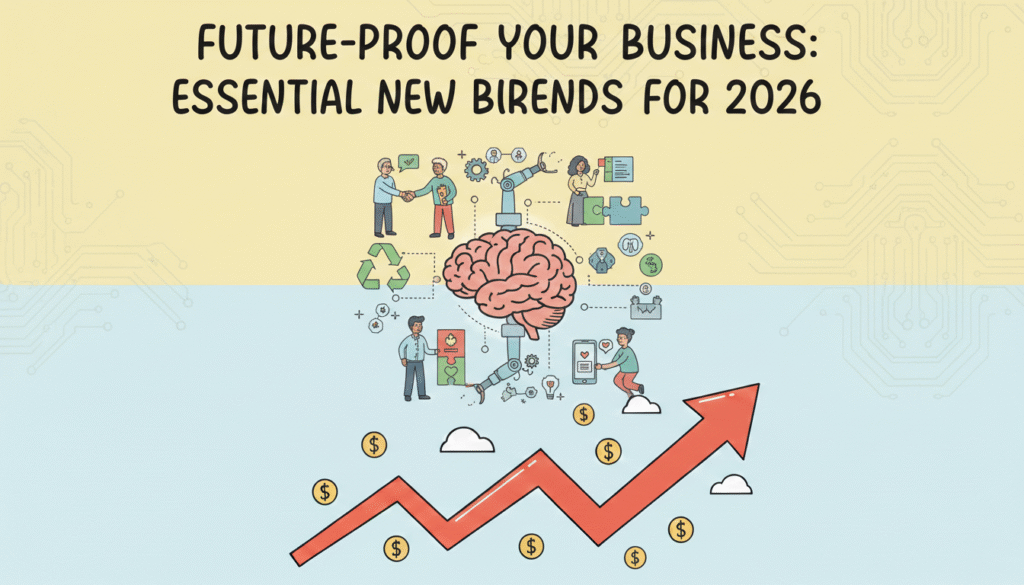
Stepping into 2026 feels like a strategic reset. For those of us running businesses, the focus has shifted toward building systems that are resilient enough to let us lead with vision instead of just reacting to the latest fire in our inbox. We are looking for Operational Intelligence: a state of flow where the back office supports growth rather than hindering it. The numbers suggest a massive shift is underway. With US e-commerce revenue expected to climb by nearly $500 billion by 2029, the opportunities are vast, but the complexity has followed suit. While 80% of organizations agree that inadequate or outdated technology is holding back innovation, success requires looking at how these investments empower our teams and protect our mental bandwidth. This guide explores five essential shifts in technology, workplace culture, and consumer behavior that are defining the market this year. By understanding these trends, you can transition from manual labor to a model where your business is as durable as the products or services it sells. In this article 1. Synergistic AI Collaboration We have officially moved past the experimentation phase of AI. It is no longer a shiny new object to be feared or idolized; it has become a fundamental utility. By the end of 2026, most successful businesses will have moved away from basic chatbots toward true Workflow Orchestration. This involves using AI for the heavy lifting of data processing and research while a human partner provides the final 10% of nuance and accountability. Consider the common struggle of market research. A real estate agency might use a tool like Clay to scan thousands of property listings for very specific investment criteria. This technology allows them to instantly cross-reference public tax records, zoning changes, and owner locations to find distressed opportunities that basic filters often miss. In the past, a founder might have spent ten hours a week on this. Now, the AI provides a refined shortlist. An expert strategist then reviews that list to ensure the fit feels right before any outreach happens. This human-in-the-loop model is why McKinsey suggests that AI could technically automate about 57% of work hours. The goal is to move away from manual labor toward a model where humans act as the ultimate quality control for intelligent systems. 2. Modern Skills-Based Hiring The way we build our teams is undergoing its most significant transformation in decades. The old debate over office space has matured into a more sophisticated discussion about results. We are seeing the rise of the Results-Only model, where talent is measured by what they can actually produce rather than where they went to school or how long they sit at a desk. Skills-based hiring is becoming the new gold standard. 90% of companies now report that they make much better hires when they prioritize specific, verifiable competencies over traditional four-year degrees. Technology has made this easier to manage for businesses of all sizes. Platforms like Deel or Gusto allow us to handle global payroll for hybrid teams, while tools like Loom or Slack facilitate high-quality communication that does not require everyone to be in the same time zone. We are seeing law firms and tech giants move away from traditional requirements to find specialized talent that can actually move the needle on day one. 3. Strategic Circular Operations In 2026, sustainability has moved from the marketing department into the heart of operations. The Circular Economy model (where we design waste out of our systems and keep materials in use longer) is now a competitive requirement. Consumers are increasingly skeptical of greenwashing and are looking for brands that offer radical transparency. Research shows that 81% of consumers now trust brands that are open about their operations and even their challenges. Some businesses use Notion to build public-facing transparency portals, while others use Watershed to track their actual environmental impact. This transparency builds a layer of trust that traditional advertising simply cannot buy. Beyond the ethical benefits, this trend is a survival tactic. Circularity protects you against geopolitical shocks in the supply chain. When your business model includes refurbishment or reuse, you become far less dependent on the volatile global markets for raw materials. It is about building a business that is as durable as the products it sells. 4. Cultivating Gen Z Loyalty Gen Z and Alpha consumers are rewriting the rules of brand loyalty. They expect a relationship that feels helpful and human-led rather than purely algorithmic. For these generations, community is the primary currency. The financial impact of this connection is significant, as some organizations have found that active community members generate five times more revenue compared to those who are less engaged. The tools for this have become incredibly accessible. Many brands use Klaviyo for hyper-personalized, behavior-based emails that feel like a conversation rather than a broadcast. Others are moving their most loyal fans into owned communities on platforms like Circle or Substack. With attention spans now averaging just over eight seconds, the format matters as much as the message. Short-form, vertical video is now the primary way three-quarters of all video content is consumed. It is a fast-paced environment, but those who lead with authenticity and provide value quickly are seeing the highest conversion rates. 5. Scaling through Seamless Integration Moving toward these trends is rarely a straight line. It is easy to feel a sense of app fatigue when you have too many tools that do not talk to each other. This often results in technical debt, where the founder ends up spending more time managing software than leading people. The way to handle this is by adopting an integration-first policy. We should only bring in tools that have a robust way to sync with our existing systems, usually through a platform like Zapier. This keeps our data in one place and prevents the scattered feeling of having five different logins for one project. Another common friction point is the quality gap that comes with over-automation. When we rely too much on AI, our brand can start to feel cold or generic. The solution is to build a human guardrail. For any customer-facing output or high-stakes financial task, there should be a rule that an expert performs a final sanity check. Technology provides the speed, but people provide the
Top 5 Reasons Why Small Businesses Fail and How to Avoid Them
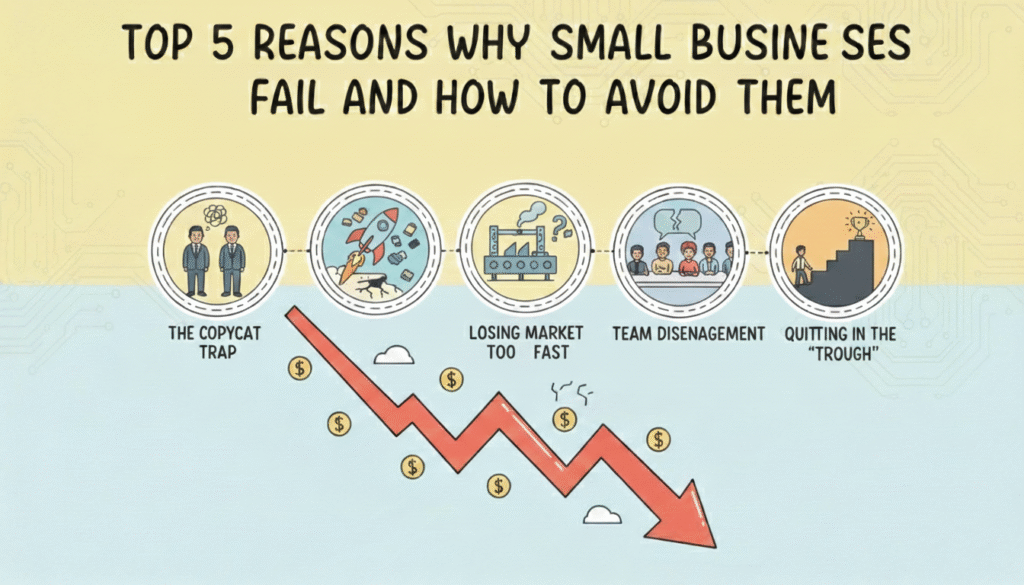
Starting a business is easily one of the most rewarding journeys you’ll ever embark on. There’s nothing quite like the rush of that first sale or the pride of seeing your logo on a real office door. Yet, for all the excitement, it’s also incredibly lonely and, at times, brutal. As we look toward 2026, the entrepreneurial spirit is louder than ever, yet the quiet reality remains: many small businesses struggle to stay afloat. According to 2024 data from the U.S. Bureau of Labor Statistics, nearly 50% of businesses fail within their first five years. We don’t believe failure is a foregone conclusion. Usually, it isn’t one giant catastrophe that sinks the ship; it’s a series of small, quiet cracks in the hull that no one noticed or wanted to see. In our experience watching what separates the survivors from the statistics, success often comes down to navigating a few specific, hidden hurdles. Here are the five real reasons businesses stall, and how you can navigate around them to build something that lasts. In this article 1. The Copycat Trap It starts with a seductive, familiar thought: “They’re making a killing, and I know I can do it better at a lower price.” It’s a common mindset that feels like a shortcut to success. You see a local leader or a big industry player and try to mirror their every move while undercutting their costs. This is the “Copycat Model,” and while it feels like a safe bet, it’s actually a trap. When you copy, you’re competing against someone who has more history, deeper pockets, and an established reputation. If your only way to win is to be “slightly cheaper,” you aren’t building a business; you’re operating on razor-thin margins that leave no room for error or future growth. When your only edge is price, any increase in your costs or a counter-move from a larger competitor can instantly wipe out your remaining profit. As Peter Thiel famously wrote in Zero to One: “The next Bill Gates will not build an operating system. The next Larry Page or Sergey Brin won’t make a search engine.” If you aren’t bringing something uniquely you to the table, you’re just holding a spot until someone with more capital decides to take it. You don’t need to reinvent the wheel, but you do need to give people a reason to choose yours. How to stay ahead: 2. Scaling Too Fast We’ve all felt that “first milestone” adrenaline. You’ve got your first big clients, you’ve hired a Virtual Assistant, and for the first time, the dream feels real. This can be the danger zone. It’s when founders get impatient and start pouring money into massive hiring sprees or new markets before their core engine is actually stable. The numbers are staggering: 74% of high-growth startups fail because they scaled prematurely, according to the Startup Genome Report. Take the story of Bench, the bookkeeping giant. They raised over $100 million, had a massive team, and were the darlings of the tech world. But despite the funding and the hype, the company eventually had to shut down its core operations. They scaled their burn rate before they mastered their efficiency. Scaling a broken process doesn’t make you bigger; it just makes your mistakes louder and much more expensive. How to stay ahead: 3. Losing Market Flexibility There is a thin, blurry line between being “persistent” and being “stubborn.” We often fall in love with our original vision, treating it like a sacred text rather than a living document. Take Kodak as a prime example. In 1975, one of their own engineers invented the first digital camera. But the leadership was so protective of their film business that they buried the tech. They clung to the past while the world moved on. This reluctance eventually led the once-dominant giant to file for bankruptcy in 2012, which serves as a powerful lesson that past success is no guarantee of future survival. Today, failing to pivot is just as risky. According to a report by CB Insights, 42% of startups fail because there is simply no market need, often because the founders were so busy building a “perfect” product that they forgot to check if anyone actually wanted it. If you stop listening to your customers because you’re too busy “staying true to your vision,” it’s easy for the path forward to get a bit blurry. How to stay ahead: 4. Team Disengagement A business isn’t a machine; it’s a collection of people. If the people lose their spark, the engine stalls. Most of us recognize the signs: the “silent office” where everyone is just going through the motions. Gallup’s research shows that engaged teams are 21% more profitable, yet so many founders treat culture as an afterthought. High turnover isn’t just an HR headache; it’s a massive financial leak. It costs an average of $6,000 to replace a single employee, but the loss of trust and institutional knowledge is even higher. When your team feels like they are just “clocking in,” they won’t have your back when things get difficult. How to stay ahead: 5. Quitting in the “Trough” Every entrepreneur eventually finds themselves in the “Trough of Sorrow.” It’s that long, quiet stretch after the initial excitement has worn off, but the big results haven’t arrived yet. It’s the 2 AM nights spent wondering if you’ve made a huge mistake. 53% of founders reported feeling burned out. That exhaustion often leads to “Premature Capitulation”—closing a perfectly healthy business simply because the founder is spent. There’s a nuance here: you should be flexible with your method (as we saw in Point 3), but you must be relentless with your mission. Success usually happens right after you’ve considered walking away. Thomas Edison said it best: “Many of life’s failures are people who did not realize how close they were to success when they gave up.” How to stay ahead: The Path Forward: Success is a Series of Choices Building a business that lasts isn’t about luck, and it certainly isn’t about having a perfect, mistake-free first year. As we have seen, the “cracks in the hull” that sink most businesses are usually avoidable with a bit of foresight and a lot of honesty. Success comes down to your willingness to stay flexible, your commitment to your team, and your ability to look past the “copycat” shortcuts. It is about building systems that support your growth rather than just chasing the growth itself. If you can navigate the “Trough of Sorrow” with a clear mission and a solid financial foundation, you are already ahead of the statistics.
5 Financial Metrics Your Bank or Lender Will Check Before Giving You a Loan
You’ve poured your time, energy, and sleepless nights into building something strong. You’ve overcome the initial hurdles, found product-market fit, and now you’re ready for the next big leap. That means securing the capital required to hire, expand your inventory, or move into a bigger space. This journey, though, brings you face-to-face with a tough reality: obtaining that financing is often the single biggest hurdle for small businesses. According to 2025 research from Allica Bank, SME loan rejections have dramatically increased from just 5-10% three decades ago to 40% today. In other words, lenders are far more selective than they used to be. The moment you submit that application, you step into a rigorous due-diligence process where lenders are looking past your gross revenue to assess two critical things: risk and repayment capacity. If you don’t know the core metrics they care about, you can’t prepare your books effectively or present your case with confidence. Here are the five essential financial metrics your bank will scrutinize before approving your loan. In this article 1. Quick Ratio (Acid-Test Ratio) Think of the Quick Ratio as your company’s emergency financial safety net. It’s a crucial measure of short-term liquidity, answering the question every lender silently asks: “If sales hit a sudden wall, could this business instantly pay its most urgent bills?” This metric focuses only on your most liquid assets—cash and receivables—and deliberately excludes inventory because that can be slow to sell or difficult to liquidate quickly. Lenders generally look for a Quick Ratio above 1.0. A strong Quick Ratio proves you have the immediate cash flow cushion to weather an unexpected storm, which builds confidence in your business’s foundational health. To put it simply: if you owe $10,000 in short-term bills, lenders want to see at least $10,000 in highly liquid assets; ideally more. Quick Ratio = (Cash + Accounts Receivable + Marketable Securities) / Current Liabilities 2. Debt-to-Equity (D/E) Ratio The D/E Ratio measures the financial structure of your business. It answers whether you’re funding growth primarily through debt or through the owners’ investment (equity) and accumulated profits. Lenders look for a lower ratio, typically below 1.5. A high D/E ratio (say, 3.0) signals that your business is highly leveraged and therefore vulnerable if revenues dip, as fixed debt payments remain relentless. Conversely, a low ratio proves the owners are committed and the company has strong internal stability. Debt-to-Equity Ratio = Total Liabilities / Total Equity 3. Debt Service Coverage Ratio (DSCR) When a bank considers giving you a new loan, DSCR is what matters most. It is arguably the most critical metric for any new debt, measuring your company’s direct repayment capacity for all its debt obligations. DSCR = Net Operating Income / Total Debt Service (Principal + Interest Payments) Banks usually require a DSCR between 1.25 and 1.50. Think of this simply: a DSCR of 1.25 means your operating income is 125% of your required debt payments. This provides a safety margin. If your DSCR is below 1.0, the loan conversation stops instantly—you’re simply not generating enough income to cover your required payments. 4. Gross Profit Margin While the initial metrics focus on risk, the Gross Profit Margin proves the viability of your core business model. It answers: “How profitable is your product or service itself, before the lights are even turned on?” Lenders look for a high and consistent margin. A strong Gross Profit Margin proves that your core service is priced correctly and that you are efficient at managing your direct production costs (COGS). This shows the inherent earning power of your product, assuring the lender that even if overhead expenses rise, the core offering is financially sound. Gross Profit Margin = (Revenue – Cost of Goods Sold) / Revenue To see why your total sales are different from the money you actually keep, read our guide on the difference between revenue and profit to make sure your business stays healthy. 5. Accounts Receivable (A/R) Aging and DSO This metric focuses on cash flow quality and the efficiency of your collections process. A healthy balance sheet is useless if you can’t actually get the money in the door. Lenders pay close attention to your A/R aging report to see how many outstanding invoices are over 90 days due. If a large percentage of your revenue is perpetually uncollected, that’s a massive red flag. Days Sales Outstanding (DSO) measures the average number of days it takes for you to collect revenue after making a sale. DSO = (Average Accounts Receivable / Total Credit Sales) x Number of Days Lenders want to see a low DSO, indicating fast and efficient collection (ideally under 45 days). A high DSO suggests your credit control is weak or your clients are unreliable, significantly raising the lender’s risk profile. Preparation as a Competitive Advantage Securing a loan starts long before you submit the application. It begins with shifting your mindset from “keeping the books” to “strategic reporting.” Lenders aren’t just looking at your bank balance; they are looking for a narrative of stability and foresight. When you can present these five metrics clearly and instantly, you demonstrate that you aren’t just a business owner—you are a sophisticated operator who understands risk and repayment capacity. In the competitive 2026 lending environment, that level of clarity is often the difference between a rejection and an approval at the best possible rates. About the Author Isabella Jones started her career at Deloitte, where she worked on tax compliance for some of the country’s fastest-growing companies. She later joined Fynlo as Senior Financial Strategist, bringing that experience to freelancers and small business owners who need practical financial guidance without the corporate complexity. With an Accounting degree from Villanova University, Isabella focuses on making financial planning easier to understand and apply in day-to-day business. She works closely with freelancers and small businesses on areas like taxes, cash flow, and building more stable financial systems.
Should You Lease or Buy Equipment? A Financial Breakdown
Every small business owner hits a wall where their old equipment just won’t cut it anymore. Maybe it’s time for a faster work truck, a major new piece of machinery, or simply upgrading every laptop in the office. This decision isn’t just about whether you have the cash today; it’s one of the most important financial choices you’ll make all year. The question of whether to lease (rent) or buy (own) directly impacts your immediate cash flow, your tax bill, and the overall look of your company’s financial health. Understanding the difference is the first step toward making a profitable move. In this article The Case for Buying (Financing or Ownership) When a business buys equipment, it usually means taking out a loan to cover the cost. You own the asset outright, and it immediately goes onto your Balance Sheet. The Tax Advantage: Depreciation The biggest financial benefit of buying is that you get to claim the entire purchase price as an expense over the asset’s useful life. This is called depreciation. It’s a wonderful non-cash deduction that essentially gives you a massive tax break. For example, in the United States, rules like Section 179 allow you to deduct the full purchase price of some assets immediately. No one wants a surprise bill from the tax authorities, and claiming depreciation is a straightforward way to reduce your taxable income. Cash Flow and Final Cost While the upfront cost might be higher or require a significant down payment, the long-term benefit is that you build equity. Once the loan is fully paid off, the asset is yours free and clear. If you use the equipment for ten years, your total cost of ownership (after taxes) can often be lower than renting it for the same period. The Case for Leasing (Renting or Operating) Leasing is essentially renting the equipment for a set period, typically three to five years. This option is popular because it minimizes risk and keeps things simple. Flexibility and Low Upfront Cost The primary appeal of leasing is the minimal initial expense. You usually don’t need a large down payment, making it ideal if your business needs to preserve cash liquidity for other operating expenses, like marketing or inventory. Because you don’t own the asset, when the lease is up, you simply hand the old equipment back and upgrade to the newest model, which is perfect for rapidly changing technology like computers or software licenses. Accounting Simplicity From an accounting perspective, leasing is straightforward. Your monthly lease payment is treated as a simple operating expense, similar to paying rent. It goes directly onto your Profit and Loss (P&L) Statement, reducing your gross profit immediately. This process is far less complicated to track than the depreciation schedules required when you buy. Decision Matrix: Choosing the Right Path The ideal choice depends entirely on your company’s needs and long-term outlook. When to Buy (Stability is Key): When to Lease (Flexibility is Key): Accounting Impact: How Each Choice Affects Your Statements Regardless of which path you choose, you need an organized system to track the financial consequences correctly. Buying is more complex to track. When you buy, you must record the full asset value and the corresponding liability (the loan) on your Balance Sheet. Then, your accounting system needs to correctly calculate and post the depreciation entries monthly or annually, following local tax rules. This meticulous tracking is essential if you ever need to apply for a loan, as banks will heavily scrutinize your Debt-to-Equity ratio. Example 1: Buying (The Balance Sheet Impact) When you buy a $10,000 piece of equipment with a loan, your books change immediately and permanently: Account Effect Statement Value Equipment Asset Increases Balance Sheet + $10,000 Loan Payable Liability Increases Balance Sheet + $10,000 Annual Depreciation Expense Increases P&L Statement + $1,000 Accumulated Depreciation Asset Value Decreases Balance Sheet + $1,000 The Takeaway: Buying creates a complex tracking relationship between the Balance Sheet (Asset/Loan) and the P&L (Depreciation). Leasing keeps your Balance Sheet clean. Since leasing is treated as an operating expense, the monthly payment only touches your P&L statement. It avoids adding large debt obligations to your books, which can sometimes be advantageous if your company is trying to stay lean to secure a future loan or meet specific financial covenants required by lenders. Example 2: Leasing (The P&L Simplicity) When you pay a $300 monthly lease payment, the transaction is simple and only affects two things: Account Effect Statement Value Lease Expense Expense Increases P&L Statement + $300 Cash Asset Decreases Balance Sheet – $300 The Takeaway: The cost is immediate, transparent, and easy to track, requiring no complex depreciation schedules. Your Strategic Decision The decision to lease or buy equipment is a strategic one, balancing immediate cash needs against long-term tax and ownership benefits. It requires careful tracking of depreciation schedules, loan balances, and expense categories. Don’t let these complex entries be a source of error or confusion. You need a system that ensures your fixed assets are tracked accurately, your depreciation is automatically calculated, and your financial reports are audit-ready, whether you are owning an asset or simply renting its use. Ready to gain control over your assets and deductions? Schedule a quick demo today to see how Fynlo simplifies fixed asset management, expense tracking, and financial reporting for growing businesses.