
5 Business Tasks You Should Outsource to Scale Faster
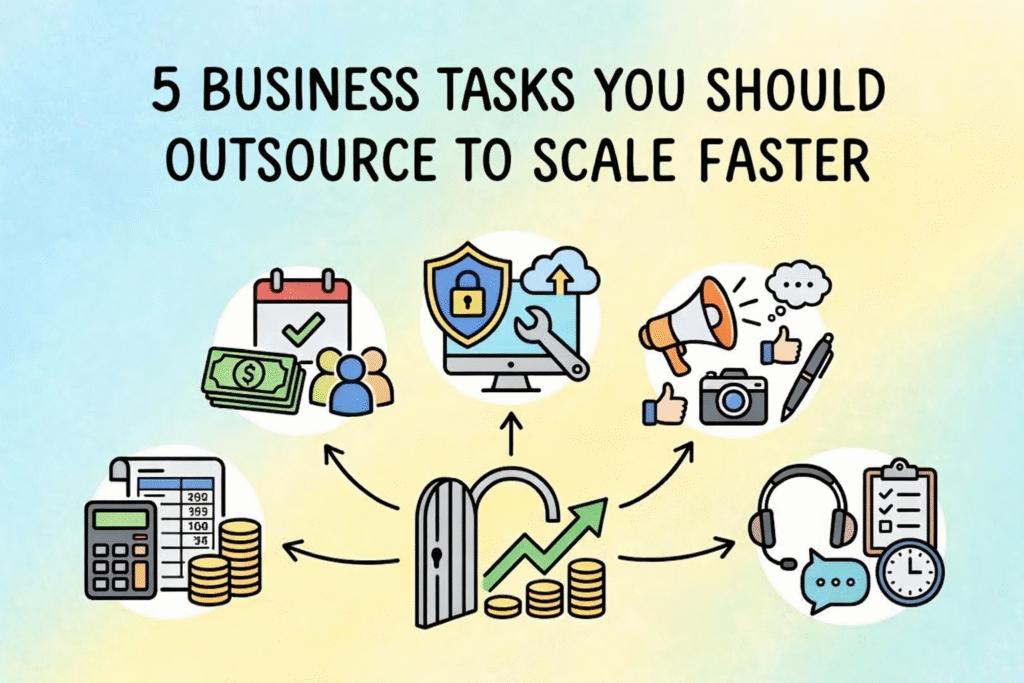
Most of us start our businesses with a “DIY” mindset. It works at first, but eventually, you hit a wall where there just aren’t enough hours in the day. Trying to handle everything yourself isn’t just exhausting—it actually stops your business from growing. Strategic outsourcing is about taking the specialized or repetitive stuff off your plate so you can focus on the work that actually moves the needle. In this Article Framework: How to decide which task to outsource first Before you hire anyone, you need to know where you’re currently wasting your energy. Take a look at your to-do list from the last week and plot your tasks into this simple grid: Task Profile Examples Action Low Skill / High Time Data entry, scheduling, basic emails Outsource these immediately. These are the “time-thieves” keeping you from big-picture work. High Skill / High Risk Tax filings, legal contracts, cybersecurity Outsource to experts. Don’t try to “wing it” here; the cost of a mistake is way too high. High Skill / High Growth Strategy, sales, closing big deals Keep these for yourself. This is the core of your business. 1. Moving from “Doer” to “CEO” in your finances The biggest hurdle for growing companies is the owner still acting as the daily bookkeeper. If you’re spending your Sunday nights categorizing expenses, you’re performing a job that pays much less than your actual worth as a business owner. By handing this off, you shift from “doing” the data entry to “reviewing” the financial health of your company. Modern tools like Xero, Quickbook, and Fynlo automate a lot of this, so your books stay clean without you ever touching a spreadsheet. This lets you spend your brainpower on sales and strategy—the things that actually increase your bank balance. 2. Staying on the right side of the IRS (Tax & Compliance) Tax rules change constantly, and trying to keep up with them is a full-time job in itself. If you’re handling your own filings or using a “cheap” service, you might not notice an error until you get a scary letter from the IRS. Outsourcing your tax and compliance work gives you a layer of protection. These experts track deadlines for payroll taxes and corporate returns so you don’t have to worry about interest or penalties. It’s less about “saving time” and more about moving that risk off your shoulders and onto a professional. 3. Reclaiming your calendar with admin support Admin tasks like managing your inbox, scheduling meetings, and updating your CRM are necessary, but they don’t bring in new revenue. As you grow, these “little things” multiply and start causing decision fatigue. If you’re buried under 50 unread emails, you aren’t in the right headspace to make big business moves. A Virtual Assistant can easily reclaim 10 to 15 hours of your week. Imagine what you could do with an extra two workdays every month. The goal is to make sure that every hour you spend working is spent on something that only you can do. 4. Protecting your business with managed IT Small businesses are huge targets for hackers because they usually don’t have the same defenses as the big guys. Managing your own cybersecurity is a massive liability. If your system crashes or you get hit by a data breach, it can shut you down for weeks. Outsourced IT providers offer 24/7 monitoring and backup plans. For most businesses, a monthly subscription for IT support is a lot cheaper than trying to recover from a ransomware attack or a total system failure. It’s basically an insurance policy for your data. 5. Scaling your brand with marketing experts You probably know your industry inside and out, but that doesn’t mean you’re an expert in SEO or social media algorithms. Marketing moves fast, and trying to keep up with every new trend is an inefficient use of your time. By outsourcing your marketing to an agency or a pro freelancer, you get high-level strategy and content that actually looks professional. They have the tools to track what’s working and what isn’t, making sure your marketing budget is actually bringing in new leads instead of just disappearing. A better way to scale Outsourcing isn’t about “giving up” on parts of your business; it’s about being smart with your resources. When you delegate things like bookkeeping, IT, and admin, you lower the chance of human error and get your life back. Fynlo is designed to help with this transition. We give you the financial clarity you need to manage your business from the top down, while the experts handle the day-to-day details. Ready to scale? [Schedule a call]
7 Essential Steps to Streamline Your Month-End Close Process
If you’ve ever found yourself juggling receipts, double-checking spreadsheets, and wondering where the last few hours went, you know that month-end can feel like a race you didn’t sign up for. You start the month with good intentions, but somewhere between chasing invoices and untangling bank statements, things start to pile up. You’re not alone. The month-end close is one of the most common pain points for freelancers, accountants, and small business owners. Yet, when done right, it doesn’t have to be a stressful ritual. A streamlined process helps you stay organized, confident, and in control of your finances: not just at the end of the month, but every day. Here’s how to make your month-end close smoother, faster, and more reliable with seven connected steps that build on each other for lasting efficiency. Table of Contents 1. Build a Consistent Closing Checklist Every smooth month-end close starts with a plan. A checklist keeps the process organized, consistent, and repeatable, so nothing falls through the cracks when things get busy. Here’s a sample checklist to guide you: Your checklist may vary based on your business, but the key is to have one that evolves with your needs. Over time, you’ll notice which steps can be simplified, automated, or delegated, making your close faster with each cycle. 2. Keep Your Books Updated Throughout the Month The easiest way to simplify your month-end is to avoid the end-of-month rush altogether. Instead of waiting to record and categorize transactions all at once, make bookkeeping a weekly habit. Dedicate short, focused sessions during the week to update your records, review income and expenses, and match receipts. By staying current, you reduce errors, eliminate the panic of missing data, and make the final close feel more like a confirmation step than a cleanup project. Think of it like tidying your workspace a little each day rather than cleaning it after a month; it’s faster, cleaner, and less stressful. 3. Reconcile Continuously, Not Just at Month-End Reconciliation is where your accounting data meets reality. Regularly matching your accounting records with your bank and credit card statements helps you spot discrepancies early and avoid unpleasant surprises. Instead of saving reconciliation for the final hours of month-end, do it weekly, or biweekly. Check that all deposits, transfers, and payments have been properly recorded. This habit saves you hours later and ensures your financial data is always ready for review. Continuous reconciliation creates momentum for your close. It turns what used to be a scramble into a series of quick, confident checks. 4. Automate the Routine to Focus on What Matters Once your process is consistent and your data stays current, the next step is automation. Manual entry is time-consuming, and prone to errors. Automation saves time and reduces risk. Adopt cloud-based accounting tools that automatically import transactions from your bank accounts, credit cards, and payment platforms. Many tools can even categorize expenses, send invoice reminders, and generate recurring journal entries. Integration is key. Connect your accounting system to tools you already use, such as payroll software, project management systems, or e-commerce platforms. The fewer manual steps you need to repeat each month, the faster and more accurate your close becomes. 5. Review Financial Statements with Insight By this stage, your numbers are clean and reconciled. Now it’s time to turn data into understanding. Generate your key reports: But don’t just run the reports and move on. Review them with intention. Are your expenses trending higher than expected? Are some clients or products consistently more profitable? Is your cash position improving? A strong month-end close isn’t just about closing the books; it’s about opening your eyes to opportunities and risks before they grow. 6. Document Adjustments and Keep an Audit Trail Even the best systems need adjustments. Maybe an invoice arrived late, a transaction was miscategorized, or a refund needs to be recorded. What matters most is that every change is documented clearly. Keep notes within your accounting software or in a shared record explaining what was adjusted and why. This creates a transparent audit trail, which not only protects you in case of an audit but also helps you (and your team) understand the context behind every entry next month. Documenting adjustments transforms your close from a reactive scramble into a learning process that gets sharper each time. 7. Reflect, Refine, and Repeat Once you’ve completed the close, take time to evaluate what worked and what didn’t. A streamlined close isn’t something you achieve once—it’s something you improve continuously. Ask yourself a few quick questions: Use your answers to refine your checklist, adjust your timeline, or adopt new tools that help you stay ahead. Month-end should feel like a well-practiced rhythm, not a recurring fire drill. Run your Business with Confidence A clean, efficient month-end close gives you accurate numbers and, most importantly, peace of mind. You don’t need to be an accountant to have control; you just need the right process, discipline, and the right tools. If you’re ready to ditch the spreadsheets, Fynlo is that tool. Ready to automate busywork, gain financial clarity, and close your books faster? Schedule a quick meeting with us today to see Fynlo in action!
13 Surprising Ways Accounting Impacts Your Everyday Life: From Your Morning Coffee Price to Your Next Promotion

When most people hear ‘accounting,’ they picture tax forms, expense receipts, or a spreadsheet they’ve been promising to organize for months. For freelancers and small business owners, it often feels like a back-office task that only matters during tax season or when something goes wrong. But accounting influences far more of your everyday life than you might expect. It shapes the price of your morning coffee, the stability of your neighborhood stores, the subscriptions you rely on, and even how your city maintains public services. Accounting is not just about math or compliance. It is about the decisions behind how money moves, grows, and supports the world around you. Once you notice how often accounting quietly plays a role in daily life, it becomes easier to appreciate its importance, especially when you are building a business of your own. Here are 13 surprisingly relatable ways accounting affects your day-to-day world. 1. The Price of Everyday Purchases The price tag on your groceries, gym membership, or the laptop you are reading this on is not random. Behind every number is a careful calculation of materials, labor, rent, marketing, packaging, and logistics. Businesses rely on cost accounting to make sure prices cover expenses while leaving room for profit. When global events like the 2024 Red Sea shipping crisis or rising import tariffs disrupt supply chains, those higher costs often show up on the shelf. The price you pay is the result of complex accounting decisions designed to keep a business running while staying competitive. 2. Why Some Local Businesses Thrive While Others Close You have probably seen it happen. Two cafés open on the same street, both busy, both loved by locals. Yet within a year, one becomes a neighborhood favorite and the other quietly shuts its doors. The difference is often accounting. Busy does not guarantee profit. A café might sell hundreds of lattes but fail to track which items generate real profit, allocate costs incorrectly, overstock inventory, or underprice high-demand products. Another café may analyze these numbers, adjust menu pricing, and manage inventory more tightly. The shop that survives is not just lucky. It actively monitors its finances and makes decisions based on real data. 3. Avoiding Phantom Profits in Your Own Business This one is personal for many freelancers and small business owners. You can look profitable on paper yet still struggle to pay bills if you track only cash in and out. Accrual accounting gives a clearer picture by matching expenses to the revenue they generate. Imagine sending $10,000 worth of invoices but still owing $7,000 to suppliers. Without accrual accounting, your profit might look healthy when it actually is not. Understanding this distinction helps prevent unpleasant surprises and keeps your business financially steady. 4. What Determines Your Next Pay Raise Even your paycheck reflects accounting. Employers rely on performance metrics drawn from financial data to decide promotions, raises, and bonuses. For example, a sales team’s success is measured not only by revenue but also by profit margins and customer retention costs. For freelancers, understanding project profitability helps determine fair rates. Without accurate financial tracking, recognizing real value and contribution would be guesswork. 5. Why Subscription Prices Keep Changing Your favorite streaming service or software platform likely uses subscription accounting to decide when and how to adjust pricing. Companies monitor revenue per user, customer churn, and lifetime value to stay sustainable. When costs increase or too many users downgrade, pricing plans shift. Those seemingly small price changes are often the result of months of financial forecasting and data analysis designed to keep the service profitable and growing. 6. How You Get Approved for Loans and Credit When you apply for a mortgage, a car loan, or a small business line of credit, lenders evaluate your financial story through accounting records. For individuals, your credit score is built on a form of personal accounting that tracks payments and debt management. For business owners, lenders look at income statements, balance sheets, and cash flow reports to assess whether your company can manage debt responsibly. Good accounting builds trust with banks and investors, turning financial discipline into financial opportunity. 7. How Your Commute Depends on Budgets The public buses, subways, and trains you use every day run on numbers as much as wheels. Transit authorities rely on accounting to decide which routes to fund, how to set ticket prices, and when to maintain infrastructure. In 2023, several cities revamped their transit systems based on budget analyses that showed where routes were underused. Accounting made it possible to redirect funds to areas that needed them most, improving efficiency and reliability for daily commuters. 8. How Your Retirement Fund Stays Secure If you have a 401(k), IRA, or pension plan, you are already benefiting from investment accounting. Every dollar contributed, every dividend earned, and every management fee paid is tracked and verified. Without this accountability, it would be impossible for fund managers to report performance accurately or for regulators to ensure transparency. Sound accounting keeps your future secure and ensures your hard-earned savings grow safely over time. 9. The Reason Grocery Shelves Stay Stocked The next time you pick up milk or bread, thank accounting. Supermarkets rely on precise inventory management systems that track sales, orders, and expiration dates. If a store over-orders, products spoil and profits vanish. If it under-orders, customers face empty shelves. During the 2024 shipping delays that affected global trade routes, stores with accurate inventory accounting adapted quickly to keep essential goods available. Behind the smooth shopping experience is careful financial coordination. 10. How Your Favorite Events Stay Affordable Concerts, sports games, and local festivals all rely on precise accounting to balance costs and ticket revenue. Event organizers track venue rental, staff wages, equipment, marketing, and insurance to ensure the event remains financially viable. Even small mistakes in budgeting or cost allocation can force last-minute cancellations, unexpected price hikes, or losses for organizers. Every time you buy a
7 Tips to Build a Seven-Figure Business for Freelancers and Small Business Owners

Growing a business beyond the early stages is a constant evolution. In the beginning, success comes from sheer hustle, saying yes to every opportunity, learning on the fly, and doing whatever it takes to get paid. But at some point, the same approach that helped you grow becomes the very thing that holds you back. The truth is, the jump from six to seven figures is not about working more hours. It is about shifting how you think, how you operate, and how you structure your business so it can grow without depending on you for every task. This is the moment when you stop being the person who does the work and start becoming a builder of a business that can scale. Here are seven practical, human, and sometimes uncomfortable tips to guide you toward the one million dollar milestone. Tip 1: Treat Adaptability as a Daily Habit If there’s one thing guaranteed in business, it’s change. The strategy that helped you thrive two years ago might barely move the needle today. AI has transformed how service businesses operate, client expectations are evolving, and new competitors appear overnight. A seven-figure business isn’t built by clinging to what used to work. It grows because the owner stays curious, open, and willing to adjust. Adaptability doesn’t mean chasing every trend; it means evolving your offers, systems, and approach before the market forces you to. Tip 2: Be Honest With Yourself (Even When It’s Uncomfortable) A powerful trait shared by successful founders is intellectual honesty. It’s the ability to look at your business with clear eyes, even when the truth stings a little. Review your numbers and ask the hard questions: • Which clients are truly profitable? • Where are we losing time, money, or energy? • Is this offer still relevant? Honest evaluation doesn’t make you pessimistic. It makes you intentional, and that precision fuels smarter decisions as your business scales. Tip 3: Make Clients Feel Seen, Not Sold To You don’t need the flashiest sales pitch to grow; you need empathy that makes clients feel genuinely understood. Before a meeting, don’t just rehearse your offer. Learn about the client, their industry, their recent wins or challenges, and what truly matters to them. Ask thoughtful questions. Listen more than you talk. Tailor your solution like it was built just for them. Clients stay longer, spend more, and refer better when they feel seen and supported, not pushed. Tip 4: Write Things Down (Your Future Team Will Thank You) A freelancer sells time. A business sells a repeatable experience that doesn’t depend on one person. The moment you find yourself repeating a task, it’s ready to be documented. Create simple Standard Operating Procedures (SOPs) so anyone can deliver the same level of client experience. SOPs reduce errors, speed up onboarding, and turn your know-how into real business value. Someday, these processes might be what makes your company sellable or scalable. Tip 5: Start Delegating Before You Feel Ready If you’re doing everything yourself, growth will always hit a ceiling. Delegation isn’t about handing off tasks; it’s about handing off ownership. Instead of hiring someone to “help with admin” or “post on social media,” look for people who can manage an entire function. Free up your time for what only you can do: strategy, relationships, product innovation, and growth. That’s where seven-figure leaps are made. Tip 6: Say What You Mean and Follow Through High-trust communication is one of the most underrated growth engines. In a world where many over-promise and under-deliver, doing what you said you would do instantly sets you apart. Clients remember how you make them feel. Teams stay when they feel respected. Partners refer you when they trust you. Marketing gets attention, but relationships build momentum. Tip 7: Treat Failure as Feedback, Not a Full Stop Not every offer will sell. Not every hire will work out. Not every idea will land. That’s normal for any business growing to seven figures. The difference is how you respond. Instead of letting a setback derail you, ask: • What did this teach me about timing, audience, offer, or pricing? • What would I adjust next time? Resilience isn’t avoiding mistakes; it’s refusing to repeat them. Your Next Move: Get Clarity Behind the Scenes Many founders stay stuck not because of lack of ambition, but because their financial picture feels overwhelming or unclear. The moment you understand your numbers, everything becomes easier: pricing, hiring, investments, and planning for growth. You don’t need to untangle it alone. Schedule a Fynlo demo and get a clear view of your finances so you can scale with confidence and less stress.
The Future of Work in Asia: How to Start and Scale a Profitable Freelance Business
The way Asia works is changing. Across the continent—from the dynamic tech hubs of Singapore and Bangalore to the booming creative industries in Manila and Jakarta—the freelance and gig economy is exploding. Millions of talented professionals are leaving traditional employment to seek more flexibility, control, and, most importantly, higher net income. If you’re looking to transition from an employee to an entrepreneur, or if you’re already freelancing but struggling with inconsistent cash flow, you’re not alone. The secret to success isn’t just talent; it’s treating your freelance career like the lean, profitable business it is. Here is your guide on how to launch and scale a profitable freelance business in the Asian market. Whether you’re a designer in Manila, a consultant in Kuala Lumpur, or a remote developer in Ho Chi Minh City, the fundamentals for building a profitable freelance business in Asia are the same. Table of Contents 1. Stop Trading Time for Money Many new freelancers make the mistake of competing solely on price, often charging rates that barely cover their time, let alone their operating expenses and desired profit. To scale, you must disconnect your income from the hours you work. A. Calculate Your True Hourly Rate Before you quote a project, determine the minimum you need to charge. This calculation moves beyond your old salary. Target Annual Income + Annual Business Expenses (software, tax, training) = Annual Revenue Goal Divide this goal by the number of billable hours you plan to work in a year (realistically, this is usually 1,000 to 1,500 hours, not 2,000). This provides your true hourly rate. Anything less is unprofitable. B. Shift to Value-Based Pricing Instead of charging per hour, charge for the value and outcome you deliver. A marketing consultant doesn’t charge for 10 hours of work; they charge for delivering a strategy that will increase the client’s sales by $10,000. That’s how you scale your income without scaling your exhaustion. 2. Secure Your Cash Flow Stability The single greatest threat to a freelancer’s financial stability is inconsistent cash flow. A client paying 60 days late can ruin your month. A. Demand Deposits and Milestones Never start a project without a deposit (typically 30–50% of the total fee). For large projects, structure payment into milestones. Tie each payment to a specific, measurable deliverable. This protects you and gives the client incentive to approve work quickly. B. Build a Cash Buffer Fund Treat your business like a small corporation and build a cash reserve. Your goal should be to save enough to cover three to six months of all your personal and business operating expenses. This buffer allows you to ride out the slow seasons or quickly replace a client that churns, without dipping into debt. C. Simplify Cross-Border Payments If you serve international clients (common for Asian freelancers), don’t let exchange rates and transaction fees erode your net income. Use transparent platforms like Wise or Payoneer that offer more favorable conversion rates than traditional banks or older remittance systems. 3. The Path to Agency-Style Scaling Scaling your freelance business means moving beyond doing all the work yourself. Freelancer Mindset Business Owner Mindset I have to do this myself to ensure quality. I need to document my process so others can deliver quality. My income is limited by my available hours. My income is limited by my ability to manage good talent. I sell one service: my time. I sell packaged solutions that solve specific client problems. The first step is systemizing. Document your processes (onboarding, project management, delivery). Once documented, you can hire and train subcontractors or specialists to handle parts of the workload. This allows you to manage multiple clients simultaneously, dramatically increasing your total revenue potential. 4. Master Your Financial Blueprint A successful freelancer must be a proficient financial manager. The time spent manually tracking invoices in a spreadsheet is time not spent on billable work. Focus on Two Key Financial Metrics: Budgeting is essential. You must forecast your expenses (software, professional development) and your desired income for the next quarter. Compare this to your actual performance monthly to quickly identify if you need to focus on securing more clients or cutting back on unnecessary spending. This is how freelancers shift from simply “getting gigs” to running a truly scalable freelance business in Asia. 5. Capitalize on Asia’s Gig Economy Boom This isn’t a side trend; it’s a structural shift that is reshaping entire national economies. In major economies like China, over 200 million workers engage in gig roles, about 25% of the workforce. Across the Asia-Pacific region, the gig economy is projected to be one of the fastest-growing globally in the coming years. Why This Matters for Your Business: This momentum gives established freelancers a huge opportunity — but only for those who price correctly, systemize, and manage money well. Ready to Launch a Predictable Business? The future of work in Asia is independent, digital, and full of opportunity. But success doesn’t come from hustle alone; it comes from structure, planning, and clarity. Stop juggling spreadsheets and uncertainty. Tools like Fynlo let you see your revenue, expenses, and profit side by side, so you can focus on building a resilient, scalable venture. Ready to get started? Schedule a demo with our financial specialists to see how Fynlo can transform your freelance earnings into predictable profit.
4 Ways Small Business Owners Can Use AI to Reclaim 20+ Hours Weekly
Most founders think they need more time. In reality, what they need is fewer interruptions. The issue usually isn’t the big tasks. It’s the small ones—checking a transaction, replying to a quick message, updating a spreadsheet. Each one only takes a few minutes, but they keep pulling you out of whatever you were doing. Replying to one email isn’t the problem. It’s what it interrupts. Over time, this constant switching is what makes the day feel scattered. You’re busy the whole time, but it’s hard to point to what actually moved forward. This is where AI actually helps. Not by doing everything for you, but by quietly removing the small tasks that keep breaking your focus. In this article The Productivity Shift: Old Way vs. New Way Business Task The Manual Method A More Streamlined Approach Weekly Time Saved Bookkeeping Sorting receipts & manual entry Auto-categorization + review 4–6 Hours Marketing Starting from a blank page Draft-first workflow with AI 3+ Hours Support Answering the same questions daily AI + human handoff 5+ Hours Admin Moving data between tools Simple workflow connections 2–4 Hours 1. Bookkeeping without constant checking Bookkeeping is one of those tasks that never feels urgent, but keeps coming back. You check a few transactions, match a receipt, fix a category. It’s quick, but it interrupts your day more than you notice. Most tools already sync with your bank, but they still depend on you to finish the work. A better setup is when the system starts recognizing patterns. If the same expense shows up every month, it gets categorized the same way without you having to review it repeatedly. In practice, this shifts your role. You’re no longer doing the bookkeeping piece by piece. You review it when something looks off. Even starting with one or two recurring expenses can reduce the number of times you feel the need to check something, which is often where the interruption begins. 2. Getting past the starting point in marketing Marketing has a different kind of friction. It’s not the switching, it’s the starting. You sit down to write something, and nothing happens. So you delay it or move on to something easier. That is where most of the time gets lost. AI is useful here, but not in the way people expect. It works best when you give it something to build on, such as notes from a client conversation, a few bullet points, or a rough idea. Turning that into a first draft is usually enough to get you moving. Once there is something on the page, the rest becomes easier. You refine the message, adjust the tone, and add your own perspective. Instead of spending an hour trying to start, you spend that time improving something that already exists. 3. Reducing interruptions in customer support Customer messages are another constant source of interruption. They do not come in batches. They show up throughout the day, often right when you are focused on something else. Most of these questions are predictable, such as shipping details, account access, or pricing. They are easy to answer, but they still break your concentration. This is where AI can help by handling the repetitive questions in the background. At the same time, it is important to stay involved when it actually matters. A simple approach is to define when a human should step in. For example, when certain words like “urgent,” “refund,” or “disappointed” appear, the conversation shifts to you or your team. That balance tends to work better than trying to automate everything. You reduce interruptions without losing the human side of the experience. 4. Connecting your workflows A lot of work is not difficult. It is just fragmented. You copy something from an email, paste it into another tool, create a task, and send a follow-up. Each step is small, but together they break your focus again and again. Instead of trying to fix everything at once, it is more effective to connect one simple workflow. For example, when someone fills out a form, a task is created automatically and they receive a scheduling link. Or when an invoice becomes overdue, a reminder is sent without you needing to check it. This is where basic automation starts to make a difference. Even linking just one or two steps removes the need to constantly check and act, which is often where a surprising amount of time goes. Building a system that actually helps Most people think of AI as a way to do more. In practice, it is more useful as a way to do less. Less switching, less checking, and fewer small decisions throughout the day. Once those are reduced, your time does not just increase. It becomes easier to use. You are able to stay on one thing long enough to actually finish it, which is often the bigger challenge. Fynlo is designed to support this on the financial side, so you are not constantly pulled back into bookkeeping and tracking. If your day often feels fragmented, this is where the shift starts by removing the small tasks that pull you away from real work. Book a quick call and we will walk you through how this can work for you.
9 Fastest Growing Industries for Freelancers & Small Businesses in the U.S. Right Now
Freelancing is no longer just a side gig — it’s become a full-time career path for millions of Americans. As businesses increasingly prefer flexible, specialized talent, demand is surging in certain fields. If you’re a freelancer or small business owner trying to figure out your next move, this article is for you. We’ll cover 9 of the fastest-growing industries in 2025, detailing the exact high-paying roles in demand and the market data that proves these niches are where you should focus your expertise. Table of Contents Quick-View: The Top 9 High-Growth Freelance Industries (2025) Here’s a snapshot of the fastest-growing freelance industries in 2025, plus the top roles and what’s driving demand in each. Use this list to spot where your skills fit best. Industry Focus Top In-Demand Roles Growth Driver 1. AI, Automation & Emerging Tech AI Engineer, Prompt Designer, Automation Specialist Businesses are racing to integrate AI into customer support and data processing. 2. Digital Marketing, Content & Creative Design SEO Strategist, Video Editor, Brand Content Producer, Graphic Designer Explosive growth of the “Creator Economy” and need for cost-effective, specialized marketing. 3. Web Design, No-Code Tools & UX/UI Webflow Designer, UX/UI Consultant, E-commerce Specialist Businesses need fast, customer-friendly, and scalable digital experiences. 4. FinTech & Blockchain FinTech Compliance Consultant, Blockchain Developer, Financial Content Writer Massive innovation and funding in digital banking and payments require regulatory and technical experts. 5. Consulting, Operations & Project Management Remote Project Manager, Process Consultant, Workflow Specialist Companies are replacing full-time operations staff with specialized, part-time remote experts. 6. Online Education & E-Learning Course Creator, Instructional Designer, Specialized Tutor Global e-learning market projected to reach $475B by 2030 as companies invest in upskilling. 7. Sustainability & ESG Consulting Carbon Accounting Expert, ESG Reporting Specialist, Environmental Storyteller New regulations and soaring consumer/investor expectations drive mandatory reporting. 8. Cybersecurity & Data Protection Penetration Tester, Privacy Consultant, Compliance Auditor Persistent shortage of qualified professionals amid a massive, growing global threat landscape. 9. Telemedicine & Virtual Health Services Telehealth UX Designer, Patient Education Writer, Virtual Health Coach Robust market expansion driven by patient demand and technological adoption in healthcare. See details below for each industry. 1. AI, Automation & Emerging Tech AI is reshaping how freelancers work — and it’s also creating brand-new opportunities. Independent market analyses consistently show that highly skilled freelancers in specialized technical areas are commanding premium rates. For instance, experts in Artificial Intelligence and Machine Learning frequently earn $150 per hour or more globally, positioning this sector among the highest-earning freelance fields. Businesses are racing to integrate AI into customer support, marketing, and data processing, creating openings for AI engineers, prompt designers, chatbot builders, automation specialists, and even creative AI consultants. This can be seen with freelancers building workflow automations with tools like Zapier, or AI-powered chatbots for small businesses. High-profile examples include 2. Digital Marketing, Content & Creative Design Even as AI grows, marketing remains a deeply human field, and the digital creator economy has exploded. Businesses constantly need fresh visuals, compelling brand storytelling, SEO strategies, and ad campaigns — and most turn to freelancers to fill the talent gap. According to a 2025 report from the Interactive Advertising Bureau (IAB), digital creator jobs in the U.S. jumped from roughly 200,000 in 2020 to 1.5 million in 2024—a 7.5x increase. The U.S. freelance market continues to expand as companies seek specialized expertise that is also cost-effective. In fact, 63% of small businesses report saving up to 30% on marketing costs by outsourcing compared to building an in-house team. This high demand means video editors, copywriters, SEO strategists, and graphic designers remain top-requested roles. Case in Point: Independent professionals find success running niche agencies, mastering platforms like Fiverr and 99designs, or scaling one-person media operations (like MKBHD or Ali Abdaal) using freelance editors and scriptwriters. 3. Web Design, No-Code Tools & UX/UI In 2025, if your business isn’t online, it simply won’t survive. The Freelance Platforms Market is forecast to grow from $1.3 billion in 2023 to $5.2 billion by 2032, driven largely by businesses seeking freelance web and UX designers to build customer-friendly digital experiences. No-code platforms like Webflow, Bubble, and Framer make it possible for designers to deliver fast, scalable websites without large teams — ideal for freelancers. For instance, small studios like HJ Web Studio or solo designers specializing in Shopify stores. Freelancers on Dribbble or Behance who master both design and conversion optimization are particularly in demand. 4. FinTech & Blockchain The financial technology sector is one of the most innovative and heavily funded areas in the U.S., driving massive demand for specialized, flexible talent. This market is exploding because traditional banks are rapidly digitizing, and startups are constantly creating new payment rails, lending apps, and investment tools. The pace of innovation means businesses critically need expertise in two key areas: regulatory compliance and secure development. The scale of this opportunity is massive: the North American FinTech market is projected to grow fourfold to $520 billion in 2030, fueling continuous, high-value project work. This environment is ripe for freelancers who specialize in areas where finance and technology merge. Top roles include the FinTech Compliance Consultant (advising on evolving regulations like KYC/AML), the Blockchain Developer (building secure, decentralized applications), and the Financial Content Writer (creating clear, authoritative content for investment and banking platforms). Companies often hire these independent experts to bypass the time and cost of an in-house team. Freelancers are brought in specifically to navigate complex regulatory landscapes or accelerate the launch of platform features like cross-border payments, making this a stable and high-value niche. 5. Consulting, Operations & Project Management Remote work has created a growing need for freelance project managers, process consultants, and operations specialists. Many small companies now hire part-time experts instead of full-time employees to streamline their systems. The FlexJobs 2025 State of Remote Freelance Jobs report highlights consulting and operations among the most in-demand freelance sectors, particularly for remote-first teams. Examples of this trend include freelancers assisting startups with managing product
Bookkeeping Services for Small Businesses: How to Choose Right and Avoid Costly Mistakes

When you decided to run your own business, you stepped into a role that requires managing every moving part—from client relationships to cash flow. One of the hardest but most important jobs you have is keeping your finances in order. While you may not be a certified accountant, maintaining accurate financial records is the single most important action you can take to ensure business stability and tax compliance. This guide breaks down what high-quality bookkeeping services truly entail in the modern era, what essential features you must demand from any system (or provider), and the critical, non-obvious errors that could hurt your financial visibility and cash flow. By the end, you will know exactly how to establish an expert-level foundation for your small business finances. Table of Contents What Exactly Are Bookkeeping Services? A Modern Definition and Supporting Evidence Bookkeeping is the structured process of recording and classifying every financial transaction that flows through your business. It transforms raw data—your invoices, receipts, and bank statements—into organized, accurate financial records that serve as the foundation for all strategic and tax-related decisions. The Real Cost of Inefficiency The core reason to professionalize your financial system isn’t just about compliance—it’s about protecting your time and profit. Inefficient bookkeeping directly drains both. The Bookkeeper’s Core Responsibilities Without accurate bookkeeping, you can’t make confident business decisions. Cash flow insights, tax planning, and even investor confidence all depend on organized financial data. In other words, bookkeeping isn’t just compliance—it’s strategy. Here are the four pillars of effective modern bookkeeping: What Good Bookkeeping Should Expertly Offer In today’s market, reliance on spreadsheets is no longer effective. Whether you hire a firm or use a powerful, integrated accounting platform, your “bookkeeping service” must deliver these expert-level capabilities: A. Integrated, Real-Time Data Flow A top-tier system doesn’t rely on weekly or monthly imports. It utilizes secure, API connections to your bank and credit accounts, providing a continuous, real-time feed of transactions. This automation is key to achieving instant financial visibility and virtually eliminating the need for manual data entry. B. Intelligent Categorization and Workflow Automation The system must go beyond simple logging. It should use AI-driven logic to suggest the correct category for each transaction based on vendor name and historical data. Crucially, it must handle the entire expense workflow: C. Superior Compliance and Tax Readiness Your system should not just record; it should prepare. It needs to track expenses according to the specific rules of the applicable tax code. Look for integrated features that: D. Seamless Invoicing and Accounts Receivable Management For many freelancers and small businesses, cash flow is everything. An expert solution integrates invoicing directly into the books. When you send an invoice, it’s immediately logged as revenue due; when the payment clears the bank feed, the system instantly marks the invoice paid and performs the reconciliation—all without manual intervention. Common Bookkeeping Mistakes to Avoid These mistakes move beyond the obvious (like not separating accounts) and focus on the technical errors that often trip up small business owners, leading to confusion and unnecessary tax exposure. Mistake 1: Neglecting the Sales Tax Liability Account If your business collects sales tax from customers, that money is not your income; it’s a liability you owe the state. A common error is recording collected sales tax as part of gross revenue. This overstates your income, leading to higher income tax liability and inaccurate P&L Statements. You must correctly classify collected sales tax into a dedicated liability account on your Balance Sheet until it is paid. Mistake 2: Misclassification of Fixed Assets Many businesses immediately categorize large purchases—such as a new $3,000 laptop or specialized business software with a lifespan over a year—as a regular expense. However, these are fixed assets. Failing to capitalize them (recording them as assets) and using the appropriate depreciation method distorts your true profitability and can lead to incorrect calculations for your tax basis. Mistake 3: Failing to Regularly Review Unapplied Customer Payments This error happens when a customer pays an amount that doesn’t exactly match an outstanding invoice, or they pay before the service is invoiced. The money sits in a temporary “Unapplied Customer Payments” account. If left unreviewed, this money can be missed, leading to inaccurate Accounts Receivable totals and future confusion during account reconciliation. Regularly clearing this account ensures your books reflect your true client payment status. Mistake 4: Improperly Handling Owner Draws and Contributions For sole proprietors and partnerships, taking money out of the business is called an Owner’s Draw, and putting personal money in is a Contribution. A common error is mistakenly recording these movements as business expenses or revenue. This will seriously skew your P&L Statement. These transactions must be logged against the Owner’s Equity accounts on the Balance Sheet, ensuring your income and expenses remain clean for tax filing. Mistake 5: The Expense vs. Capital Improvement Dichotomy If you own property, be careful classifying renovation costs. Routine repairs (like fixing a broken window) are immediately deductible operating expenses. However, improvements that increase the property’s value or useful life (like installing a new HVAC system) must be capitalized and depreciated over time. Incorrectly classifying a capital improvement as an expense can lead to immediate tax authority scrutiny and adjustments to your taxable income. The Path to Expert-Level Financial Control The takeaway is clear: efficient, accurate bookkeeping is not a luxury; it’s a necessary component of your professional toolkit. By choosing a system that provides the integrated, automated, and expert-level features detailed above, you move past basic data entry and gain a powerful strategic advantage. You secure your compliance, optimize your tax position, and gain the ultimate peace of mind. Fynlo is an intuitive, all-in-one accounting platform engineered for the small business owner and freelancer who demands both simplicity and subject matter expertise. We provide a single, integrated solution that delivers automated transaction flow, intelligent categorization, effortless tax readiness, and real-time financial reporting—empowering you to take full control of your business accounting without needing a finance degree. Ready to implement an expert-level
Accounting Services for Small Business: A Comprehensive Guide to Whether You Need an Accountant, a Bookkeeper, or Just Better Software
If you’re running a small business or working as a busy freelancer, you know the feeling: the bookkeeping pile is growing, tax deadlines are looming, and you’re suddenly asking Google, “What accounting services for small business do I actually need?” It’s one of the biggest questions entrepreneurs face. On one hand, you don’t want to overspend on services you could handle yourself. On the other, getting the finances wrong can lead to costly mistakes, missed opportunities, and—worst of all—IRS penalties. The truth is, “accounting services” isn’t a single thing—it’s a spectrum of financial help. The right choice depends entirely on your business’s size and complexity. For most small operations, you can handle the basics with smart tools, saving the expense of a human expert for complex strategy and tax filing. To help you decide where to focus your resources, here’s a quick look at the four main tiers of financial help available, followed by a deeper dive into each role. Table of Contents Accounting Software vs. Professional Services: Where to Invest Your Money When should you hire a human professional, and when is dedicated software your best financial partner? The ideal mix helps you achieve full compliance without overspending. Tier of Service Can Software Handle It? When to Hire a Human Expert Bookkeeping (Tier 1) Yes. Automated accounting software can handle 90% of routine categorization, expense tracking, and reconciliation. Your business has high transaction volume (500+ per month), manages multiple currencies, or handles complex inventory. Accounting (Tier 2) Partially. Software generates the reports, but a human must review them for strategic insight. You need help interpreting metrics like Gross Profit Margin or preparing financial statements for a loan application. Tax Preparation (Tier 3) Yes, for the basic returns (e.g., Schedule C). Your business is an S-Corp or C-Corp, or you have complicated state tax nexus issues. Strategy (Tier 4) No. Forecasting and consulting require human judgment, market knowledge, and expertise. You need advice on pricing, mergers, acquisitions, or long-term growth financing. The Spectrum of Financial Help: 4 Tiers of Accounting Services When you look for professional help with your business finances, the service you need typically falls into one of these four essential categories: Tier 1: Bookkeeping—The Day-to-Day Foundation Bookkeeping is the foundation of all business finance. If you’re looking for professional bookkeeping services for small business, this is where you start. This involves the accurate recording of all financial transactions—sales, purchases, receipts, and payments. It’s the daily chore that provides the raw data for all your other financial reports. Tier 2: Accounting—Reporting and Financial Review Accounting takes the raw data created by the bookkeeper and organizes it into meaningful financial statements (Profit & Loss, Balance Sheet, Cash Flow Statement). When engaging Certified Public Accountant (CPA) services, they take the lead on interpreting these reports to ensure accuracy, compliance, and strategic planning. For more info, read our another blog “Financial Statements: A Comprehensive Guide.” Tier 3: Tax Preparation—The Annual Filing This is the specialized service most businesses use at least once a year. When seeking small business tax services, a tax preparer (often a CPA or Enrolled Agent) ensures your tax return is filed correctly and on time, minimizing your liability while staying compliant with IRS rules. Tier 4: Financial Consulting & Strategy (The Growth Partner) This is the most advanced tier of service. A financial consultant or Fractional CFO works with you throughout the year to help you make major business decisions, such as budgeting for expansion or planning an exit strategy. Your Solution for Smart, Simple Accounting The overwhelming majority of small businesses—especially service-based ones and freelancers—find the sweet spot is automating Tiers 1 and 2 (Bookkeeping and basic Reporting) using robust software, and hiring a CPA only for Tier 3 (Tax Filing). This model saves thousands of dollars annually in unnecessary bookkeeping fees while ensuring you maintain accurate financial records that minimize your tax burden and keep you audit-ready. You don’t need a full-time accountant to tell you where your money is going; you need a tool that shows you, instantly. This is where a solution like Fynlo comes in. Our platform is designed specifically to make running your books simple, providing the automated categorization and real-time reporting you need to handle Tier 1 and 90% of Tier 2 services yourself. With Fynlo, you gain the clarity of professional small business accounting without the recurring fees, ensuring your data is always organized and ready for your CPA come tax season. Ready to take control of your accounting and get professional-grade insights without the professional price tag? Schedule a demo with us or sign up today.
12 Costly Mistakes U.S. Small Businesses & Freelancers Make (And How to Easily Avoid Them)
Running your own business comes with freedom, creativity, and pride. But it also comes with rules — thousands of them. And if you break those rules, even by accident, you can get slapped with fines that derail your finances. The numbers show how high the stakes can be. In fiscal year 2022, the IRS assessed $73.6 billion in civil penalties, and compliance missteps remain one of the biggest obstacles for entrepreneurs. According to the MetLife & U.S. Chamber of Commerce Small Business Index (Q4 2024), 51% of small businesses reported that regulatory requirements are actively hindering their growth. And when you’re already juggling sales, clients, and payroll, the last thing you need is a surprise bill from the government. The good news? Most of these fines are avoidable once you know where the landmines are. Here’s a breakdown of 12 common small business fines, what they cost, and how to protect your business from these costly mistakes. Table of Contents 1. Late-Filing Penalty (Income Tax) This is one of the most common pitfalls for new entrepreneurs. Missing the deadline to file your business or personal tax return can trigger a significant penalty from the IRS. The penalty is typically 5% of the unpaid taxes for each month or part of a month that the return is late, with a maximum cap of 25%. How to Avoid It: 2. Underpayment Penalty (Estimated Taxes) As a freelancer or sole proprietor, you are required to pay income and self-employment taxes in four quarterly installments throughout the year. If you don’t pay enough by the due date for each quarter, the IRS can impose an underpayment penalty. This often catches new business owners by surprise, as they may assume they can simply pay their entire tax bill in April. How to Avoid It: For a detailed breakdown of deadlines and calculations, read our blog: The Freelancer’s Guide to the 2025 Self-Employed Quarterly Tax Schedule. 3. Misclassification Fine Misclassifying a worker as an independent contractor when they should be an employee is a major red flag for both the IRS and the Department of Labor (DOL). While using contractors can be more flexible for your business, the government has strict rules. If they determine you’ve misclassified a worker, you could face severe fines and be required to pay back taxes, interest, and other penalties. Some states impose fines of tens of thousands of dollars per misclassified worker. How to Avoid It: 4. Forgotten 1099-NEC Penalty If you pay a contractor $600 or more in a single tax year, you are required to file a Form 1099-NEC with the IRS and provide a copy to the contractor. Many small business owners overlook this crucial step. The fines for late or incorrect filing can be steep, ranging from $60 to $330 per form, with a penalty of $660 per form for intentional disregard. The deadline is typically January 31st. How to Avoid It: 5. OSHA Workplace Safety Fine Even if you run a small office or a creative studio, you are legally required to provide a safe working environment for your employees. The Occupational Safety and Health Administration (OSHA) can inspect your premises and issue fines for violations. For 2024, the penalty for a “serious” violation can be up to $16,550 per violation, while a “willful” or “repeated” violation can reach a maximum of $165,514. Don’t think you’re too small to be noticed; many businesses are fined for common oversights like failing to have a clear exit path or not providing basic safety equipment. How to Avoid It: 6. ADA Website Accessibility Fine In today’s digital world, your website is considered a “public accommodation” under the Americans with Disabilities Act (ADA). This means it should be accessible to people with disabilities who rely on screen readers, keyboard navigation, or other assistive technologies. The ADA doesn’t publish a fixed fine schedule for websites. Instead, enforcement usually happens through lawsuits or settlements. These cases can be costly—legal fees and settlements often run into the tens of thousands of dollars, and in some cases much higher. The Department of Justice can also impose civil penalties, which currently range up to $75,000 for a first violation and $150,000 for subsequent violations—but in practice, the real financial impact often comes from litigation costs. How to Avoid It: 7. Data Privacy Violation Fine If your business collects any customer data—even just names and email addresses—you have a legal responsibility to protect it. With new laws like California’s CCPA, fines for data breaches or mishandling can be astronomical. Violations can range from tens of thousands of dollars to much more, depending on the severity and number of people affected. How to Avoid It: 8. Unpaid Sales Tax Fine For businesses that sell physical goods (or certain taxable services), collecting and remitting sales tax is legally required. Many small businesses run into trouble because they’re unaware of their state’s nexus laws—the thresholds or connections (sales volume, number of transactions, physical presence) that trigger sales tax obligations. Penalties and interest for late or unpaid sales tax vary widely by state and situation. In typical cases, fines might be 10–30% of the tax owed, plus interest. But in more serious cases—such as fraud, willful evasion, or repeat violations—some states may impose penalties ranging up to 50% or more of the unpaid tax. How to Avoid It: 9. Trademark/Copyright Infringement Fine Using a protected logo, image, song, or slogan without permission can quickly turn into a legal nightmare. Many small business owners run into this problem by pulling images or music from the internet, assuming they’re “free to use.” In reality, infringement lawsuits are often far more expensive than simply licensing the material. How to Avoid It: 10. Unlicensed Business Fine Depending on your industry and location, you may need a specific business license to operate legally. This can be anything from a home-based business license to a professional license for a service provider. Operating without the necessary license can result in fines from city, county, or