
Is Your Business Actually Profitable? Revenue vs. Income Explained
The 30-Second Summary Revenue represents the total volume of sales your business generates, while income is the actual profit remaining after all obligations—including operating costs, taxes, and interest—are met. High revenue indicates market demand, but only high income ensures long-term business sustainability. To grow effectively in 2026, founders must prioritize their efficiency ratio over top-line sales figures. In this Article Why Looking at General Expenditure Is Not Enough It is a common mistake to look at expenses as one large bucket. While tracking total expenditure tells you how much you spent, it doesn’t tell you where the business is failing. By breaking income into three distinct layers, you can diagnose the specific health of your business model. If you only look at the bottom line, you might see a loss and assume you need to cut staff. However, a three-layer analysis might reveal that your staff is efficient, but your raw material costs have risen, meaning you actually need to raise your prices, not reduce your headcount. The Three Layers of Financial Diagnosis 1. Gross Income (The Product Filter) Formula: Revenue – Cost of Goods Sold (COGS) This measures how much profit you make on the actual item or service sold before any overhead is considered. 2. Operating Income (The Management Filter) Formula: Gross Income – Operating Expenses (OPEX) This accounts for the costs of staying in business: rent, payroll, software, and marketing. 3. Net Income (The Owner Filter) Formula: Operating Income – Taxes and Interest This is the final residue, the money that actually belongs to the shareholders. In professional reporting, the terms Income, Profit, and Net Income are used interchangeably to mean exactly this: what remains after every single expense is paid. Common Misconceptions About Financial Growth How to Maximize Your Actual Profit To drive profitability in the current economic climate, consider these advanced financial levers that move beyond basic cost-cutting. 1. Prioritize High-Quality Revenue Not all sales are equal. Sophisticated founders track the Contribution Margin by Customer to identify which clients are actually driving profit. You may find that your top 10% of customers produce 80% of your income, while the bottom 20% actually cost you money in support and custom work. Scaling your bottom line often involves parting ways with low-margin clients to focus on high-efficiency revenue. 2. Test Your Pricing Elasticity Many businesses leave significant income on the table by failing to test price increases. Because a price increase has zero associated production costs, it flows directly to your net income. Even a small 5% increase in price can often lead to a 20–30% boost in profit, yet it is the lever founders are most afraid to pull. 3. Optimize Your Working Capital Cycles Profitability is often choked by the gap between paying your suppliers and getting paid by customers. By shortening your Days Sales Outstanding (DSO) – the time it takes to collect payment – you increase your liquid income without needing a single new sale. Even a five-day improvement in collections can significantly stabilize your cash position. 4. Monitor Your Labor Efficiency Ratio Instead of just looking at total payroll, calculate your Labor Efficiency Ratio (LER): your Gross Profit divided by your Total Labor Cost. This tells you exactly how much gross profit every dollar of salary produces. If your LER is dropping while you hire, your management overhead is likely outstripping your production. 5. Audit Subscription Creep and Shadow IT Industry benchmarks suggest that an average 30% reduction in software expenses can be achieved by eliminating underutilized or redundant tools, a phenomenon often called Shadow IT. Perform a zero-based tech audit: review every recurring subscription. You will frequently find you are paying for licenses for tools your team abandoned months ago or for multiple platforms that perform the same function. The Shift from Growth to Efficiency In the earlier stages of a business, it is natural to obsess over revenue. High sales figures feel like validation that your idea works. However, as a business matures, the focus must shift from how much you can sell to how much you can keep. Financial health is not found in the total volume of money passing through your accounts, but in the efficiency of the “filters” you have built. By diagnosing your business through these three layers, you stop guessing where your money is going and start making data-driven decisions. Whether you need to raise your prices, trim your software stack, or restructure your taxes, the path to a sustainable 2026 starts with looking past the top line. About the Author Isabella Jones started her career at Deloitte, where she worked on tax compliance for some of the country’s fastest-growing companies. She later joined Fynlo as Senior Financial Strategist, bringing that experience to freelancers and small business owners who need practical financial guidance without the corporate complexity. With an Accounting degree from Villanova University, Isabella focuses on making financial planning easier to understand and apply in day-to-day business. She works closely with freelancers and small businesses on areas like taxes, cash flow, and building more stable financial systems.
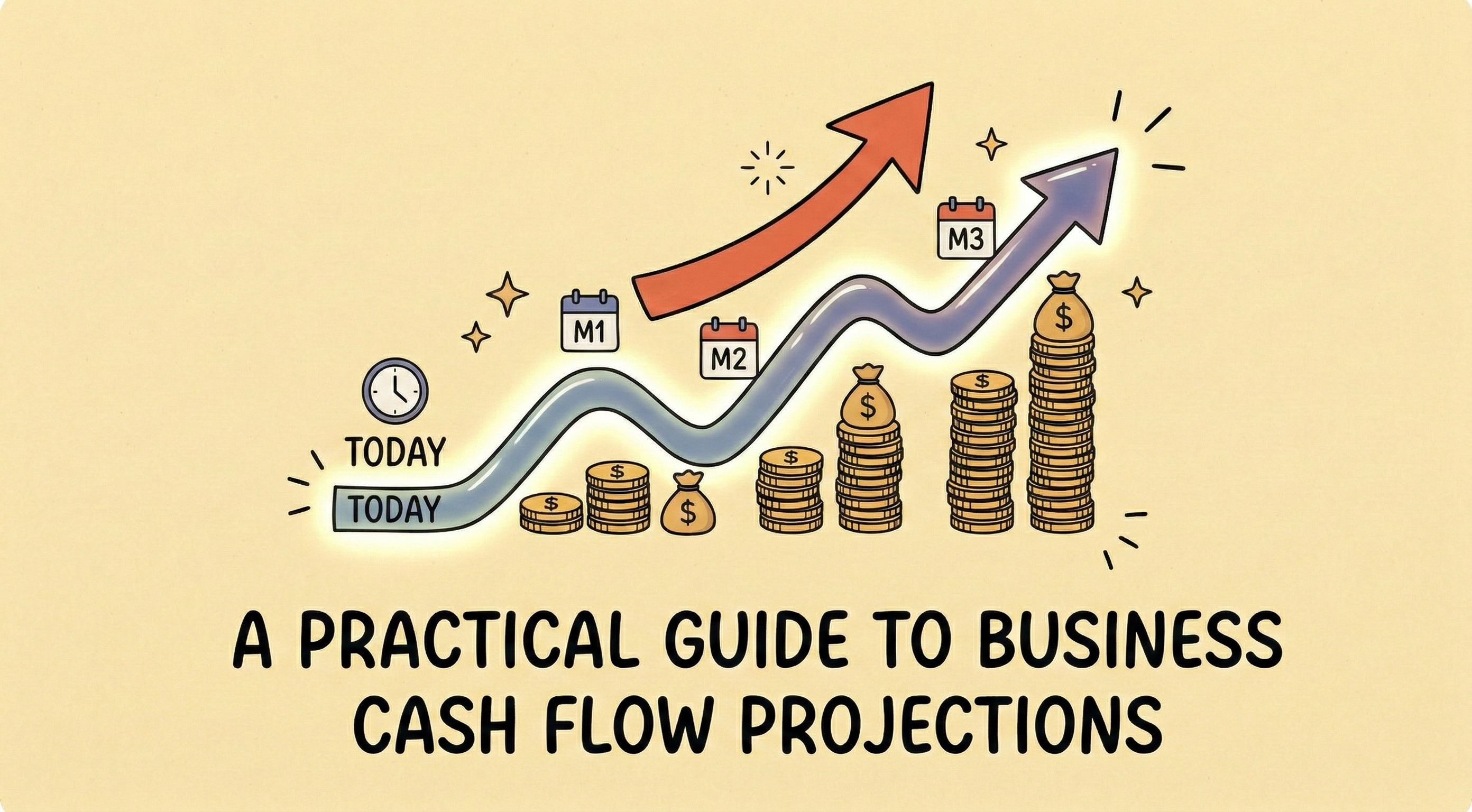
Beyond the Invoice: A Practical Guide to Business Cash Flow Projections
Imagine you have just finished a significant project. The client is pleased, and you have issued a professional invoice. On paper, your business is performing well. Then you check your bank balance. Your accounts receivable look strong. Your revenue is growing. But the actual cash available to pay software subscriptions, rent, or payroll is lower than expected — because that payment is still moving through a 30-day processing cycle. This is one of the most common financial traps in growing businesses: strong revenue, weak liquidity. A Cash Flow Projection exists to solve this problem. It is not just a spreadsheet exercise. It is a forward-looking control system that shows you — weeks or months in advance — whether your business will have the liquidity to operate smoothly. Profit is an accounting concept. Cash is a survival metric. Many profitable businesses do not fail because they lack clients. They fail because they run out of cash before payments arrive. In this article Distinguishing between paper profit and actual cash It is a common misunderstanding to assume that a “profitable” month automatically means a healthy bank account. You can be profitable — and still be unable to pay your bills on time. Cash Flow is the real-time movement of money into and out of your accounts. Profit is what remains after expenses are deducted from revenue — regardless of whether the money has physically arrived. The difference is timing. And in business, timing determines survival. To operate with stability, you must prioritize Liquidity. This means having sufficient cash on hand to cover recurring costs like software, rent, and taxes precisely when they are due. Managing the essentials of cash inflow and outflow A reliable cash flow projection is built on two categories: inflows and outflows. By tracking these accurately, you move from reacting to your finances to controlling them. Cash Inflow (The money entering your business) Record inflows based on when you expect the money to be available, not when you finish the work. Confirmed Payments: Only include revenue from signed contracts or completed milestones. The Payment Buffer: A practical best practice is to forecast payments arriving seven days later than the client’s stated due date. This accounts for bank processing times and administrative delays. Cash Outflow (The money leaving your business) Modern business expenses are increasingly digital and recurring. The Technology Stack: On average, professional freelancers and small agencies now spend 12–15% of their revenue on the software and tools required to stay competitive. The Tax Reserve: One of the most vital professional habits is allocating 25–30% of every incoming payment into a dedicated tax account. By documenting this as a mandatory “outflow” in your cash flow projection, you ensure that quarterly tax deadlines never disrupt your operations. Forecasting your monthly closing balance Once you understand your inflows and outflows, you can calculate your Closing Balance. This figure represents exactly how much cash you will have remaining at the end of the month. Closing Balance= (Starting Balance+Total Inflow) − Total Outflow A positive balance gives you flexibility to reinvest, build reserves, or absorb slow periods. A negative balance is not a crisis. It is an early warning signal. The purpose of a projection is not prediction; it is preparation. Implementation: Your cash flow projection template To help you move from theory to practice, we have provided a structured cash flow projection template below. Week Starting Balance Expected Inflow Planned Outflow Projected End Balance Week 1 $5,000 $1,200 ($800) $5,400 Week 2 $5,400 $0 ($1,500) $3,900 Week 3 $3,900 $3,500 ($400) $7,000 Week 4 $7,000 $500 ($2,000) $5,500 When you review this weekly, patterns begin to emerge: These patterns are where financial control begins. Financial health Q&A 1. Should I include “potential” leads in my forecast? No. To keep your projection accurate, only include projects where a contract is signed. Relying on a “potential” lead to cover fixed costs can lead to significant cash shortages. 2. How do I handle unpredictable monthly income?Build your projection based on your “Financial Floor”—your guaranteed retainers or your lowest historical monthly earnings. Anything earned beyond that is a bonus, but your essential bills should be covered by your most conservative estimate. 3. What if my projected balance turns negative?First, do not panic; the entire purpose of a projection is to give you time to adjust before the situation becomes an actual problem. Review variable costs such as marketing campaigns, new equipment, or discretionary spending. These can often be deferred. At the same time, use the projection as a prompt to follow up on overdue invoices to accelerate inflow. The earlier you see the dip, the more options you have. 4. How do I know if my business is “safe”?Aim to maintain a “Cash Floor” that can cover at least three months of your total outflows. Running out of cash is one of the top 5 reasons small businesses fail. This provides the security to navigate project delays or seasonal dips in work without compromising your operations. 5. What hidden outflows should I watch for? Commonly missed expenses include: Always forecast based on net cash received, not the gross amount invoiced. From Reactive Bookkeeping to Proactive Control Taking control of your cash flow is the most effective way to eliminate the “financial fog” that often leads to burnout. Projections move you away from the stress of wondering if a client payment will arrive in time to cover rent, allowing you to focus on the work that actually grows the business. Resilience isn’t built by hoping for a good month; it is built by seeing a potential dip sixty days out and having the clarity to adjust your spending or follow up on invoices before it becomes a crisis. When you master your cash flow, you stop being a passenger in your business and start being the pilot. About the Author Isabella Jones started her career at Deloitte, where she managed tax compliance for some of the country’s fastest-growing companies. She later joined Fynlo as Senior Financial Strategist, bringing that experience to freelancers and small business owners who need practical financial guidance without the corporate complexity. With an Accounting degree from Villanova University, Isabella focuses on making
Stop the 20% Profit Leak: Why 88% of Spreadsheet Budgets Struggle to Scale (+ Free Templates)
When you first start a business, financial oversight is natural. With a team of five, you likely see every receipt and approve every software subscription. But as you grow, that direct visibility begins to fade. You decentralize, giving credit cards to department heads and autonomy to managers. This transition often leads to what procurement professionals call “Maverick Spend”: purchasing that happens outside of agreed-upon budgets or central visibility. It isn’t usually the result of bad intentions; it is simply the result of a growing team moving faster than its financial systems. A 35-person SaaS company discovered they were paying for 214 SaaS licenses, but only 147 were active users. The excess cost them $4,800 per month. No one intended the waste. It accumulated silently. Most founders don’t lose control because they’re reckless. They lose control because their systems were built for 5 people—and they’re now managing 50. In this guide, we explore how to regain control of this “profit leak” and provide a practical blueprint for departmental financial health. In this article What is a Departmental Budgeting? At its core, a departmental budget is a financial roadmap for a specific segment of your business. It is a document, typically a spreadsheet or dashboard, that forecasts revenue and expenses for a set period—usually a month, quarter, or year. Core Elements: The Spreadsheet Risk Multiplier While decentralization causes visibility issues, the tools we use to manage that growth often introduce their own risks. Most scaling companies rely on a master spreadsheet—a file with dozens of tabs and thousands of rows. The danger here is rarely a single massive catastrophe; it is the accumulation of small, invisible mistakes. Imagine a manager accidentally hard-coding a $5,000 monthly expense into a cell rather than using a dynamic formula. At a small scale, you might spot the discrepancy. Yet in a complex file, that static number remains unchanged while your actual costs triple. By the time the error is caught six months later, you have over-allocated $60,000 based on a single “broken cell.” In a landscape where research by Professor Ray Panko shows that 88% of spreadsheets contain significant errors, these minor technical slips are often the hidden reason runways disappear faster than expected. Top Free Budgeting Templates If you aren’t ready for software, a template is a solid starting point. The right choice depends on your team’s bandwidth, your comfort with formulas, and whether you need basic tracking or in-depth departmental ROI analysis. Microsoft Office Templates: SlideTeam Presentation Templates: Liveflow SaaS Templates: Smartsheet Budget Templates: Your 5-Step Implementation Guide If you’re ready to move from a single consolidated budget to departmental accountability, follow this path: Step 1: Assign Departmental Leads Identify your primary departments (e.g., Marketing, Sales, Product, Ops). Assign one leader to each who is responsible for their team’s spending accuracy. Step 2: Conduct a 3-Month Look-Back Gather the last 90 days of transactions and categorize them by department. You will likely find expenses that “belong” to everyone (like Slack seats) and expenses that should be isolated (like specific LinkedIn ad spend). Step 3: Define Your Fixed Monthly Costs Work with leads to determine their fixed monthly costs—salaries and essential software. This is their “Baseline.” Any spend above this must be linked to a specific growth target. Step 4: Establish the Request Protocol Create a process for new expenses. If Marketing wants a new $200/month tool, they must identify which “Baseline” expense they are cutting to make room for it, or prove how it increases their specific ROI. Step 5: Monthly Performance Comparison On the 5th of every month, sit down with your leads for 15 minutes. Compare what they planned to spend vs. what they actually spent. This creates a culture of transparency where numbers aren’t a surprise. The Strategic Blueprint for Advanced Control 1. The Zero-Based Variance AuditMany companies take last year’s figures and add 5%. This often makes wasteful spending permanent. A more robust method is the Zero-Based Audit, where once a year, every department must justify their expenses from $0 up. This is the most effective way to identify “ghost subscriptions” for tools your team no longer uses. 2. Aligning Budgets with Contribution Margins Rather than simply assigning a “pot of money,” consider setting budgets based on Contribution Margin targets. This means every dollar allocated to a department should be tied to an efficiency metric. For instance, you might authorize a budget that fluctuates based on the team’s ability to keep the Customer Acquisition Cost (CAC) within a certain range. 3. Decentralizing Responsibility through LERTrue financial control happens when department heads feel ownership. One way to foster this is by tracking the Labor Efficiency Ratio (LER). By asking managers to monitor how much gross profit their specific team generates for every dollar spent on their payroll, you shift their focus from “spending” to “value creation.” 4. Implementing “Soft-Close” VisibilityWaiting for a formal “Month-End Close” is often too slow. Implementing a Soft-Close dashboard allows you to see “committed spend” (money promised to vendors) alongside “actual spend” (money that has already left the bank). This prevents the surprise of a large, unforecasted vendor bill hitting your books on the 30th. The Path to Strategic Oversight Spreadsheets eventually reach a functional breaking point. When you’re spending more time fixing formulas than analyzing margins, it’s a clear sign you’ve outgrown manual tools. Shifting toward an integrated system lets you stop reacting to data and start using it as a strategic dashboard to steer your growth. About the Author Isabella Jones started her career at Deloitte, where she worked on tax compliance for some of the country’s fastest-growing companies. She later joined Fynlo as Senior Financial Strategist, bringing that experience to freelancers and small business owners who need practical financial guidance without the corporate complexity. With an Accounting degree from Villanova University, Isabella focuses on making financial planning easier to understand and apply in day-to-day business. She works closely with freelancers and small businesses on areas like taxes, cash flow, and building more stable financial systems.
8 Free Business Reporting Templates for Small Businesses
Trying to get a clearer picture of how your small business is doing can feel like a big task, especially when you’re focused on the day-to-day. You might wonder about profitability, cash flow, or customer trends without wanting to dive into complicated systems. If that sounds familiar, this post will offer some helpful starting points. We’ve gathered 8 free business report templates that can provide valuable insights, and to make things a little easier, we’ve also found links to free, straightforward templates that you can explore. Most of them are compatible with Microsoft Excel and Google Sheets, allowing you to easily customize them to fit your specific business needs. Let’s see how these templates can help you move from guesswork to making informed decisions, all without any cost. Table of Contents 1. Profit and Loss (P&L) Statement P&L statement summarizes revenue, costs, and profits over a period (monthly, yearly), revealing your business’s profitability. It identifies cost-saving opportunities or growth potential, helping you make data-driven decisions to boost your bottom line. Free Templates: Smartsheet IntuitConta 2. Monthly Sales Report A monthly sales report tracks sales performance, including volume and revenue, on a monthly basis. It highlights trends, informs marketing strategies, and assists in optimizing pricing or promotions, ensuring revenue maximization with minimal effort. Free Templates: HubSpotDocsAutomator Unito 3. Inventory Report An inventory report tracks stock levels, costs, and turnover for products or supplies. It prevents overstocking or shortages, reduces waste, and optimizes purchasing, ensuring efficient operations and cost control for retail or service businesses. Free Templates: Template.net Smartsheet ClickUp 4. Marketing Campaign Report A marketing campaign report evaluates marketing efforts (e.g., social media, email) through KPIs like engagement or conversions. It optimizes marketing spend, crucial for small budgets, and refines campaigns to attract more customers. Free Templates: Smartsheet Semrush Goodocs 5. Balance Sheet Balance sheet shows your business’s financial position by listing assets (what you own, like cash), liabilities (what you owe, like loans), and equity (your net worth) at a specific time. It helps assess financial health, secure loans, or plan investments, giving clarity on stability without complex accounting. Free Templates: SCORE Association Agriculture and Horticulture Development Board (AHDB) Compeer Financial 6. Annual Business Performance Report An annual business performance report offers a comprehensive overview of your company’s yearly performance, encompassing financial results, operational achievements, and strategic milestones. It’s invaluable for stakeholders and aids in setting future goals. Free Templates: Adobe Smartsheet ClickUp 7. Project Status Report A project status report monitors project progress, timelines, and resource allocation. It keeps stakeholders informed about developments, milestones achieved, and any issues encountered, ensuring transparency and accountability. Free Templates: ZapierSmartsheetAtlassian 8. Employee Performance Report An employee performance report evaluates employee productivity and sets performance goals. It assists in conducting regular performance reviews, setting objectives, and providing feedback, fostering employee development and satisfaction. Free Templates: WPS TemplateTeamflectSmartsheet Final Thoughts Managing business reports doesn’t have to be overwhelming. With these eight free templates, you can efficiently track finances, sales, and projects, allowing you to focus on growing your business. Start by selecting a template that fits your needs, customize it to reflect your brand, and update it regularly. Sharing these reports with stakeholders ensures transparency and keeps everyone aligned. If you’re looking to further simplify your reporting, consider exploring tools designed to enhance financial tracking and support your business’s success. Fynlo offers an all-in-one accounting platform that combines income tracking, budgeting, and reporting in one place. It’s free, making it an excellent value for small businesses and freelancers. [Sign Up for FREE]
Top 5 Reasons Why Small Businesses Fail and How to Avoid Them
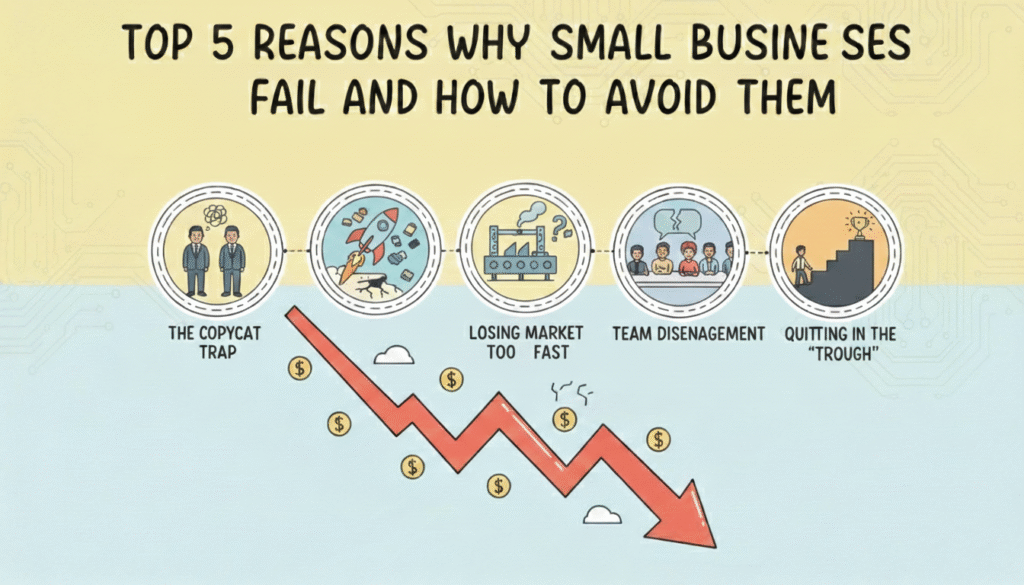
Starting a business is easily one of the most rewarding journeys you’ll ever embark on. There’s nothing quite like the rush of that first sale or the pride of seeing your logo on a real office door. Yet, for all the excitement, it’s also incredibly lonely and, at times, brutal. As we look toward 2026, the entrepreneurial spirit is louder than ever, yet the quiet reality remains: many small businesses struggle to stay afloat. According to 2024 data from the U.S. Bureau of Labor Statistics, nearly 50% of businesses fail within their first five years. We don’t believe failure is a foregone conclusion. Usually, it isn’t one giant catastrophe that sinks the ship; it’s a series of small, quiet cracks in the hull that no one noticed or wanted to see. In our experience watching what separates the survivors from the statistics, success often comes down to navigating a few specific, hidden hurdles. Here are the five real reasons businesses stall, and how you can navigate around them to build something that lasts. In this article 1. The Copycat Trap It starts with a seductive, familiar thought: “They’re making a killing, and I know I can do it better at a lower price.” It’s a common mindset that feels like a shortcut to success. You see a local leader or a big industry player and try to mirror their every move while undercutting their costs. This is the “Copycat Model,” and while it feels like a safe bet, it’s actually a trap. When you copy, you’re competing against someone who has more history, deeper pockets, and an established reputation. If your only way to win is to be “slightly cheaper,” you aren’t building a business; you’re operating on razor-thin margins that leave no room for error or future growth. When your only edge is price, any increase in your costs or a counter-move from a larger competitor can instantly wipe out your remaining profit. As Peter Thiel famously wrote in Zero to One: “The next Bill Gates will not build an operating system. The next Larry Page or Sergey Brin won’t make a search engine.” If you aren’t bringing something uniquely you to the table, you’re just holding a spot until someone with more capital decides to take it. You don’t need to reinvent the wheel, but you do need to give people a reason to choose yours. How to stay ahead: 2. Scaling Too Fast We’ve all felt that “first milestone” adrenaline. You’ve got your first big clients, you’ve hired a Virtual Assistant, and for the first time, the dream feels real. This can be the danger zone. It’s when founders get impatient and start pouring money into massive hiring sprees or new markets before their core engine is actually stable. The numbers are staggering: 74% of high-growth startups fail because they scaled prematurely, according to the Startup Genome Report. Take the story of Bench, the bookkeeping giant. They raised over $100 million, had a massive team, and were the darlings of the tech world. But despite the funding and the hype, the company eventually had to shut down its core operations. They scaled their burn rate before they mastered their efficiency. Scaling a broken process doesn’t make you bigger; it just makes your mistakes louder and much more expensive. How to stay ahead: 3. Losing Market Flexibility There is a thin, blurry line between being “persistent” and being “stubborn.” We often fall in love with our original vision, treating it like a sacred text rather than a living document. Take Kodak as a prime example. In 1975, one of their own engineers invented the first digital camera. But the leadership was so protective of their film business that they buried the tech. They clung to the past while the world moved on. This reluctance eventually led the once-dominant giant to file for bankruptcy in 2012, which serves as a powerful lesson that past success is no guarantee of future survival. Today, failing to pivot is just as risky. According to a report by CB Insights, 42% of startups fail because there is simply no market need, often because the founders were so busy building a “perfect” product that they forgot to check if anyone actually wanted it. If you stop listening to your customers because you’re too busy “staying true to your vision,” it’s easy for the path forward to get a bit blurry. How to stay ahead: 4. Team Disengagement A business isn’t a machine; it’s a collection of people. If the people lose their spark, the engine stalls. Most of us recognize the signs: the “silent office” where everyone is just going through the motions. Gallup’s research shows that engaged teams are 21% more profitable, yet so many founders treat culture as an afterthought. High turnover isn’t just an HR headache; it’s a massive financial leak. It costs an average of $6,000 to replace a single employee, but the loss of trust and institutional knowledge is even higher. When your team feels like they are just “clocking in,” they won’t have your back when things get difficult. How to stay ahead: 5. Quitting in the “Trough” Every entrepreneur eventually finds themselves in the “Trough of Sorrow.” It’s that long, quiet stretch after the initial excitement has worn off, but the big results haven’t arrived yet. It’s the 2 AM nights spent wondering if you’ve made a huge mistake. 53% of founders reported feeling burned out. That exhaustion often leads to “Premature Capitulation”—closing a perfectly healthy business simply because the founder is spent. There’s a nuance here: you should be flexible with your method (as we saw in Point 3), but you must be relentless with your mission. Success usually happens right after you’ve considered walking away. Thomas Edison said it best: “Many of life’s failures are people who did not realize how close they were to success when they gave up.” How to stay ahead: The Path Forward: Success is a Series of Choices Building a business that lasts isn’t about luck, and it certainly isn’t about having a perfect, mistake-free first year. As we have seen, the “cracks in the hull” that sink most businesses are usually avoidable with a bit of foresight and a lot of honesty. Success comes down to your willingness to stay flexible, your commitment to your team, and your ability to look past the “copycat” shortcuts. It is about building systems that support your growth rather than just chasing the growth itself. If you can navigate the “Trough of Sorrow” with a clear mission and a solid financial foundation, you are already ahead of the statistics.
5 Financial Metrics Your Bank or Lender Will Check Before Giving You a Loan

You’ve poured your time, energy, and sleepless nights into building something strong. You’ve overcome the initial hurdles, found product-market fit, and now you’re ready for the next big leap. That means securing the capital required to hire, expand your inventory, or move into a bigger space. This journey, though, brings you face-to-face with a tough reality: obtaining that financing is often the single biggest hurdle for small businesses. According to 2025 research from Allica Bank, SME loan rejections have dramatically increased from just 5-10% three decades ago to 40% today. In other words, lenders are far more selective than they used to be. The moment you submit that application, you step into a rigorous due-diligence process where lenders are looking past your gross revenue to assess two critical things: risk and repayment capacity. If you don’t know the core metrics they care about, you can’t prepare your books effectively or present your case with confidence. Here are the five essential financial metrics your bank will scrutinize before approving your loan. In this article 1. Quick Ratio (Acid-Test Ratio) Think of the Quick Ratio as your company’s emergency financial safety net. It’s a crucial measure of short-term liquidity, answering the question every lender silently asks: “If sales hit a sudden wall, could this business instantly pay its most urgent bills?” This metric focuses only on your most liquid assets—cash and receivables—and deliberately excludes inventory because that can be slow to sell or difficult to liquidate quickly. Lenders generally look for a Quick Ratio above 1.0. A strong Quick Ratio proves you have the immediate cash flow cushion to weather an unexpected storm, which builds confidence in your business’s foundational health. To put it simply: if you owe $10,000 in short-term bills, lenders want to see at least $10,000 in highly liquid assets; ideally more. Quick Ratio = (Cash + Accounts Receivable + Marketable Securities) / Current Liabilities 2. Debt-to-Equity (D/E) Ratio The D/E Ratio measures the financial structure of your business. It answers whether you’re funding growth primarily through debt or through the owners’ investment (equity) and accumulated profits. Lenders look for a lower ratio, typically below 1.5. A high D/E ratio (say, 3.0) signals that your business is highly leveraged and therefore vulnerable if revenues dip, as fixed debt payments remain relentless. Conversely, a low ratio proves the owners are committed and the company has strong internal stability. Debt-to-Equity Ratio = Total Liabilities / Total Equity 3. Debt Service Coverage Ratio (DSCR) When a bank considers giving you a new loan, DSCR is what matters most. It is arguably the most critical metric for any new debt, measuring your company’s direct repayment capacity for all its debt obligations. DSCR = Net Operating Income / Total Debt Service (Principal + Interest Payments) Banks usually require a DSCR between 1.25 and 1.50. Think of this simply: a DSCR of 1.25 means your operating income is 125% of your required debt payments. This provides a safety margin. If your DSCR is below 1.0, the loan conversation stops instantly—you’re simply not generating enough income to cover your required payments. 4. Gross Profit Margin While the initial metrics focus on risk, the Gross Profit Margin proves the viability of your core business model. It answers: “How profitable is your product or service itself, before the lights are even turned on?” Lenders look for a high and consistent margin. A strong Gross Profit Margin proves that your core service is priced correctly and that you are efficient at managing your direct production costs (COGS). This shows the inherent earning power of your product, assuring the lender that even if overhead expenses rise, the core offering is financially sound. Gross Profit Margin = (Revenue – Cost of Goods Sold) / Revenue To see why your total sales are different from the money you actually keep, read our guide on the difference between revenue and profit to make sure your business stays healthy. 5. Accounts Receivable (A/R) Aging and DSO This metric focuses on cash flow quality and the efficiency of your collections process. A healthy balance sheet is useless if you can’t actually get the money in the door. Lenders pay close attention to your A/R aging report to see how many outstanding invoices are over 90 days due. If a large percentage of your revenue is perpetually uncollected, that’s a massive red flag. Days Sales Outstanding (DSO) measures the average number of days it takes for you to collect revenue after making a sale. DSO = (Average Accounts Receivable / Total Credit Sales) x Number of Days Lenders want to see a low DSO, indicating fast and efficient collection (ideally under 45 days). A high DSO suggests your credit control is weak or your clients are unreliable, significantly raising the lender’s risk profile. Preparation as a Competitive Advantage Securing a loan starts long before you submit the application. It begins with shifting your mindset from “keeping the books” to “strategic reporting.” Lenders aren’t just looking at your bank balance; they are looking for a narrative of stability and foresight. When you can present these five metrics clearly and instantly, you demonstrate that you aren’t just a business owner—you are a sophisticated operator who understands risk and repayment capacity. In the competitive 2026 lending environment, that level of clarity is often the difference between a rejection and an approval at the best possible rates. About the Author Isabella Jones started her career at Deloitte, where she worked on tax compliance for some of the country’s fastest-growing companies. She later joined Fynlo as Senior Financial Strategist, bringing that experience to freelancers and small business owners who need practical financial guidance without the corporate complexity. With an Accounting degree from Villanova University, Isabella focuses on making financial planning easier to understand and apply in day-to-day business. She works closely with freelancers and small businesses on areas like taxes, cash flow, and building more stable financial systems.
Stop Losing Money: How Exchange Rates Silently Affect Your Global Freelance Income (And the Simple Fixes)

If you run a freelance business or a small company that serves clients across borders—from London to Sydney, or Tokyo to Berlin—you’ve likely faced an invisible threat: exchange rate volatility. Every time a foreign payment lands in your bank, its value might have shifted. These small, daily movements in foreign exchange (FX) rates can quietly eat into your revenue, disrupt your budget, and turn a profitable contract into a financial annoyance. You delivered the work perfectly, yet the currency market took a cut. Understanding how to neutralize this currency risk isn’t just for big corporations; it’s essential for maintaining control over your cash flow and safeguarding your growth. Table of Contents Why Currency Risk Is a Critical Problem Right Now The days of stable, predictable exchange rates are largely behind us. In recent years, central bank policies, geopolitical events, and high inflation cycles have made currency markets far more volatile. A survey by Convera also found that “currency volatility and conversion costs” rank among the top challenges for businesses managing cross-border payments, underscoring how widespread and persistent this issue has become. Whether it’s the U.S. Federal Reserve hinting at interest rate changes (which immediately affects the strength of the dollar globally) or political uncertainty in Europe causing sudden shifts in the Euro and Pound Sterling, these external factors have real-world consequences for your business. For example, during sharp market movements, the EUR/USD rate can shift significantly in just a few months. When the currency your client pays you in weakens against your local currency, you receive fewer dollars, euros, or pounds back home. This loss, known as FX exposure, is the price of doing international business if you don’t manage it proactively. The Core Loss: How Timing Eats Your Profit When you invoice a client in their local currency, you face two risks: the day you issue the invoice, and the day you receive payment. Let’s look at how that timing gap can cost you money. Example: A graphic designer based in the Eurozone (Home Currency: EUR) completes a consulting project for a client in the UK (Foreign Currency: GBP) for an agreed value of €5,000 EUR. Scenario Date Exchange Rate (EUR to GBP) EUR Equivalent Received Contract Signed January 1st £0.85 GBP per €1 EUR (Equivalent to approx. £4,250) Payment Expected February 1st £0.85 GBP per €1 EUR €5,000 EUR Payment Received February 1st £0.88 GBP per €1 EUR €4,830 EUR In this scenario, the Euro strengthened, meaning it took more Pounds (£) to buy one Euro (€). Because the client was locked into paying the Pound equivalent of the original invoice, the designer lost €170 of expected revenue—a real loss caused entirely by a small market movement. The Hidden Drain: Where Your Money Disappears Exchange rate losses often occur subtly, in ways that are hard to spot in a simple P&L statement. For freelancers and small business owners focused on growth, these losses usually hit in three key areas: 1. Quoting and Invoicing Risk The moment you issue a quote or an invoice valid for 30 or 60 days, you’re essentially making a short-term bet on currency stability. If you invoice in a weaker currency, and that currency dips further before the payment arrives, your original price loses purchasing power back in your home currency. Best practice: Protect your margin by pricing with a small currency buffer or shortening payment windows. 2. The Cost of Conversion Fees When a payment moves from your client’s foreign bank account to your local bank, it passes through intermediaries—often a major bank or a payment processor like PayPal. These entities rarely use the mid-market rate (the true rate you see on Google). Instead, they apply a conversion rate margin that can be 1–5% worse than the real rate. This margin is an invisible fee that ensures you lose money every time you convert funds, often buried deep in transaction summaries. Best practice: Always compare conversion rates and consider borderless payment platforms to minimize hidden costs. 3. Paying International Subscriptions and Suppliers Your business might rely on premium software, cloud services, or raw materials billed in foreign currencies. When your home currency suddenly weakens—say, the Australian Dollar against the USD—those subscription fees and supplier payments immediately become more expensive. If you budgeted $100 a month for your software stack, a 5% currency shift means you’re suddenly spending $105, tightening your margins without warning. This is the perfect time to perform a zero-based audit using our 20 strategic ways to trim your business expenses to ensure your tools aren’t eating your international profit. Best practice: Track recurring foreign expenses so you can adjust pricing or timing before exchange rate shifts erode your profit. Simple Strategies to Protect Your Cash Flow You don’t need a Wall Street trading floor to manage FX risk—just smart terms and the right tools. Here are practical strategies to strengthen financial control: Strategy 1: Lock in Your Price by Quoting in Your Home Currency The easiest way to eliminate currency risk is to shift that risk to your client’s side—gently and professionally. By stating the final price and invoice amount in your home currency (HC)—whether that’s USD, CAD, EUR, or AUD—you ensure the amount you receive is fixed. The client’s bank or payment service will handle the conversion on their end, meaning they bear the risk if the market shifts. This approach offers immediate clarity and guarantees that your profit margin remains exactly what you planned, though you must be prepared for the occasional client who prefers paying in their local currency. Strategy 2: Use Multi-Currency Accounts to Time Your Conversions If your clients insist on paying in their local currency (which is common, especially with large corporate clients), your best move is to avoid immediate conversion. Set up a borderless or multi-currency account using modern payment services. When your client pays in Euros or Yen, the funds stay in that currency until you decide to convert—ideally when the rate is more favorable. You can even use those foreign funds directly for subscriptions or suppliers abroad (a form of natural hedging). This strategic patience can save you hundreds, or even thousands, over a year. Strategy 3:
7 Financial Red Flags U.S. Small Businesses & Freelancers Can’t Afford to Miss

Running your own business comes with freedom and flexibility — but it also comes with paperwork, deadlines, and financial risks. While invoices and expense spreadsheets may not feel as urgent as closing the next client or shipping the next order, they’re often where trouble starts. In fact, 82% of small business failures are linked to cash flow problems. In fiscal year 2024, the IRS assessed $84.1 billion in civil penalties overall, much of it hitting small businesses who missed deadlines or mismanaged cash. Here’s the bright side: Your financial reports can act like a smoke alarm — they’ll tell you when something’s wrong long before the fire spreads. The trick is knowing what to look for. We’ve compiled 7 critical financial red flags that U.S. small businesses and freelancers often overlook. By learning how to read financial statements and spot these warnings in your financial data, you can take corrective action today and secure your future growth. We’ll also share simple benchmarks so you can see how your numbers stack up. Table of Contents 1. Profit is Up, But Cash Flow is Down (Slow Collections) This is the most important warning sign. Your Cash Flow Statement tracks the actual money moving in and out of your business, while your Income Statement tracks profit on paper. If your income statement shows a profit, but your cash flow statement is consistently negative, it means you’re failing to convert sales into usable cash. This is usually due to clients taking too long to pay (Days Sales Outstanding, or DSO), which traps your capital. The Warning Sign: You frequently need to rely on loans or personal savings to cover routine bills, even though you have a high volume of pending invoices. Benchmark to Watch: A healthy DSO is usually under 45 days. If it’s much higher, you may be heading into small business cash flow problems. How to Address It: 2. Your Profit Margin is Falling Your Gross Profit Margin (found on your Profit & Loss Statement) is the percentage of revenue left after paying the direct costs of your product or service (Cost of Goods Sold). If this margin shrinks, it means you’re making less money on every sale, even if your total sales volume is high. The Warning Sign: Your overall revenue is up, but the percentage of profit you keep per project or item is falling steadily. Benchmark to Watch: For many service-based freelancers, a gross margin of 50% or higher is considered healthy, while product businesses often target 30–40%. How to Address It: 3. Excessive Debt-to-Equity Ratio Found on the Balance Sheet, the Debt-to-Equity (D/E) ratio compares your total debt to your owner’s equity. A high D/E ratio signals that your business is heavily financed by loans and credit cards, making it vulnerable to interest rate hikes and economic downturns. The Warning Sign: Your debt is growing rapidly without a corresponding increase in retained profit. Benchmark to Watch: A D/E ratio above 2:1 is considered risky for most small businesses, though some industries (like construction) can sustain higher leverage. How to Address It: 4. Inventory Is Sitting Too Long (Low Inventory Turnover) If your business sells physical products, your Inventory Turnover rate is key. A low rate means products are taking a long time to sell. This ties up working capital and increases the risk that your stock will become outdated. The Warning Sign: You frequently have too much product in storage, leading to high holding costs and frequent markdowns. Benchmark to Watch: Most retailers aim for an inventory turnover of 4–6 times per year. If you’re under that, capital is likely tied up in slow-moving goods. How to Address It: 5. Discrepancies in Account Reconciliation Account reconciliation is the process of matching every transaction in your bank statements with your accounting software entries. Skipping this is a critical operational failure that masks mistakes, unrecorded fees, and, worst of all, potential fraudulent activity. The Warning Sign: You haven’t compared your bank statement to your accounting software records in over 30 days. How to Address It: 6. Owner Draws Exceeding Net Income For freelancers and sole proprietors, the “Owner’s Draw” is the cash you pull out of the business for personal use. If your draws are consistently higher than your actual Net Income, you are dangerously liquidating the business’s capital reserves and emergency cash. The Warning Sign: You find yourself taking larger, erratic draws that leave the business with insufficient cash to cover upcoming tax payments or slow client periods. Benchmark to Watch: Aim to keep owner draws below net income and ideally not more than 30–40% of profits, depending on your reinvestment needs. How to Address It: 7. Operating Expenses Are Growing Faster Than Revenue This is a subtle but dangerous red flag often found on the Profit & Loss Statement. If your operating expenses (e.g., software subscriptions, rent, marketing costs, administrative salaries) are increasing at a faster percentage rate than your total revenue, your business is losing efficiency. You are investing more money to generate less relative income. The Warning Sign: You see revenue growth of 10% year-over-year, but your total operating expenses have increased by 20% or more. This means your operational efficiency is dropping. Benchmark to Watch: Track your Operating Expense Ratio = Operating Expenses ÷ Revenue. For many small businesses, keeping this under 30–35% is a healthy target. How to Address It: Final Takeaway: Red Flags Are Early Warnings Red flags don’t necessarily mean your business is failing — but ignoring them is risky. Spotting issues early gives you time to correct course before small cracks turn into financial sinkholes. And you don’t have to track all this alone. Fynlo makes staying on top of your bookkeeping, expenses, and financial reports easy. Our platform gives you a clear, real-time view of your business’s financial health, helping you spot these red flags before they become a crisis. Ready to catch red flags before they cost you? Book a quick demo with Fynlo today.
Mastering Cash Flow Management: The #1 Reason Small Businesses Thrive
Ever wonder what truly separates a thriving small business from one that struggles? It’s not just a brilliant idea or massive profits; it’s the art of cash flow management. While profit is certainly vital, having enough cash in the bank to cover your expenses, invest in growth, and seize opportunities is the real game-changer. It’s a skill that’s more critical than ever, with a staggering 88% of U.S. small businesses facing cash flow disruptions. The good news is, by mastering cash flow, you gain immense power to protect your business, reduce stress, and set yourself on a path to lasting financial stability. Let’s explore the essentials of cash flow management, from what it is to how you can take control of it today. Table of Contents What Is Cash Flow? It’s easy to mistake cash flow for profit, but they’re distinct concepts crucial to your business’s health. Your profit is what remains after you subtract all your expenses from your total revenue over a period—it’s a measure of your business’s overall financial performance. Cash flow, on the other hand, is the actual movement of money in and out of your business accounts. Think of your business’s bank account as a reservoir. You want a steady, predictable inflow of water (cash) to keep it comfortably full, ready for any needs or opportunities that arise. Common Challenges to Healthy Cash Flow Even the most profitable businesses can face cash flow challenges. Here are some of the most common hurdles freelancers and small businesses encounter, along with a quick solution for each: Practical Steps for Better Cash Flow Taking command of your cash flow might seem like a huge undertaking, but it’s really about implementing a few smart, consistent habits. 1. Forecast Your Cash Flow You can’t effectively manage what you don’t anticipate. Start by creating a simple cash flow forecast. Project your expected income and expenses for the next 3-6 months. This forward-looking view is like a financial weather forecast, allowing you to spot potential shortfalls before they happen. If you see a dip coming in two months, you have time to adjust spending or chase new sales. 2. Accelerate Your Income Inflow The faster cash comes in, the healthier your business. 3. Optimize Your Outflow Be strategic about how and when you pay your own bills. 4. Conquer Your Tax Obligations Don’t let tax season be a source of anxiety. Implement a system to consistently set aside funds for your tax obligations. A simple method is to automatically transfer a percentage (e.g., 20-30% for federal and state taxes) of every payment you receive into a separate, earmarked bank account. This ensures the cash is available when those quarterly estimated tax payments are due, preventing a major headache and costly penalties. Empower Your Business with the Right Tools Managing cash flow doesn’t have to be a source of stress or endless spreadsheets. The key to financial well-being for any small business or freelancer is having simple, effective tools that automate the tedious parts and give you clear insights. This is where a tool like Fynlo truly shines. Our easy-to-use software is specifically designed for freelancers and small business owners. It simplifies tracking your income and expenses, makes sending professional invoices effortless, and helps you stay on top of your estimated tax payments – all crucial elements of strong cash flow management. We take the guesswork out of bookkeeping, so you can focus your energy on growing your business and serving your clients. Ready to transform your business’s financial future? We’re here to help. You can explore how Fynlo works by starting a free trial, or schedule a call to speak with our team directly.
20 Easy Ways to Cut Costs

When you’re running your own business, every dollar counts. Lately, expenses have been climbing faster than revenues. According to Biz2Credit’s Small Business Earnings Report, average monthly costs rose from $209,400 in January 2023 to $575,300 by April 2024. The good news is that cutting costs does not require huge sacrifices or an entire operational overhaul. Often, the biggest savings come from small, strategic tweaks that add up over time. It’s about working smarter, not cheaper. Whether you’re a freelancer or a growing small business, here are 20 easy ways to trim the fat and boost your profitability today. Table of Contents Slash Your Software & Tech Spending 1. Conduct a Subscription Audit. Are you still paying for that project management tool you haven’t used in six months? Go through your bank statements and list every recurring subscription. You’ll likely find services you can cancel, downgrade to a free plan, or consolidate. 2. Embrace Open-Source and Freemium Software. Before you pay for expensive software, check for powerful free alternatives. Use LibreOffice instead of Microsoft 365, GIMP instead of Adobe Photoshop, or the free version of tools like Mailchimp and Trello, which are often more than enough for small-scale needs. 3. Buy Refurbished Tech. You don’t always need the latest and greatest model. Reputable manufacturers like Apple and Dell offer certified refurbished laptops, monitors, and phones that work like new but come with a significantly lower price tag and a warranty. 4. Consolidate Your Web Services. Are you paying one company for your domain, another for web hosting, and a third for your business email? Many providers, like Google Workspace or Hover, allow you to bundle these services, often resulting in a simpler bill and a nice discount. Optimize Your Workspace & Operations 5. Go Fully Remote (or Hybrid). The most significant overhead for many small businesses is rent. If your work allows, giving up a physical office can save you thousands per month in rent, utilities, and commuting costs. 6. Use a Coworking Space. If you need an office but don’t want the commitment of a long-term lease, a coworking space is the perfect middle ground. You get a professional workspace, meeting rooms, and amenities for a flexible monthly fee. 7. Go Paperless. Switch to digital invoicing, contracts, and note-taking. You’ll save money on paper, ink, printers, and postage, while also making it easier to find documents and reduce your environmental footprint. 8. Optimize Your Shipping. If you ship products, don’t just stick with one carrier. Use shipping software (like Pirate Ship) to compare rates and access discounted prices. Take advantage of flat-rate boxes, which can be cheaper for heavier, smaller items. Market Smarter, Not Harder 9. Focus on Content Marketing. Create a blog, post helpful tips on social media, or start a simple newsletter. Providing value builds trust and attracts customers organically over time without the high cost of traditional advertising. 10. Launch a Referral Program. Your happiest customers are your best salespeople. Offer a small discount, a gift card, or a service credit to clients who refer new business your way. It’s one of the most cost-effective ways to acquire new, high-quality leads. 11. Master Email Marketing. Building an email list is a direct line to your audience that you own. Unlike social media, you aren’t fighting an algorithm. It consistently delivers one of the highest returns on investment in marketing. 12. Barter Your Services. Connect with other freelancers or small business owners. Need a new logo, but you’re a great copywriter? Find a graphic designer who needs help with their website content and propose a skill swap. It’s a win-win that saves cash, builds relationships, and provides access to a new professional network. Rethink Your Team & Outsourcing 13. Hire Freelancers Over Full-Time Staff. When you need help, consider hiring a contractor for a specific project. You get specialized expertise without the long-term financial commitment of a salary, benefits, and payroll taxes. 14. Automate Repetitive Tasks. Use tools like Zapier or IFTTT to connect your apps and automate simple workflows. You can automate social media posting, data entry, and email responses, freeing up your valuable time to focus on revenue-generating activities. 15. Outsource Your Weaknesses. Struggling with bookkeeping or taxes? Trying to do it all yourself can lead to costly mistakes. Hiring a freelance bookkeeper or accountant for a few hours a month is often cheaper than the time you’d waste and the penalties you might incur. Manage Your Finances Wisely 16. Renegotiate with Your Suppliers. If you’ve been a loyal customer to a supplier or service provider, don’t be afraid to ask for a better rate. The worst they can say is no, and you might be surprised at what they’ll offer to keep your business. 17. Review Your Insurance Policies Annually. Don’t just auto-renew your business insurance. As your business changes, so do your needs. Shop around for quotes each year to ensure you have the right coverage at the best possible price. 18. Switch to a Fee-Free Business Bank. Many modern online banks offer business checking accounts with no monthly maintenance fees, no minimum balance requirements, and unlimited transactions. Compare this to traditional banks that can charge $15-$25 per month for the same service. 19. Negotiate Credit Card Processing Fees. If you accept credit cards, those processing fees can add up. As your sales volume grows, contact your provider (like Stripe, Square, or PayPal) and ask if you qualify for a lower rate. 20. Pay Invoices Early for Discounts. Review the payment terms from your vendors. Some offer a small discount (typically 1-2%) for paying an invoice within 10 days instead of the usual 30. If you have the cash flow, it’s an easy way to save. Putting It into Practice Choose two or three strategies that hit your biggest costs first. Set clear targets (for example, reduce software spending by 20 percent or trim utility bills by 15 percent) and review your progress each month. Reinvest every dollar saved into activities that drive