
The 2026 Profit Guide: 7 States That Help You Retain More Revenue
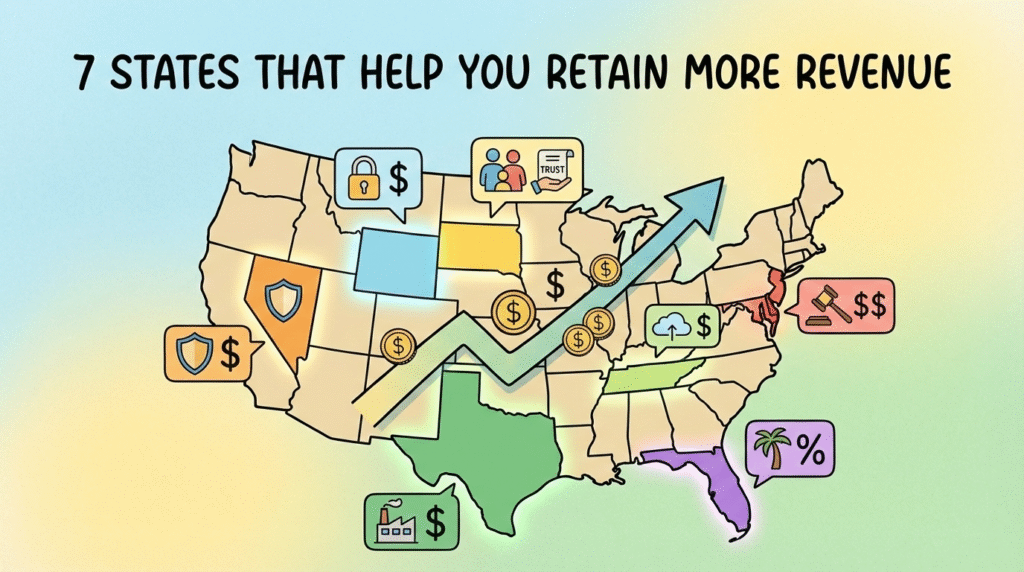
Most founders start their journey with a focus on top-line growth, but as the business matures, the focus shifts to the bottom line. In 2026, where your business “lives” is just as important as what it sells. Between state-level taxes, franchise fees, and administrative overhead, your choice of location can change your net profit by thousands of dollars annually. With the 2026 economy favoring remote-first structures, you have more flexibility than ever to choose a home base that aligns with your financial goals. Here is a detailed look at seven states designed for high retention and low friction. In this article Quick Comparison: 2026 Top Tax-Friendly States Selecting the right home for your business in 2026 requires balancing immediate fees against long-term strategic goals. Use the decision matrix below to identify your path, then verify the technical thresholds in the comparison table. State Annual Base Fee Tax-Exempt Threshold (2026) Privacy & Asset Protection Primary Strategic Advantage Wyoming $60 100% Tax-Free Elite: No member names in public records; strong charging order. The “Lean” Leader: Lowest combined maintenance and setup costs in the U.S. Delaware $300 100% Tax-Free (Non-DE income) Standard: Member names are generally private; expert court system. VC/IPO Ready: The mandatory standard for institutional investment. Texas $0 $2,650,000 (Revenue threshold) Standard: Publicly accessible officer names; stable pro-business courts. Scale Hub: Massive infrastructure and labor pool for large operations. Florida $138.75 100% Tax-Free (Personal income) Moderate: High transparency; aggressive business-first legislation. Growth Epicenter: Top migration destination for tech founders in 2025-2026. Nevada $350 $4,000,000 (Revenue threshold) Ultra: Strongest “Exclusive Remedy” charging order protection in the U.S. Maximum Shield: Preferred for high-liability professional or real estate assets. S. Dakota $55 100% Tax-Free (No income/capital gains) Dynasty Tier: Permanent court seal for trusts; generational privacy. Legacy Focus: Designed for multi-generational wealth and asset management. Tennessee $300+ $50,000 (Excise deduction) Moderate: Standard corporate disclosure; business-friendly climate. Remote Incentive: Asset-light agencies benefit from 2024 franchise tax repeal. 1.Wyoming: The Efficiency Leader Wyoming maintains a regulatory environment centered on administrative simplicity and established legal precedent. As the first state to codify the LLC structure in 1977, it has a long-standing history of prioritizing legislative stability for business entities. In 2026, Wyoming continues to hold the #1 rank on the Tax Foundation’s State Tax Competitiveness Index, a position it retains due to its lack of complex entity-level taxes. 2. Delaware: The Global Standard for Scaling Delaware remains the definitive ecosystem for companies with national or international ambitions. It is the legal home for over 65% of the Fortune 500 and approximately 79% of all U.S. initial public offerings (IPOs). Its reputation is anchored by the Court of Chancery, a specialized court that has spent over 200 years refining the case law that governs modern corporate life. 3. Florida: The Strategic Hub for Growth Florida has moved beyond its reputation as a retirement destination, recently overtaking traditional tech hubs like Austin and Seattle as the primary destination for founders. This shift is backed by massive state investment in high-speed connectivity and a “Business-First” legislative agenda that has matured significantly by 2026. 4. Nevada: Advanced Protection for Business Assets Nevada is often compared to Wyoming, but its positioning in 2026 is distinct: it is the jurisdiction of choice for high-liability industries or founders seeking the most aggressive legal “shield” available in the U.S. While Wyoming leads in efficiency, Nevada leads in asset defense. 5. Texas: The Choice for Large-Scale Operations Texas has moved beyond its reputation for traditional industry to become a global hub for technology and high-volume logistics. For founders planning to scale from a lean startup to a significant enterprise, the state offers a predictable fiscal environment designed to support high-growth operations. 6. South Dakota: Privacy for Long-Term Wealth South Dakota is a powerhouse for financial privacy and generational wealth preservation, often favored by founders whose strategy involves multi-generational longevity rather than a short-term exit. In 2026, it remains a global leader in trust and asset protection laws, frequently compared to international hubs like Switzerland for its commitment to confidentiality. 7. Tennessee: The Incentive for Remote Innovation Tennessee has become a favorite for the creative and tech-heavy remote workforce, particularly after completing the full repeal of its final income tax on interest and dividends in 2021. As of 2026, it is one of only nine states with no personal income tax of any kind. 2026 Business Location Checklist Before finalizing your choice, ensure you have addressed these three critical factors: Disclaimer: This guide is for informational purposes only and does not constitute legal, tax, or financial advice. While we strive to provide the most current data as of early 2026, tax laws and state fees are subject to change. Always consult with a qualified professional before making business formation or tax-related decisions. About the Author Isabella Jones started her career at Deloitte, where she worked on tax compliance for some of the country’s fastest-growing companies. She later joined Fynlo as Senior Financial Strategist, bringing that experience to freelancers and small business owners who need practical financial guidance without the corporate complexity. With an Accounting degree from Villanova University, Isabella focuses on making financial planning easier to understand and apply in day-to-day business. She works closely with freelancers and small businesses on areas like taxes, cash flow, and building more stable financial systems.
Wyoming vs. Delaware LLC: A Strategic Look at Your Business Home in 2026
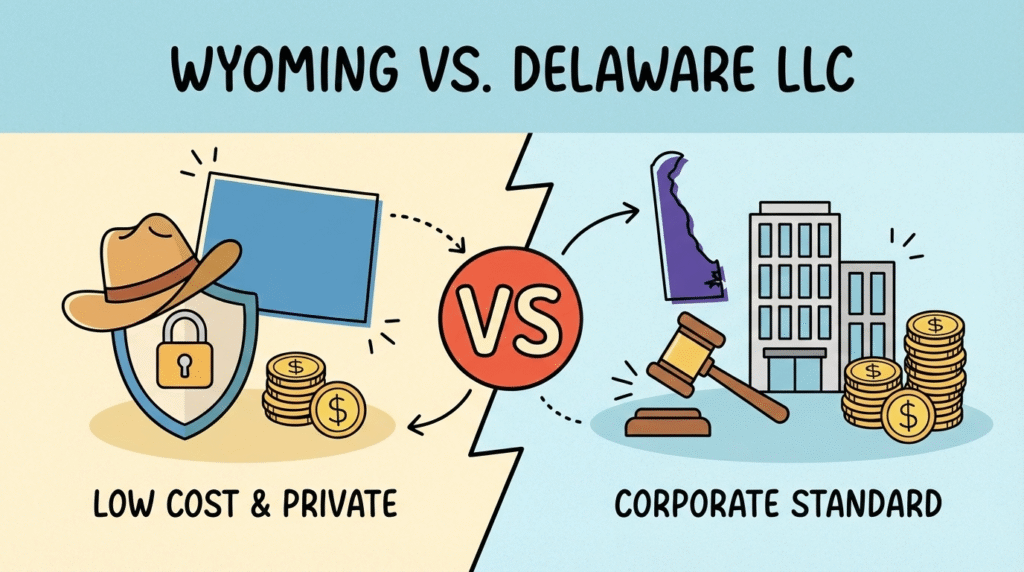
I recently caught up with a founder who was set on registering her digital agency in Delaware. When I asked why, her answer was simple: “It’s what everyone does.” After we walked through her three-year plan, it turned out she was about to take on administrative costs and legal layers that her current model didn’t actually need. Picking a state for your LLC isn’t a one-size-fits-all choice anymore. In 2026, with state filing systems going digital and federal reporting—like the Corporate Transparency Act—getting more specific, the right choice depends on your funding path, your need for privacy, and where you actually sit at your desk. Let’s look at the actual numbers and the logic behind both states so you can make a call based on what fits your business today. In this article 2026 Maintenance and Compliance Overview To see the long-term impact on your bank account, you need to look at the recurring costs. While starting an LLC costs roughly the same in both states, the yearly bills look quite different. Category Wyoming LLC Delaware LLC Yearly Maintenance Fee $60 (Annual Report) $300 (Franchise Tax) Late Filing Penalty No late fee; but non-filing = dissolution. $200 Flat Fee + 1.5% Interest State Income Tax 0% 0% (unless the LLC has Delaware-source income) Setup Cost (State Fee) $100 $110 Privacy Rank (2026) Top Tier Mid Tier 1. Why Delaware is the “Legal Standard” Delaware’s biggest selling point isn’t its tax rate; it’s the legal system. The state is home to the Court of Chancery, a specialized court that only hears business disputes. Because judges (not juries) decide these cases, the outcomes are incredibly predictable. This predictability is exactly why over 65% of Fortune 500 companies are incorporated in Delaware. If you plan to raise venture capital or offer stock options to employees, most investors will expect a Delaware entity. It’s the “legal language” they already speak, which can save you a lot of time during a fundraising round. 2. The Annual Cost of Doing Business in Delaware While the legal benefits are a major draw, they come with a fixed price tag. Every Delaware LLC pays a $300 Annual Franchise Tax. Think of this as a mandatory subscription fee to keep your company active. In 2026, the state remains very strict about its June 1st deadline. If you’re even a day late, a $200 penalty hits your account. Over a five-year stretch, you’re looking at a minimum of $1,500 in state taxes just to exist in Delaware. For a bootstrapped startup, that is capital that could have been spent on your first marketing campaign or hardware. 3. The Wyoming Advantage: Privacy and Lower Overhead If you aren’t chasing Wall Street investors, Wyoming is often the smarter move for lean operations. They don’t have a franchise tax; they just have a $60 Annual Report Fee. Beyond the savings, Wyoming is famous for its privacy. In 2026, data security is a top concern for founders. Wyoming allows you to keep the names of your LLC’s members and managers off the public record. In a world where your personal info is often just a Google search away, this “anonymity by default” is a huge plus for many business owners. 4. Asset Protection: The “Charging Order” Shield One technical detail you’ll appreciate is Wyoming’s Charging Order Protection. This is a legal shield that prevents a personal creditor from seizing your business assets or forcing you to sell the company to pay a personal debt. Wyoming was the first state to give this protection to single-member LLCs, and their laws are still among the strongest in the country. Delaware offers great protection too, but Wyoming’s statutes are often preferred by legal experts for smaller, closely-held businesses that want to keep their professional and personal lives strictly separate. 5. Registering “Away from Home”: The Foreign Qualification Rule This is the part where many founders accidentally double their workload. If you live in a state like California or New York but register your LLC in Wyoming to save on taxes, you usually have to register as a “Foreign LLC” in your home state anyway. This process often involves: Industry data suggests that roughly 30% of founders who incorporate out-of-state eventually pay significantly more in multi-state compliance fees than they would have by simply incorporating in their home state. Unless you have a specific legal or privacy reason to be in Wyoming or Delaware, incorporating where you live is often the path of least resistance. Which State Fits Your Business? Deciding on a state usually comes down to your “exit strategy” and where you actually spend your time. Choosing Your Foundation Don’t pick a state just because it’s “what everyone does”. Whether you need Delaware’s legal prestige for future investors or Wyoming’s low-cost privacy, the real win is in keeping your personal and business records strictly separate. By staying organized from day one, you ensure your legal foundation actually protects your assets instead of just adding to your administrative workload. About the Author Isabella Jones started her career at Deloitte, where she worked on tax compliance for some of the country’s fastest-growing companies. She later joined Fynlo as Senior Financial Strategist, bringing that experience to freelancers and small business owners who need practical financial guidance without the corporate complexity. With an Accounting degree from Villanova University, Isabella focuses on making financial planning easier to understand and apply in day-to-day business. She works closely with freelancers and small businesses on areas like taxes, cash flow, and building more stable financial systems.
Freelancing in 2026: Your Guide to Thriving in the Gig Economy
The pandemic flipped the traditional 9-to-5 workday on its head, and freelancing is here to stay. More and more people are ditching the office for the flexibility and freedom of working from home. This article dives into the freelancing trend, explores the ups and downs, and gives you actionable tips to succeed. Want to know if freelancing is right for you? In this article, we’ll explore the state of freelancing in the U.S., analyze the benefits and challenges, and share practical tips to help you make informed decisions. Table of Contents The US Freelance Scene: A Quick Look Service Offered Hourly Rate Range Equivalent Annual Salary Web Development $50-60 $69,000 Mobile Development $55-65 $75,000 Graphic Design $40-45 $53,000 Content Editor $25-35 $38,000 Copywriter $30-40 $44,000 Programmer $60-70 $81,000 Online Marketing/SEO $40-50 $56,000 CRM Management $50-60 $69,000 Data Analysis $55-65 $75,000 While these averages provide a baseline, certain niches command significantly more. Explore our list of the 15 highest paying freelance jobs to see which industries are leading the market in 2026. The Freelance Challenge Freelancing offers incredible freedom, but it’s not always sunshine and rainbows. Here are some of the hurdles you’ll likely encounter: The Freelance Opportunity Despite the challenges, freelancing offers incredible potential. Here are some of the exciting opportunities available: Tips for Freelance Success Useful Resources for Freelancers About the Author Isabella Jones started her career at Deloitte, where she worked on tax compliance for some of the country’s fastest-growing companies. She later joined Fynlo as Senior Financial Strategist, bringing that experience to freelancers and small business owners who need practical financial guidance without the corporate complexity. With an Accounting degree from Villanova University, Isabella focuses on making financial planning easier to understand and apply in day-to-day business. She works closely with freelancers and small businesses on areas like taxes, cash flow, and building more stable financial systems.
8 Free Business Reporting Templates for Small Businesses
Trying to get a clearer picture of how your small business is doing can feel like a big task, especially when you’re focused on the day-to-day. You might wonder about profitability, cash flow, or customer trends without wanting to dive into complicated systems. If that sounds familiar, this post will offer some helpful starting points. We’ve gathered 8 free business report templates that can provide valuable insights, and to make things a little easier, we’ve also found links to free, straightforward templates that you can explore. Most of them are compatible with Microsoft Excel and Google Sheets, allowing you to easily customize them to fit your specific business needs. Let’s see how these templates can help you move from guesswork to making informed decisions, all without any cost. Table of Contents 1. Profit and Loss (P&L) Statement P&L statement summarizes revenue, costs, and profits over a period (monthly, yearly), revealing your business’s profitability. It identifies cost-saving opportunities or growth potential, helping you make data-driven decisions to boost your bottom line. Free Templates: Smartsheet IntuitConta 2. Monthly Sales Report A monthly sales report tracks sales performance, including volume and revenue, on a monthly basis. It highlights trends, informs marketing strategies, and assists in optimizing pricing or promotions, ensuring revenue maximization with minimal effort. Free Templates: HubSpotDocsAutomator Unito 3. Inventory Report An inventory report tracks stock levels, costs, and turnover for products or supplies. It prevents overstocking or shortages, reduces waste, and optimizes purchasing, ensuring efficient operations and cost control for retail or service businesses. Free Templates: Template.net Smartsheet ClickUp 4. Marketing Campaign Report A marketing campaign report evaluates marketing efforts (e.g., social media, email) through KPIs like engagement or conversions. It optimizes marketing spend, crucial for small budgets, and refines campaigns to attract more customers. Free Templates: Smartsheet Semrush Goodocs 5. Balance Sheet Balance sheet shows your business’s financial position by listing assets (what you own, like cash), liabilities (what you owe, like loans), and equity (your net worth) at a specific time. It helps assess financial health, secure loans, or plan investments, giving clarity on stability without complex accounting. Free Templates: SCORE Association Agriculture and Horticulture Development Board (AHDB) Compeer Financial 6. Annual Business Performance Report An annual business performance report offers a comprehensive overview of your company’s yearly performance, encompassing financial results, operational achievements, and strategic milestones. It’s invaluable for stakeholders and aids in setting future goals. Free Templates: Adobe Smartsheet ClickUp 7. Project Status Report A project status report monitors project progress, timelines, and resource allocation. It keeps stakeholders informed about developments, milestones achieved, and any issues encountered, ensuring transparency and accountability. Free Templates: ZapierSmartsheetAtlassian 8. Employee Performance Report An employee performance report evaluates employee productivity and sets performance goals. It assists in conducting regular performance reviews, setting objectives, and providing feedback, fostering employee development and satisfaction. Free Templates: WPS TemplateTeamflectSmartsheet Final Thoughts Managing business reports doesn’t have to be overwhelming. With these eight free templates, you can efficiently track finances, sales, and projects, allowing you to focus on growing your business. Start by selecting a template that fits your needs, customize it to reflect your brand, and update it regularly. Sharing these reports with stakeholders ensures transparency and keeps everyone aligned. If you’re looking to further simplify your reporting, consider exploring tools designed to enhance financial tracking and support your business’s success. Fynlo offers an all-in-one accounting platform that combines income tracking, budgeting, and reporting in one place. It’s free, making it an excellent value for small businesses and freelancers. [Sign Up for FREE]
5 High-Value Service Roles Shaping the AI Economy
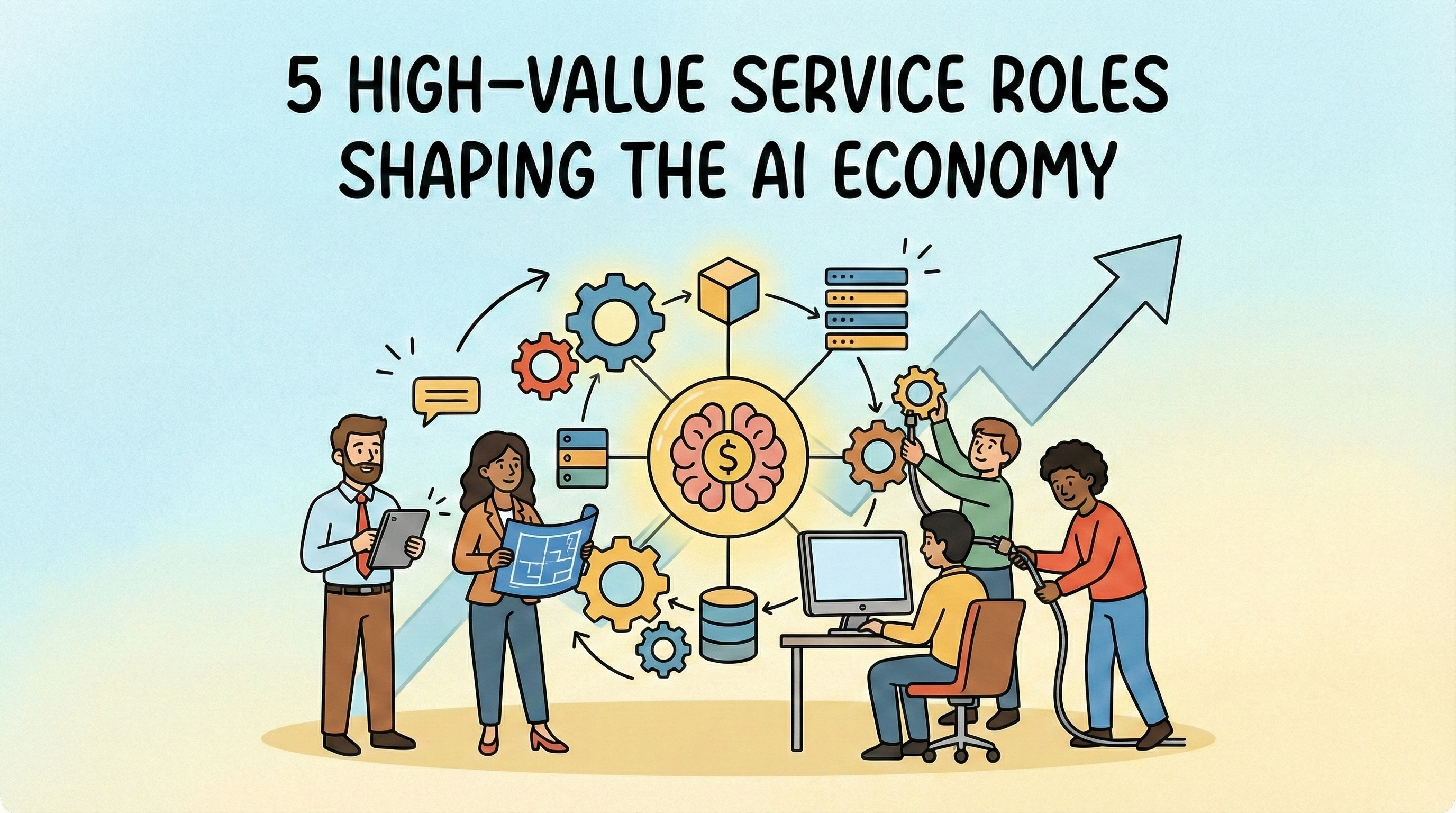
It feels like every time we check the news, there is a new story about AI coming for everyone’s job. While those headlines can be a bit overwhelming, the real story is actually much more positive for small business owners. AI isn’t just about robots replacing people. It is opening up entirely new ways for us to work as specialists. According to McKinsey’s report, generative AI could add up to $4.4 trillion to the global economy every year. A huge chunk of that value isn’t going to the tech giants. Instead, it is going to specialized service providers who know how to make this technology work for real-world businesses. We are seeing a shift where value is moving away from basic data entry and toward the “brains” behind the systems. For entrepreneurs and small firms, this is the perfect time to pivot into niches that didn’t even have a name a few years ago. Here are five of the fastest-growing roles emerging in this new economy. 1. The AI Workflow Automation Architect Gartner predicts that by 2026, over 80% of enterprises will be using generative AI to automate their workflows. That sounds great on paper, but in reality, there is a massive “integration gap.” Most businesses have plenty of tools, but they are often stuck in a tangle of software where nothing talks to each other correctly. Automation Architects are the people who fix this mess. They don’t just use AI; they build autonomous systems that handle the boring parts of a job. Imagine a setup where a new lead arrives and the AI automatically researches the prospect’s background, drafts a personalized intro, and updates your records. This happens in the background while the business owner is actually focused on the creative work they love. Because this work is so results-driven (you are literally giving a founder their time back), these architects can command premium fees. They usually run very lean operations and rely on the same automation they sell. For them, manual bookkeeping isn’t just a chore; it is a total contradiction to their business model. 2. The Fractional Chief AI Officer (CAIO) Every small business owner knows they should be using AI, but most are simply too busy running their daily operations to figure it out. They can’t afford a full-time executive with a massive salary, yet they are worried about falling behind. The World Economic Forum’s Future of Jobs Report 2025 actually highlights that while AI will displace some roles, it is expected to create 170 million new ones globally, leading to a net gain of 78 million jobs by 2030. Many of these are high-level, specialized roles that support business transformation. A Fractional CAIO is essentially a “part-time expert for hire.” They might jump in for a few hours a month to audit a company’s processes and provide a clear roadmap. They help the team decide which tools are worth the investment and which are just hype. It is a high-level role that lets the CEO focus on growth while the CAIO handles the tech strategy. Managing a portfolio of high-value clients like this requires extreme organization. When you are juggling five different companies, you cannot afford a messy back office. These consultants need a clear, professional view of their cash flow across all their retainers so they can stay focused on the strategy their clients are paying for. 3. The Niche Data Fine-Tuner General AI can be a bit of a “jack-of-all-trades, master of none.” A law firm doesn’t need a chatbot that knows how to write a poem; they need a system that understands specific regional real estate laws. This has created a boom for Fine-Tuners. These are consultants who take generic models and “teach” them using industry-specific data. This is meticulous, high-value work. You might spend weeks cleaning up a client’s proprietary contracts or internal logs to ensure the AI becomes an expert in that one specific field. This role bridges the gap between raw data and actually useful intelligence. Since these projects often involve heavy technical costs and irregular billing, such as a large deposit followed by a success fee, tracking project profitability is vital. If you don’t keep a close eye on your expenses as they happen, those big margins can disappear faster than you might think. 4. The “Hallucination Hunter” (AI Risk Auditor) With new regulations like the EU AI Act rolling out, companies are now legally responsible for what their AI says. If a chatbot gives bad financial advice or leaks private data, the business is on the hook. AI Auditors are the “human safety net.” They stress-test AI systems to find bias, errors, or privacy leaks before they go live. It is a role built entirely on trust and accuracy. In high-stakes worlds like healthcare or finance, these auditors are the reason companies feel safe hitting “publish” on a new tool. If your entire brand is built on being a rigorous auditor, your own internal records have to be spotless. These professionals need an audit-ready paper trail for their own finances. Using tools that automate record-keeping doesn’t just save them time; it ensures they are practicing the same level of accuracy they promise their clients. 5. The Human-Centric Experience Designer We’ve all had that frustrating experience of getting stuck in a chatbot loop where you just want to talk to a real person. Businesses are starting to realize that total automation often leads to zero customer satisfaction. Gartner found that 64% of customers still want a human touch for complex problems. Experience Designers are the bridge. They design the “hand-off,” which is the exact moment where the AI steps back and a human steps in. They ensure that automation feels like a help rather than a barrier. You could think of them as the Empathy Engineers of the tech world. These designers often work with a revolving door of creative contractors like writers, developers, and researchers. That means a lot of moving parts in their bank account. Keeping those project budgets and contractor payments organized is the only way they can stay in their “creative zone” without getting bogged down in spreadsheets. Future-Proofing Your Back Office The roles we are seeing emerge all have one thing in common: they are lean, fast-moving, and highly specialized. These entrepreneurs are
Future-Proof Your Business: Essential New Business Trends for 2026
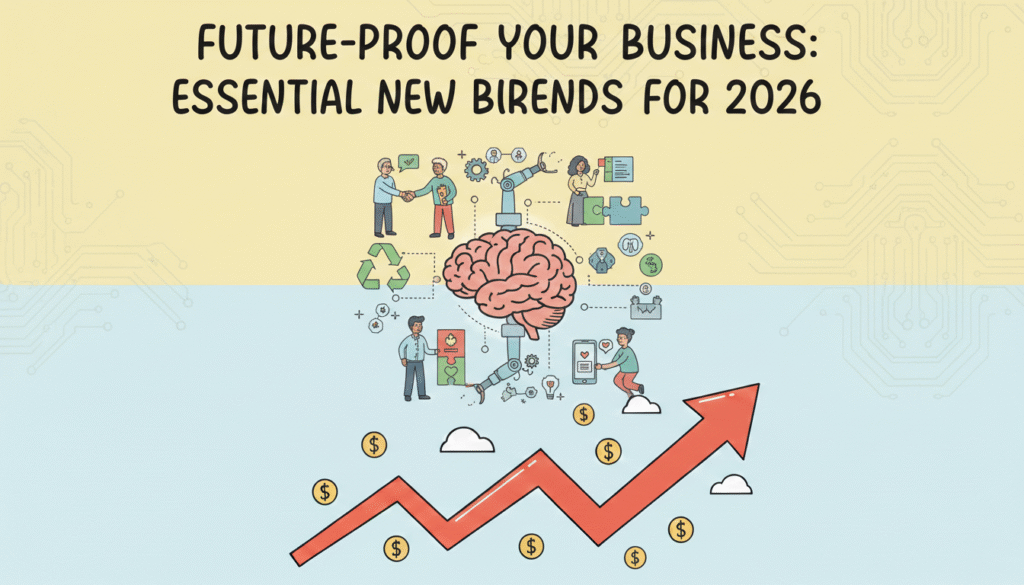
Stepping into 2026 feels like a strategic reset. For those of us running businesses, the focus has shifted toward building systems that are resilient enough to let us lead with vision instead of just reacting to the latest fire in our inbox. We are looking for Operational Intelligence: a state of flow where the back office supports growth rather than hindering it. The numbers suggest a massive shift is underway. With US e-commerce revenue expected to climb by nearly $500 billion by 2029, the opportunities are vast, but the complexity has followed suit. While 80% of organizations agree that inadequate or outdated technology is holding back innovation, success requires looking at how these investments empower our teams and protect our mental bandwidth. This guide explores five essential shifts in technology, workplace culture, and consumer behavior that are defining the market this year. By understanding these trends, you can transition from manual labor to a model where your business is as durable as the products or services it sells. In this article 1. Synergistic AI Collaboration We have officially moved past the experimentation phase of AI. It is no longer a shiny new object to be feared or idolized; it has become a fundamental utility. By the end of 2026, most successful businesses will have moved away from basic chatbots toward true Workflow Orchestration. This involves using AI for the heavy lifting of data processing and research while a human partner provides the final 10% of nuance and accountability. Consider the common struggle of market research. A real estate agency might use a tool like Clay to scan thousands of property listings for very specific investment criteria. This technology allows them to instantly cross-reference public tax records, zoning changes, and owner locations to find distressed opportunities that basic filters often miss. In the past, a founder might have spent ten hours a week on this. Now, the AI provides a refined shortlist. An expert strategist then reviews that list to ensure the fit feels right before any outreach happens. This human-in-the-loop model is why McKinsey suggests that AI could technically automate about 57% of work hours. The goal is to move away from manual labor toward a model where humans act as the ultimate quality control for intelligent systems. 2. Modern Skills-Based Hiring The way we build our teams is undergoing its most significant transformation in decades. The old debate over office space has matured into a more sophisticated discussion about results. We are seeing the rise of the Results-Only model, where talent is measured by what they can actually produce rather than where they went to school or how long they sit at a desk. Skills-based hiring is becoming the new gold standard. 90% of companies now report that they make much better hires when they prioritize specific, verifiable competencies over traditional four-year degrees. Technology has made this easier to manage for businesses of all sizes. Platforms like Deel or Gusto allow us to handle global payroll for hybrid teams, while tools like Loom or Slack facilitate high-quality communication that does not require everyone to be in the same time zone. We are seeing law firms and tech giants move away from traditional requirements to find specialized talent that can actually move the needle on day one. 3. Strategic Circular Operations In 2026, sustainability has moved from the marketing department into the heart of operations. The Circular Economy model (where we design waste out of our systems and keep materials in use longer) is now a competitive requirement. Consumers are increasingly skeptical of greenwashing and are looking for brands that offer radical transparency. Research shows that 81% of consumers now trust brands that are open about their operations and even their challenges. Some businesses use Notion to build public-facing transparency portals, while others use Watershed to track their actual environmental impact. This transparency builds a layer of trust that traditional advertising simply cannot buy. Beyond the ethical benefits, this trend is a survival tactic. Circularity protects you against geopolitical shocks in the supply chain. When your business model includes refurbishment or reuse, you become far less dependent on the volatile global markets for raw materials. It is about building a business that is as durable as the products it sells. 4. Cultivating Gen Z Loyalty Gen Z and Alpha consumers are rewriting the rules of brand loyalty. They expect a relationship that feels helpful and human-led rather than purely algorithmic. For these generations, community is the primary currency. The financial impact of this connection is significant, as some organizations have found that active community members generate five times more revenue compared to those who are less engaged. The tools for this have become incredibly accessible. Many brands use Klaviyo for hyper-personalized, behavior-based emails that feel like a conversation rather than a broadcast. Others are moving their most loyal fans into owned communities on platforms like Circle or Substack. With attention spans now averaging just over eight seconds, the format matters as much as the message. Short-form, vertical video is now the primary way three-quarters of all video content is consumed. It is a fast-paced environment, but those who lead with authenticity and provide value quickly are seeing the highest conversion rates. 5. Scaling through Seamless Integration Moving toward these trends is rarely a straight line. It is easy to feel a sense of app fatigue when you have too many tools that do not talk to each other. This often results in technical debt, where the founder ends up spending more time managing software than leading people. The way to handle this is by adopting an integration-first policy. We should only bring in tools that have a robust way to sync with our existing systems, usually through a platform like Zapier. This keeps our data in one place and prevents the scattered feeling of having five different logins for one project. Another common friction point is the quality gap that comes with over-automation. When we rely too much on AI, our brand can start to feel cold or generic. The solution is to build a human guardrail. For any customer-facing output or high-stakes financial task, there should be a rule that an expert performs a final sanity check. Technology provides the speed, but people provide the
10 Absurdly Clever Tax Deductions That Got Approved

The IRS has seen some pretty wild tax deduction attempts over the years, and some of them actually worked! Check out our list of the 10 craziest tax deductions you have ever heard of! And if you’re a freelancer, don’t miss our other blog: “The Freelancer’s Guide to Tax Deductions.” Table of Contents 10 Wild Tax Deductions Legit Deduction or Wishful Thinking? Let’s Find Out! Now that you’ve seen some of the most surprising tax deductions that actually got approved, it’s time to test your own deduction savvy. Below are a few expenses. For each, one scenario is deductible, and the other isn’t. Can you determine which is which? Cat FoodScenario 1: Junkyard owner buys food for rat-patrolling felinesScenario 2: Snack for a pet cat Guard DogScenario 1: Business guard dog expensesScenario 2: Pet dog expenses TutorsScenario 1: Specialized tutor for a child with a diagnosed learning disability, as recommended by their doctorScenario 2: Reading tutor for general academic improvement African SafariScenario 1: Dairy business owners on a wild animal-focused tripScenario 2: Family vacation Private AirplaneScenario 1: Condo owners flying themselves to check on their rental propertyScenario 2: Vegas private jet ride Personal TrainerScenario 1: Trainer for a professional athleteScenario 2: Gym-goer getting ready for summer Clown CostumesScenario 1: Professional clown costumeScenario 2: Halloween costume Sun ProtectionScenario 1: Sunscreen for carpenters/gardenersScenario 2: Sunscreen for beach trip Absolutely right! Scenario 1 is deductible, but Scenario 2 isn’t. Many of these cases are based on real stories, proving that the same expense can be approved or denied depending on the context and whether it meets the IRS rule of ‘ordinary and necessary.’ “Ordinary” means it’s common in your line of work, and “necessary” means it’s helpful and appropriate for your business—not just something you want. Tax deductions come with rules. For example, guard dog expenses are only deductible for the time the dog is actually working, and medical deductions are subject to limitations like the 7.5% AGI rule. Because tax laws are complex, it’s always best to consult a professional when in doubt. Itemized Deduction vs. Standard Deduction These unusual (and sometimes surprisingly successful) deductions highlight the importance of understanding the rules and keeping meticulous records. Navigating the tax code can be tricky, and knowing what qualifies as a legitimate deduction is crucial for any taxpayer. This is especially crucial when deciding whether to itemize or take the standard deduction. The TCJA changed the tax landscape, making the standard deduction the better option for most taxpayers. But if you have significant deductible expenses, itemizing can still work in your favor. The good news? The old deduction limit is gone, so you can claim the full amount if eligible. That said, with fewer people itemizing, the IRS is paying closer attention to those who do. If you’re planning to itemize, make sure your records are solid. About the Author Isabella Jones started her career at Deloitte, where she worked on tax compliance for some of the country’s fastest-growing companies. She later joined Fynlo as Senior Financial Strategist, bringing that experience to freelancers and small business owners who need practical financial guidance without the corporate complexity. With an Accounting degree from Villanova University, Isabella focuses on making financial planning easier to understand and apply in day-to-day business. She works closely with freelancers and small businesses on areas like taxes, cash flow, and building more stable financial systems.
Top 5 Reasons Why Small Businesses Fail and How to Avoid Them
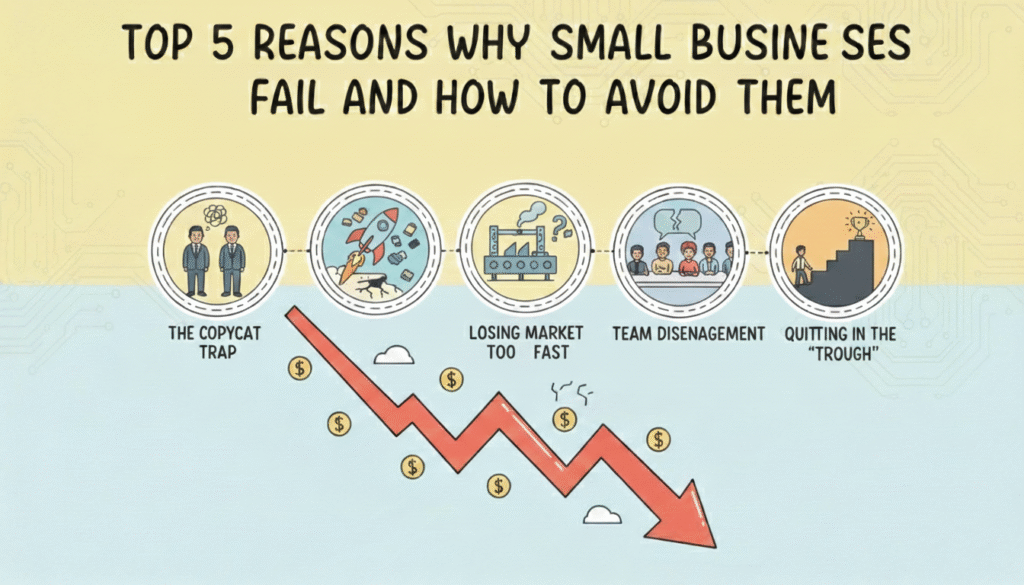
Starting a business is easily one of the most rewarding journeys you’ll ever embark on. There’s nothing quite like the rush of that first sale or the pride of seeing your logo on a real office door. Yet, for all the excitement, it’s also incredibly lonely and, at times, brutal. As we look toward 2026, the entrepreneurial spirit is louder than ever, yet the quiet reality remains: many small businesses struggle to stay afloat. According to 2024 data from the U.S. Bureau of Labor Statistics, nearly 50% of businesses fail within their first five years. We don’t believe failure is a foregone conclusion. Usually, it isn’t one giant catastrophe that sinks the ship; it’s a series of small, quiet cracks in the hull that no one noticed or wanted to see. In our experience watching what separates the survivors from the statistics, success often comes down to navigating a few specific, hidden hurdles. Here are the five real reasons businesses stall, and how you can navigate around them to build something that lasts. In this article 1. The Copycat Trap It starts with a seductive, familiar thought: “They’re making a killing, and I know I can do it better at a lower price.” It’s a common mindset that feels like a shortcut to success. You see a local leader or a big industry player and try to mirror their every move while undercutting their costs. This is the “Copycat Model,” and while it feels like a safe bet, it’s actually a trap. When you copy, you’re competing against someone who has more history, deeper pockets, and an established reputation. If your only way to win is to be “slightly cheaper,” you aren’t building a business; you’re operating on razor-thin margins that leave no room for error or future growth. When your only edge is price, any increase in your costs or a counter-move from a larger competitor can instantly wipe out your remaining profit. As Peter Thiel famously wrote in Zero to One: “The next Bill Gates will not build an operating system. The next Larry Page or Sergey Brin won’t make a search engine.” If you aren’t bringing something uniquely you to the table, you’re just holding a spot until someone with more capital decides to take it. You don’t need to reinvent the wheel, but you do need to give people a reason to choose yours. How to stay ahead: 2. Scaling Too Fast We’ve all felt that “first milestone” adrenaline. You’ve got your first big clients, you’ve hired a Virtual Assistant, and for the first time, the dream feels real. This can be the danger zone. It’s when founders get impatient and start pouring money into massive hiring sprees or new markets before their core engine is actually stable. The numbers are staggering: 74% of high-growth startups fail because they scaled prematurely, according to the Startup Genome Report. Take the story of Bench, the bookkeeping giant. They raised over $100 million, had a massive team, and were the darlings of the tech world. But despite the funding and the hype, the company eventually had to shut down its core operations. They scaled their burn rate before they mastered their efficiency. Scaling a broken process doesn’t make you bigger; it just makes your mistakes louder and much more expensive. How to stay ahead: 3. Losing Market Flexibility There is a thin, blurry line between being “persistent” and being “stubborn.” We often fall in love with our original vision, treating it like a sacred text rather than a living document. Take Kodak as a prime example. In 1975, one of their own engineers invented the first digital camera. But the leadership was so protective of their film business that they buried the tech. They clung to the past while the world moved on. This reluctance eventually led the once-dominant giant to file for bankruptcy in 2012, which serves as a powerful lesson that past success is no guarantee of future survival. Today, failing to pivot is just as risky. According to a report by CB Insights, 42% of startups fail because there is simply no market need, often because the founders were so busy building a “perfect” product that they forgot to check if anyone actually wanted it. If you stop listening to your customers because you’re too busy “staying true to your vision,” it’s easy for the path forward to get a bit blurry. How to stay ahead: 4. Team Disengagement A business isn’t a machine; it’s a collection of people. If the people lose their spark, the engine stalls. Most of us recognize the signs: the “silent office” where everyone is just going through the motions. Gallup’s research shows that engaged teams are 21% more profitable, yet so many founders treat culture as an afterthought. High turnover isn’t just an HR headache; it’s a massive financial leak. It costs an average of $6,000 to replace a single employee, but the loss of trust and institutional knowledge is even higher. When your team feels like they are just “clocking in,” they won’t have your back when things get difficult. How to stay ahead: 5. Quitting in the “Trough” Every entrepreneur eventually finds themselves in the “Trough of Sorrow.” It’s that long, quiet stretch after the initial excitement has worn off, but the big results haven’t arrived yet. It’s the 2 AM nights spent wondering if you’ve made a huge mistake. 53% of founders reported feeling burned out. That exhaustion often leads to “Premature Capitulation”—closing a perfectly healthy business simply because the founder is spent. There’s a nuance here: you should be flexible with your method (as we saw in Point 3), but you must be relentless with your mission. Success usually happens right after you’ve considered walking away. Thomas Edison said it best: “Many of life’s failures are people who did not realize how close they were to success when they gave up.” How to stay ahead: The Path Forward: Success is a Series of Choices Building a business that lasts isn’t about luck, and it certainly isn’t about having a perfect, mistake-free first year. As we have seen, the “cracks in the hull” that sink most businesses are usually avoidable with a bit of foresight and a lot of honesty. Success comes down to your willingness to stay flexible, your commitment to your team, and your ability to look past the “copycat” shortcuts. It is about building systems that support your growth rather than just chasing the growth itself. If you can navigate the “Trough of Sorrow” with a clear mission and a solid financial foundation, you are already ahead of the statistics.
Say Goodbye to Messy Word Docs: 5 Free Ways to Create Professional Invoices
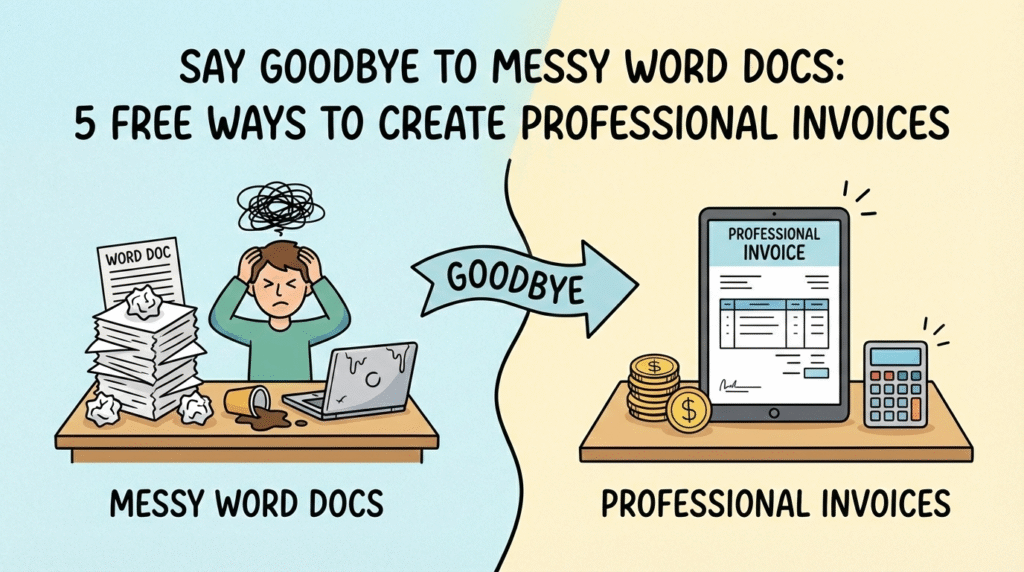
You’ve just exported the final file, closed the 17 browser tabs you’ve had open for a week, and hit “Send” on the final deliverable. You lean back in your chair, take a deep breath, and feel the weight of the project lift off your shoulders. But before you can fully celebrate, there is one last administrative hurdle: asking for the money. For many of us, this part feels awkward. We rush through it, typing a few lines into a document and hoping it looks “official enough.” But the reality is, your invoice is the final handshake of your project. It’s the last impression you leave. Sending a polished, branded invoice does more than just look good—it changes the power dynamic. Data suggests that you are 3x more likely to get paid simply by adding a company logo to your invoice. Psychologically, a sharp invoice signals, “I take my business seriously, and I expect you to do the same.” Here are 5 completely free ways to upgrade your invoicing today, ranked from the simplest quick-fix to fully automated systems. In this article 1. Free Online Invoice Generators Sometimes you just need to send one invoice, right now. You don’t want to sign up for a new platform or remember another password; you just need a PDF that doesn’t look like it was made in 1999. Quick Tip: Look for generators that allow you to change the currency symbol if you are working with international clients. Sites like Invoice Generator or Shopify are great places to start. 2. Google Docs & Sheets Templates If you are just starting out and want total control over every pixel, the Google Workspace gallery is likely your best friend. It is accessible, cloud-based, and you likely already use it for your actual work. Quick Tip: Always export as a PDF before sending. Sending an editable Google Doc looks unprofessional and allows clients to accidentally (or intentionally) change the figures. 3. Canva Templates Who says invoices have to be boring spreadsheets? If you are in a creative field—graphic design, social media management, or photography—your invoice is another piece of your portfolio. It should look as good as your work. Quick Tip: Create a “Master Template” in Canva so you don’t have to re-design it every time. Just duplicate the page and update the line items. 4. Stripe or PayPal Invoicing If your priority is getting money into your bank account fast, you might want to skip the PDF attachment entirely and send a digital invoice directly through your payment processor. Quick Tip: Enable “recurring invoices” if you have clients on a monthly retainer. The system will bill them automatically without you lifting a finger. 5. Dedicated Invoicing Software (Wave, Zoho, Fynlo) Eventually, manual templates and fees become a bottleneck. If you are sending more than 5 invoices a month, you need a system that automates your entire billing workflow—remembering your clients, numbering your invoices, and chasing payments for you. Quick Tip: With Fynlo’s Forever Free plan, you get a professional dashboard that tracks invoice views. This means a client can never use the excuse “I didn’t get the email” again, because you’ll know exactly when they opened it. Make Getting Paid the Easy Part Professionalism doesn’t have to cost money, but looking amateur will cost you opportunities. As your workload grows, tools that automate invoicing, reminders, and tracking can make a noticeable difference. Exploring a dedicated invoicing platform like Fynlo is a simple next step if you want fewer follow-ups and more predictable payments. Book a free demo to see how Fynlo might fit into your day-to-day.
Fund Accounting for Nonprofits: A 2026 Guide to Grant Compliance and Audit Protection
If you have successfully scaled your organization’s mission, you already know that landing a major grant is only half the battle. The real work begins when that money hits your bank account and the clock starts ticking on compliance. In 2026, donors and grantors are demanding more than just impact stories. They want surgical precision in how every dollar is tracked and spent. Most growing nonprofits reach a point where a single bank account is no longer enough. If you are still using one general ledger to manage three different restricted grants, you increase the risk of reporting inconsistencies that can attract additional scrutiny from regulators or auditors. Fund accounting provides the structural firewall you need to keep your tax-exempt status safe. Under U.S. nonprofit accounting standards (FASB ASC 958), organizations must clearly report how funds with donor restrictions are used. Implementing a proper fund accounting system helps ensure that reporting aligns with requirements found in filings such as IRS Form 990 and grantor financial reports. In this Article The Core Difference: Why Standard Bookkeeping Fails Nonprofits Standard accounting is built to show how much profit a company made. Fund accounting exists to prove accountability. Since your goal is mission delivery rather than the bottom line, your financial system must treat different revenue sources as separate entities. When a donor gives $10,000 specifically for a youth scholarship, that money cannot pay for office rent. In a standard setup, those dollars get buried in your general cash balance. With fund accounting, that $10,000 stays in its own self-balancing universe. This level of separation is what allows you to look a major foundation in the eye and prove exactly where their money went. This is why fund accounting is widely used by nonprofits managing multiple grants, donor-restricted gifts, or government funding. It creates a transparent structure that simplifies donor reporting and grant compliance. Beyond keeping your finances in order, fund accounting empowers your nonprofit to earn donor trust, attract funding, and advance your mission. By keeping finances clear and leveraging data, you can take your nonprofit to new heights. Categorizing Your Assets: The Three Tiers of Funds To keep your records clean, you must categorize every dollar based on the specific legal “strings” attached to it. Here is how that looks in practice. Modern nonprofit reporting standards refer to these as “Net Assets With Donor Restrictions” and “Net Assets Without Donor Restrictions.” However, many nonprofits and grant agreements still use the traditional terms “unrestricted,” “temporarily restricted,” and “permanently restricted.” Understanding both sets of terms helps nonprofit leaders interpret financial reports, grant agreements, and accounting guidance more accurately. Unrestricted Funds In modern nonprofit financial statements, unrestricted funds are reported as “Net Assets Without Donor Restrictions.” These are your most flexible assets, usually coming from general individual donations or fundraising events. You can use these to pay for salaries, utilities, or emergency repairs. Example: A $50 gift from a monthly donor that you use to pay the office internet bill. Temporarily Restricted Funds What were historically called “temporarily restricted funds” are now reported under “Net Assets With Donor Restrictions” when the restriction relates to time or purpose. These funds are earmarked for a specific timeframe or a specific project. Once the goal is met or the date passes, the restriction is “released” and the money moves into your unrestricted pool for general use. Example: A $25,000 government grant for a summer literacy program. These funds can only be spent on tutors and books through August; any leftover balance typically becomes flexible cash unless the contract requires its return. Permanently Restricted Funds Permanently restricted funds are also reported under “Net Assets With Donor Restrictions,” but they typically involve endowments where the principal must remain intact. These are typically endowments where the principal amount must remain untouched forever. The nonprofit is usually only permitted to spend the interest or investment income generated by that principal. Example: A $100,000 endowment established by a founder. You keep the $100,000 in a high-yield account and use the $4,500 in annual interest to fund a yearly community award. Compliance Risks: Mistakes That Trigger IRS Reviews The most frequent error we see is inconsistent allocation. If you change how you split overhead costs like rent or insurance halfway through the fiscal year, your reports will look unreliable. Professional fund accounting requires a fixed, defensible method for shared costs. Another major risk is delayed tracking. Waiting until the end of a quarter to log grant expenses makes errors almost inevitable. By the time you realize a restricted fund was used for a general expense, the damage is already done. For organizations receiving federal or large foundation grants, accurate allocation and documentation are particularly important because grantors often review financial reports alongside your IRS Form 990 or audited financial statements. Maintaining daily records is the only way to move your organization into a formal compliance category that carries a lower audit risk. Step-by-Step: Moving to a Formal Fund Structure Setting up a formal fund structure is a deliberate process. It involves more than just opening a new bank account. It requires reconfiguring your entire bookkeeping logic to prioritize transparency. 1. Conduct a Revenue InventoryStart by reviewing every grant agreement and major donation letter from the past year. You need to identify exactly which funds have a purpose restriction, such as building a new community center, versus a time restriction, like funds earmarked specifically for the 2026 fiscal year. 2. Update Your Chart of Accounts with DimensionsInstead of a flat list of expenses, you must transition to a multi-dimensional system. This means every transaction is tagged with a fund code and a functional code like Program, Management, or Fundraising. This setup allows your software to track a single invoice across multiple grants simultaneously, removing the need for side-spreadsheets that often lead to errors. 3. Define a Consistent Cost Allocation MethodEstablish a documented method for allocating shared costs such as rent, utilities, software subscriptions, or insurance across programs and grants. Many nonprofits allocate based on staff hours, square footage, or program budgets. Consistency is critical because auditors and grantors expect to see the same allocation methodology applied throughout the fiscal year. 4. Implement Grant-Level Expense TrackingEach grant or restricted