
8 Free QuickBooks Alternatives for 2026: Maintaining Financial Clarity Without the Subscription
Running a micro-business or a growing freelance operation means constantly balancing costs against value. You know you need professional accounting software—you need reports, tax compliance, and clean books. Yet, paying a monthly subscription for QuickBooks or Xero when your income is still irregular can feel like an unnecessary burden. You’re looking for a free alternative, but the search can be overwhelming. There are dozens of tools out there, and finding one that is truly free and powerful enough for a real micro-business is a challenge. The right tool is a strategic investment; it saves you time and ensures you build the solid financial foundation you need for future growth. Here, we review the top genuinely free alternatives available today. We look at their core features, limitations, and help you find the best starting point for your micro-business. Note: Fynlo is developed and operated by our team. We aim to keep this review entirely fair and balanced, evaluating all platforms purely on their documented features, limitations, and operational suitability. In this Article 8 Platforms at a Glance Functional Limits of Each Free Plan These platforms all offer a permanently free tier, making them excellent starting points for sole traders and service-based freelancers. Software Primary Free Plan Name Ideal Use Case Key Free Limitations Wave Starter Plan North American Micro-Businesses Many automated bookkeeping features, including bank connection functionality, are reserved for the Pro plan; Receipt scanning is available as a paid add-on or included with Pro Zoho Books Free Plan High-Growth Small Teams Revenue limits (typically <$50k USD / £35k UK, depending on region and eligibility rules) QuickFile XS, S, and M UK Low-Volume Transactions Limited to 1,000 accounting entries (nominal ledger postings) per year Pandle Pandle Free Simplified Bookkeeping Automated bank feeds reserved for paid version Fynlo Forever Free Global / Multi-Currency Restricted to 20 monthly invoices Manager.io Desktop Edition Privacy & Offline Power Users No cloud access or mobile application Akaunting Standard (Self-Hosted) Tech-Savvy Owners Advanced modules and bank feeds carry extra costs ZipBooks Starter Tier Digital Service Providers Restricted to a single user and basic reporting Strengths and Constraints of Each Platform 1. Wave Wave has established itself as a leading choice for micro-businesses in the United States and Canada, reporting support for more than 5.9 million small business owners since 2009 (company data, accessed May 2026). It carried approximately a 4.4/5 rating on G2 as of May 2026 and remains popular due to its lack of caps on the number of customers, invoices, or transactions. The “Starter Plan” provides a full double-entry accounting system at no cost. However, it is important to note that as of 2026, Wave has moved several core features to its “Pro” tier. Many automated bookkeeping features, including bank connection functionality, are now reserved for Pro users in most cases. Transaction data may therefore need to be manually uploaded via CSV or Excel files. Receipt scanning is available as a separate paid add-on on the free Starter plan, or included at no extra cost for Pro users. Certain invoice customization options also require a paid subscription. Wave generates revenue primarily through payment processing fees, making it a viable long-term solution for businesses that accept credit card payments through the platform. 2. Zoho Books Zoho Books is part of a much larger ecosystem of business software, giving it a powerful advantage in scalability. It currently held approximately a 4.6/5 rating on G2 and a 4.7/5 rating on SoftwareSuggest as of May 2026. The “Free Plan” is generous but carries strict operational caps: it is limited to a single user plus one accountant, and allows for up to 1,000 invoices per year. Furthermore, the plan is only available to businesses that do not exceed an annual revenue threshold specific to their region, such as approximately $50,000 in the USA or £35,000 in the UK. For businesses under these limits, Zoho offers sophisticated features including a dedicated client portal and multi-lingual invoicing. However, more advanced requirements like multi-currency handling and automated bank reconciliation are reserved for the paid tiers starting at $20 per month. 3. QuickFile QuickFile is a feature-rich solution that is highly regarded for its flexibility, especially within the UK market. It carries a 4.8/5 rating on Trustpilot as of May 2026. The software is permanently free for businesses that maintain fewer than 1,000 accounting entries (nominal ledger postings) in a rolling 12-month period. Unlike many free competitors, QuickFile includes full multi-currency support and MTD-compatible VAT filing within its free tiers (XS, S, and M). If a business exceeds the 1,000-transaction limit, an annual fee of £60 plus VAT applies. It also offers a “Power User” subscription for approximately £54 + VAT per year, which unlocks advanced customization and white-labeling options for those requiring a more professional appearance. 4. Pandle Pandle is designed with a focus on simplicity, currently maintaining approximately a 4.7/5 rating on Trustpilot based on more than 800 reviews as of May 2026. It is particularly popular among UK-based sole traders due to its built-in Making Tax Digital (MTD) VAT compliance. The “Pandle Free” plan provides unlimited invoicing, customers, and core bookkeeping features without a revenue cap. Its primary limitation is the lack of automated bank feeds; free users must manually import bank statements and categorize transactions. While it lacks some of the complex inventory and project management features found in larger platforms, its “Smart Automation” features (available in the £5/month Pro version) are designed to eventually reduce manual entry as the business grows. 5. Fynlo Fynlo is a specialized accounting tool designed for global freelancers and micro-businesses that require robust multi-currency reporting and project-level budget tracking. The “Forever Free” plan allows for up to 20 monthly invoices and includes income and expense tracking, budget variance analysis, and multi-currency reporting. Fynlo also includes automatic Foreign Exchange (FX) gain/loss calculations, which may be particularly useful for businesses working with international clients. The free tier supports access for one user plus one accountant. However, the free tier’s 20-invoice monthly cap may be restrictive for businesses with higher client volume. More advanced features, such as automated payment collection and advanced budgeting, are available in the paid Starter ($9/month) and Professional tiers. 6. Manager.io Manager.io provides a unique value proposition for businesses that prefer
The 5 Biggest Accounting Trends That Will Define Business Survival in 2026
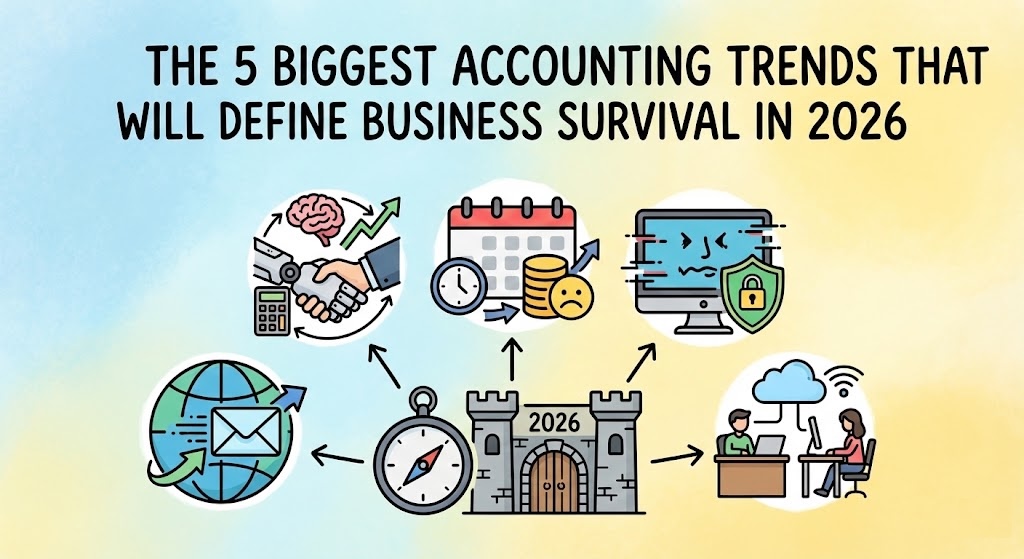
If you feel like the rules of doing business are changing faster than you can keep up, you aren’t alone. For freelancers and small business owners, 2026 is shaping up to be a turning point. We are finally moving away from the era of “I’ll get to that paperwork later” and into a world where automation is the standard and compliance is non-negotiable. We have dug into the latest government budgets and global industry reports to bring you the five biggest shifts hitting the accounting world in 2026. Here is what you need to know to stay ahead. In this article 1. Mandatory E-Invoicing Is Going Global First, let’s clear up a common misconception: E-invoicing is not just emailing a PDF. When you send a PDF, it is essentially a digital piece of paper—a human still has to open it, read it, and type the numbers into their system. True e-invoicing is data, not a document. It involves sending structured files (like XML) directly from your software to your client’s software (or the government’s), where it is read and processed instantly without human hands touching it. Governments love this because it closes tax gaps, and now they are making it the law across the globe. If you work with clients in these regions, your current method of invoicing might become obsolete. You will likely need software that generates these specific machine-readable formats automatically to ensure you can still get paid. 2. AI Will Supercharge Your Financial Productivity Ignore the doom-and-gloom headlines about robots taking jobs. In 2026, AI is less about replacing you and more about giving you your weekends back. The technology has matured from a “cool experiment” to a daily essential for cutting down busy work. 3. Late Filing Penalties Are Increasing Governments are getting smarter. They are using better data to spot mistakes faster, and the leniency we saw in previous years is disappearing. 4. The Rise of Deepfakes is Creating New Cybersecurity Risks Small businesses often think they are too small to be targeted by hackers. Unfortunately, as large corporations tighten their security, attackers are pivoting to smaller, easier targets using terrifyingly realistic tech. 5. Remote Work is the New Standard (But It’s Hybrid) The concept of having your accountant “down the street” is fading. Business owners are increasingly prioritizing talent and tech-savviness over physical proximity. Future-Proof Your Business with Fynlo The common thread across all these trends is technology. Whether it is meeting new e-invoicing mandates, staying on top of deadlines to avoid steeper penalties, or leveraging AI to save time, you need tools that evolve as fast as the world does. That is why we are excited to introduce the recently launched Fynlo AI. We built Fynlo AI to directly address the productivity and accuracy challenges mentioned above. It allows you to simply upload receipts or bank statements, and our engine takes over from there. Fynlo AI extracts the data, categorizes every entry, and updates your financial reports in real-time with 100% accuracy. No more manual data entry errors, no more late nights classifying expenses, and no more guessing where your business stands. Ready to get ahead of the 2026 trends? Schedule a demo today and experience the future of automated accounting.
5 Financial Metrics Your Bank or Lender Will Check Before Giving You a Loan

You’ve poured your time, energy, and sleepless nights into building something strong. You’ve overcome the initial hurdles, found product-market fit, and now you’re ready for the next big leap. That means securing the capital required to hire, expand your inventory, or move into a bigger space. This journey, though, brings you face-to-face with a tough reality: obtaining that financing is often the single biggest hurdle for small businesses. According to 2025 research from Allica Bank, SME loan rejections have dramatically increased from just 5-10% three decades ago to 40% today. In other words, lenders are far more selective than they used to be. The moment you submit that application, you step into a rigorous due-diligence process where lenders are looking past your gross revenue to assess two critical things: risk and repayment capacity. If you don’t know the core metrics they care about, you can’t prepare your books effectively or present your case with confidence. Here are the five essential financial metrics your bank will scrutinize before approving your loan. In this article 1. Quick Ratio (Acid-Test Ratio) Think of the Quick Ratio as your company’s emergency financial safety net. It’s a crucial measure of short-term liquidity, answering the question every lender silently asks: “If sales hit a sudden wall, could this business instantly pay its most urgent bills?” This metric focuses only on your most liquid assets—cash and receivables—and deliberately excludes inventory because that can be slow to sell or difficult to liquidate quickly. Lenders generally look for a Quick Ratio above 1.0. A strong Quick Ratio proves you have the immediate cash flow cushion to weather an unexpected storm, which builds confidence in your business’s foundational health. To put it simply: if you owe $10,000 in short-term bills, lenders want to see at least $10,000 in highly liquid assets; ideally more. Quick Ratio = (Cash + Accounts Receivable + Marketable Securities) / Current Liabilities 2. Debt-to-Equity (D/E) Ratio The D/E Ratio measures the financial structure of your business. It answers whether you’re funding growth primarily through debt or through the owners’ investment (equity) and accumulated profits. Lenders look for a lower ratio, typically below 1.5. A high D/E ratio (say, 3.0) signals that your business is highly leveraged and therefore vulnerable if revenues dip, as fixed debt payments remain relentless. Conversely, a low ratio proves the owners are committed and the company has strong internal stability. Debt-to-Equity Ratio = Total Liabilities / Total Equity 3. Debt Service Coverage Ratio (DSCR) When a bank considers giving you a new loan, DSCR is what matters most. It is arguably the most critical metric for any new debt, measuring your company’s direct repayment capacity for all its debt obligations. DSCR = Net Operating Income / Total Debt Service (Principal + Interest Payments) Banks usually require a DSCR between 1.25 and 1.50. Think of this simply: a DSCR of 1.25 means your operating income is 125% of your required debt payments. This provides a safety margin. If your DSCR is below 1.0, the loan conversation stops instantly—you’re simply not generating enough income to cover your required payments. 4. Gross Profit Margin While the initial metrics focus on risk, the Gross Profit Margin proves the viability of your core business model. It answers: “How profitable is your product or service itself, before the lights are even turned on?” Lenders look for a high and consistent margin. A strong Gross Profit Margin proves that your core service is priced correctly and that you are efficient at managing your direct production costs (COGS). This shows the inherent earning power of your product, assuring the lender that even if overhead expenses rise, the core offering is financially sound. Gross Profit Margin = (Revenue – Cost of Goods Sold) / Revenue To see why your total sales are different from the money you actually keep, read our guide on the difference between revenue and profit to make sure your business stays healthy. 5. Accounts Receivable (A/R) Aging and DSO This metric focuses on cash flow quality and the efficiency of your collections process. A healthy balance sheet is useless if you can’t actually get the money in the door. Lenders pay close attention to your A/R aging report to see how many outstanding invoices are over 90 days due. If a large percentage of your revenue is perpetually uncollected, that’s a massive red flag. Days Sales Outstanding (DSO) measures the average number of days it takes for you to collect revenue after making a sale. DSO = (Average Accounts Receivable / Total Credit Sales) x Number of Days Lenders want to see a low DSO, indicating fast and efficient collection (ideally under 45 days). A high DSO suggests your credit control is weak or your clients are unreliable, significantly raising the lender’s risk profile. Preparation as a Competitive Advantage Securing a loan starts long before you submit the application. It begins with shifting your mindset from “keeping the books” to “strategic reporting.” Lenders aren’t just looking at your bank balance; they are looking for a narrative of stability and foresight. When you can present these five metrics clearly and instantly, you demonstrate that you aren’t just a business owner—you are a sophisticated operator who understands risk and repayment capacity. In the competitive 2026 lending environment, that level of clarity is often the difference between a rejection and an approval at the best possible rates. About the Author Isabella Jones started her career at Deloitte, where she worked on tax compliance for some of the country’s fastest-growing companies. She later joined Fynlo as Senior Financial Strategist, bringing that experience to freelancers and small business owners who need practical financial guidance without the corporate complexity. With an Accounting degree from Villanova University, Isabella focuses on making financial planning easier to understand and apply in day-to-day business. She works closely with freelancers and small businesses on areas like taxes, cash flow, and building more stable financial systems.
Should You Lease or Buy Equipment? A Financial Breakdown
Every small business owner hits a wall where their old equipment just won’t cut it anymore. Maybe it’s time for a faster work truck, a major new piece of machinery, or simply upgrading every laptop in the office. This decision isn’t just about whether you have the cash today; it’s one of the most important financial choices you’ll make all year. The question of whether to lease (rent) or buy (own) directly impacts your immediate cash flow, your tax bill, and the overall look of your company’s financial health. Understanding the difference is the first step toward making a profitable move. In this article The Case for Buying (Financing or Ownership) When a business buys equipment, it usually means taking out a loan to cover the cost. You own the asset outright, and it immediately goes onto your Balance Sheet. The Tax Advantage: Depreciation The biggest financial benefit of buying is that you get to claim the entire purchase price as an expense over the asset’s useful life. This is called depreciation. It’s a wonderful non-cash deduction that essentially gives you a massive tax break. For example, in the United States, rules like Section 179 allow you to deduct the full purchase price of some assets immediately. No one wants a surprise bill from the tax authorities, and claiming depreciation is a straightforward way to reduce your taxable income. Cash Flow and Final Cost While the upfront cost might be higher or require a significant down payment, the long-term benefit is that you build equity. Once the loan is fully paid off, the asset is yours free and clear. If you use the equipment for ten years, your total cost of ownership (after taxes) can often be lower than renting it for the same period. The Case for Leasing (Renting or Operating) Leasing is essentially renting the equipment for a set period, typically three to five years. This option is popular because it minimizes risk and keeps things simple. Flexibility and Low Upfront Cost The primary appeal of leasing is the minimal initial expense. You usually don’t need a large down payment, making it ideal if your business needs to preserve cash liquidity for other operating expenses, like marketing or inventory. Because you don’t own the asset, when the lease is up, you simply hand the old equipment back and upgrade to the newest model, which is perfect for rapidly changing technology like computers or software licenses. Accounting Simplicity From an accounting perspective, leasing is straightforward. Your monthly lease payment is treated as a simple operating expense, similar to paying rent. It goes directly onto your Profit and Loss (P&L) Statement, reducing your gross profit immediately. This process is far less complicated to track than the depreciation schedules required when you buy. Decision Matrix: Choosing the Right Path The ideal choice depends entirely on your company’s needs and long-term outlook. When to Buy (Stability is Key): When to Lease (Flexibility is Key): Accounting Impact: How Each Choice Affects Your Statements Regardless of which path you choose, you need an organized system to track the financial consequences correctly. Buying is more complex to track. When you buy, you must record the full asset value and the corresponding liability (the loan) on your Balance Sheet. Then, your accounting system needs to correctly calculate and post the depreciation entries monthly or annually, following local tax rules. This meticulous tracking is essential if you ever need to apply for a loan, as banks will heavily scrutinize your Debt-to-Equity ratio. Example 1: Buying (The Balance Sheet Impact) When you buy a $10,000 piece of equipment with a loan, your books change immediately and permanently: Account Effect Statement Value Equipment Asset Increases Balance Sheet + $10,000 Loan Payable Liability Increases Balance Sheet + $10,000 Annual Depreciation Expense Increases P&L Statement + $1,000 Accumulated Depreciation Asset Value Decreases Balance Sheet + $1,000 The Takeaway: Buying creates a complex tracking relationship between the Balance Sheet (Asset/Loan) and the P&L (Depreciation). Leasing keeps your Balance Sheet clean. Since leasing is treated as an operating expense, the monthly payment only touches your P&L statement. It avoids adding large debt obligations to your books, which can sometimes be advantageous if your company is trying to stay lean to secure a future loan or meet specific financial covenants required by lenders. Example 2: Leasing (The P&L Simplicity) When you pay a $300 monthly lease payment, the transaction is simple and only affects two things: Account Effect Statement Value Lease Expense Expense Increases P&L Statement + $300 Cash Asset Decreases Balance Sheet – $300 The Takeaway: The cost is immediate, transparent, and easy to track, requiring no complex depreciation schedules. Your Strategic Decision The decision to lease or buy equipment is a strategic one, balancing immediate cash needs against long-term tax and ownership benefits. It requires careful tracking of depreciation schedules, loan balances, and expense categories. Don’t let these complex entries be a source of error or confusion. You need a system that ensures your fixed assets are tracked accurately, your depreciation is automatically calculated, and your financial reports are audit-ready, whether you are owning an asset or simply renting its use. Ready to gain control over your assets and deductions? Schedule a quick demo today to see how Fynlo simplifies fixed asset management, expense tracking, and financial reporting for growing businesses.