
5 Best U.S. States to Incorporate In: 2026 Tax & Legal Guide
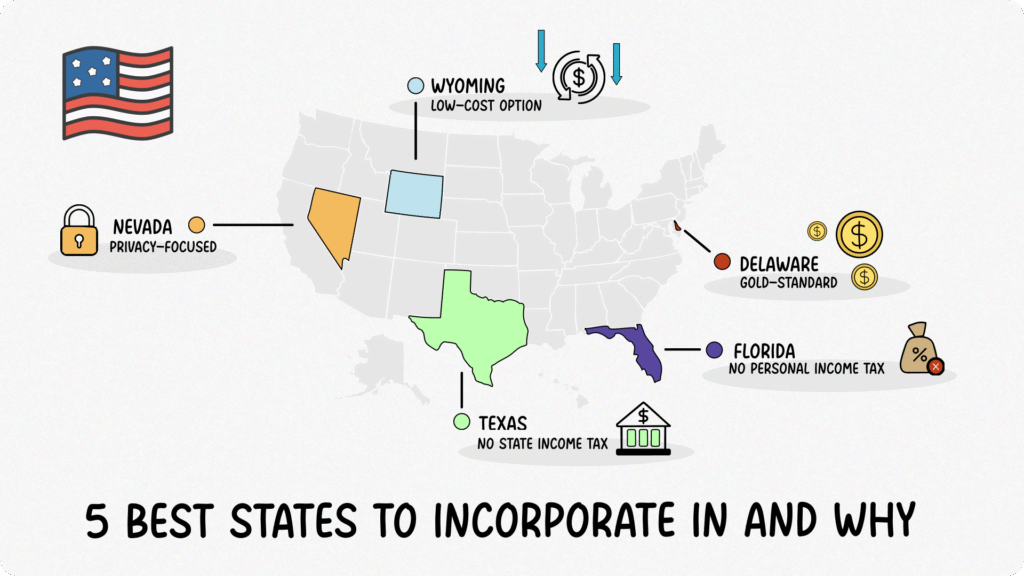
When I started my first small business, I remember staring at a blank screen, Googling “where should I incorporate?” I found conflicting advice, fees that seemed to change overnight, and legal jargon that made my head spin. Over time—after a few “oops” moments and some late-night research—I narrowed it down to five states that consistently offer the best mix of low costs, solid legal protections, and friendly environments for entrepreneurs. Here’s what I’ve learned, updated with the correct figures as of January 2026. Table of Contents Delaware: The Gold Standard for Big (and Small) Businesses “People joke that Delaware exists just so corporations can incorporate there, and it almost feels that way when you see how slick their system is.” Why Delaware? Fees (2026): Most small business owners should budget at least $225 to $450 per year depending on which method they use. For very large companies, the tax is generally capped at $200,000, though “Large Corporate Filers” (those with over $750M in assets or revenue) are subject to a higher $250,000 cap. Personal note: My first LLC wasn’t in Delaware—it was in my home state. But after attending a startup accelerator and hearing investors talk about “Delaware C-Corp, please,” I re-formed there. I still recall breathing a sigh of relief when I realized investors are so comfortable with Delaware entities that legal due diligence becomes that much smoother. Wyoming: The Friendly, Low-Cost Option for Small Businesses “Think of Wyoming as the underdog—no one talks about it as much as Delaware, but it quietly checks all the right boxes for a lean, mean small-business machine.” Why Wyoming? Personal note: When I was a freelancer, I formed a single-member Wyoming LLC just because the yearly cost was so low. It felt thrilling to pay only $160 total each year and know my personal assets had a legal buffer. Nevada: Privacy-Focused with No Corporate Income Tax “Nevada is like Wyoming’s more opulent cousin—privacy protections, no state income tax, and a reputation as the ‘Florida of the West’ for tax benefits.” Why Nevada? Fees (2026): In total, expect around $875 in year one (incorporation + list + license). Subsequent years are $650 (license $500 + annual list of officers $150). I know that sounds steeper than Wyoming, but if privacy and zero state tax on profits matter, many entrepreneurs find Nevada worth the up-front costs. Personal note: A colleague once told me, “If you live in California but want to keep your taxes honest, move to Nevada for your mental health.” He wasn’t wrong—no state income tax means one fewer headache at tax time. Texas: No State Income Tax + Seller’s Market for Services “Texas is booming—no state income tax, a thriving entrepreneurial scene, and a sense of ‘everything’s bigger in Texas,’ including opportunities.” Why Texas? Personal note: I once thought I’d set up shop in California, but I cringed at that 13.3% top-bracket personal rate on top of corporate taxes. Texas felt like a breath of fresh air—zero state income tax, and Austin’s startup vibe makes you feel like anything’s possible. Florida: No Personal Income Tax + Moderate Corporate Tax “Florida is that friend who loves to chill in flip-flops but still knows how to hustle—no personal income tax, solid consumer market, and a growing tech ecosystem.” Why Florida? Personal note: I spent a summer in Miami Beach brainstorming a business plan on the sand. The idea of paying zero state income tax gave me the energy to work late nights—and if you’ve ever tried running spreadsheets in 90-degree heat, trust me, you’ll appreciate anything that saves you a percentage point of tax. Things to Consider When Choosing a State TL;DR A quick overview of the five best states to incorporate in, plus why they might be a fit for you: State Formation Fee Annual Cost Corporate Tax Personal Tax Key Benefits Delaware $89 (C-Corp) $225 or $450 franchise tax + $50 report 8.7% (only if doing business in DE) None – Chancery Court– Flexible corporate laws– Investor-friendly Wyoming $100 (LLC) $60 annual report None None – Lowest fees– Strong privacy & asset protection– No state income tax Nevada $75 (C-Corp) $650 (license + list) None (under $4M revenue) None – Robust privacy– No corporate/personal income tax– Specialized Business Court Texas $300 (Corp) $0 (if under $2.65M revenue) 0.375%–0.75% (Margin Tax) None – No personal income tax– Large business ecosystem– Franchise tax exemption under $2.65M Florida $70 (C-Corp) $150 (Corp) or $138.75 (LLC) 5.5% None – No personal income tax– Growing tech hubs– Moderate corporate tax Final Thoughts There’s no one-size-fits-all “best state”—it really depends on your budget, growth plans, and tolerance for paperwork. When I first started, the difference between $60/year (Wyoming) and $540/year (Delaware) felt huge. But as my business matured and I talked to investors, it became clear that Delaware could save me weeks of legal back-and-forth. Meanwhile, friends who run lean e-commerce stores from home still swear by their $160/year Wyoming LLCs. In the end, pick the state that aligns with your current priorities: cost, privacy, investor confidence, or community. And remember, you can always form in one state and later register as a foreign entity in another (it’s called “qualifying” to do business in your home state). That’s exactly what many growth-stage startups do: incorporate in Delaware, then register in their home state so they can open a bank account, hire W-2 employees, and sign leases without legal headaches. I hope this guide helps you sleep a little easier as you choose your business’s “home.” Wherever you decide to incorporate, know that every entrepreneur—myself included— started exactly where you are right now: staring at a blank filing form, hoping they made the right choice. Need Help with Your Accounting? At Fynlo, we know every state has its own quirks—whether it’s Delaware’s Chancery Court, Wyoming’s low fees, Nevada’s privacy rules, Texas’s franchise tax, or Florida’s corporate rate. Our expert team can handle your bookkeeping, annual filings, and state-specific tax planning no matter where you incorporate. Schedule a call