
5 Best U.S. States to Incorporate In: 2026 Tax & Legal Guide
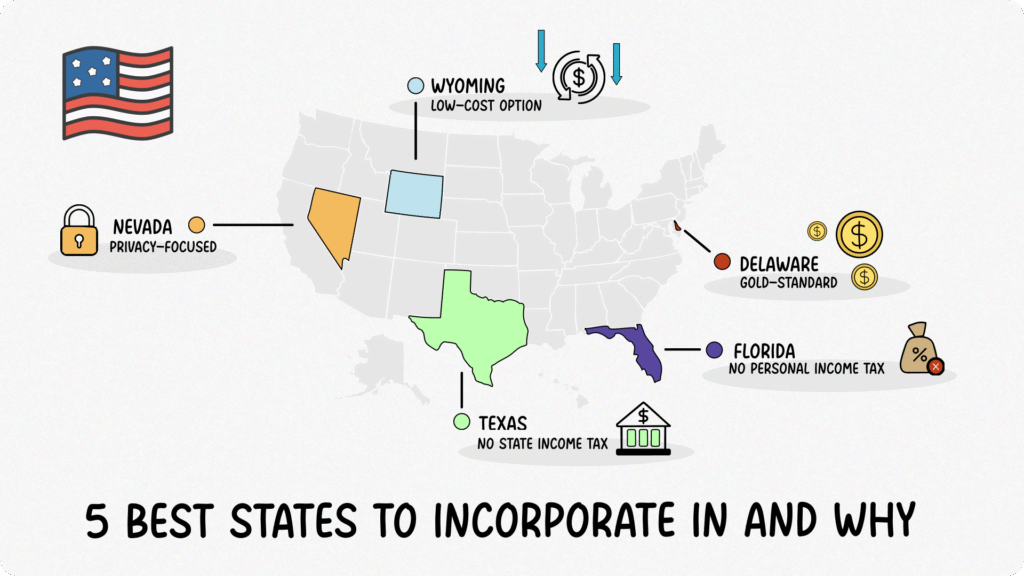
Choosing where to legally anchor your business is a major decision that impacts your tax liabilities, how easily you can manage your company, and your long-term legal protection. Many entrepreneurs default to filing in their home state, only to realize later that their funding strategies or business models would have been better served by a different jurisdiction. There is no single “best” state for every business. The right choice depends entirely on your capital structure, privacy requirements, and where you physically operate. This guide breaks down exactly how Delaware, Wyoming, Nevada, Texas, and Florida offer distinct advantages for corporate formation, looking beyond basic filing fees to examine the underlying legal and tax frameworks that impact your growth. In this Article Key Factors in Selecting a State When evaluating a state for incorporation, you need to look at four primary financial and regulatory angles. The right balance depends entirely on your specific business priorities. Comprehensive State-by-State Analysis Delaware: The Institutional and Venture Capital Standard Delaware differentiates itself not by being cost-effective, but by acting as the universally accepted legal framework for outside investors. While other states pitch low fees, Delaware focuses on corporate flexibility, maximizing options for complex equity structures, and offering unparalleled legal predictability. This is why tech giants like Alphabet (Google), Amazon, Apple, and high-growth scale-ups like Stripe and Airbnb choose Delaware. Note on Delaware LLCs vs. Corporations: If you form an LLC instead of a corporation in Delaware, you owe a flat $300 annual tax due June 1 each year instead of the franchise tax, and you do not need to file an annual report. Wyoming: Low-Cost Maintenance and Administrative Simplicity Wyoming differentiates itself by offering the leanest, most affordable corporate maintenance structure in the country. Where Delaware targets venture-backed corporations, Wyoming targets solopreneurs, digital nomads, and bootstrapped e-commerce brands looking for solid asset protection without ongoing paperwork burdens. Nevada: Premium Privacy and Robust Asset Protection Nevada differentiates itself by actively shielding corporate leadership teams from public visibility. It combines a zero-tax structure with some of the strictest operational privacy rules in the United States. Texas: Scaling Infrastructure and High-Volume Local Markets Texas differentiates itself by being an operational powerhouse rather than a passive filing haven. It is built for growing agencies, technology scale-ups, and companies that intend to establish a physical footprint, hire local talent, and capture market share within a massive domestic economy. Important Compliance Note: Even if your revenue is below the $2.65 million threshold and you owe zero franchise tax, you are still required to file a Public Information Report with the Texas Comptroller by May 15 each year. Skipping this filing triggers a $50 penalty. Florida: Balanced Taxation and Regional Ecosystem Growth Florida differentiates itself by offering an ideal tax environment for business owners who prioritize personal income retention. It strikes a highly attractive balance with a predictable low-rate corporate tax and a completely tax-free landscape for individual income. TL;DR: Summary Matrix State Primary Strategic Advantage Best Suited For Top Operational Priority Delaware Institutional credibility, VC readiness, advanced corporate courts Venture-backed startups, high-growth entities, complex boards Raising Outside Capital / IPO Roadmap Wyoming Maximum affordability, asset shielding, low paperwork Solopreneurs, e-commerce, bootstrapped digital companies Minimizing Upkeep & Protecting Solo Assets Nevada Strict leadership anonymity, asset protection, business courts Privacy-conscious owners, asset managers, mid-size firms Maximum Operational Privacy Texas Massive regional market, zero franchise tax under $2.65M revenue Agencies, regional employers, manufacturing, tech scale-ups Scaling Physical Infrastructure & Local Hiring Florida Balanced founder tax environment, high consumer market access Profitable brands, regional agencies, expanding tech hubs Founder Wealth Maximization & Distribution Critical Questions Before Filing To avoid inadvertently triggering double-compliance obligations, analyze these operational realities prior to registration: Final Thoughts Every entrepreneur starts exactly where you are right now: staring at a blank filing form, weighing numbers, and trying to predict the future layout of their company. If you find yourself stuck in analysis paralysis, simplify your decision by looking at your business model’s immediate 12-month horizon: Once you have identified the state that aligns with your current priorities, your next steps are straightforward: secure a registered agent in that jurisdiction, file your Articles of Organization or Incorporation, and obtain your federal EIN. One final reminder that applies regardless of which state you choose: incorporating in a different state from where you actually live and operate does not eliminate your home state tax obligations. You will almost certainly need to register as a foreign entity in your operating state, meaning you pay fees and meet compliance requirements in both. Factor this into your total cost comparison before making a final decision. By taking the time to match your state selection to your actual operational strategy today, you protect your personal assets and build a clean foundation for wherever your business takes you next. For a visual breakdown of how these specific legal and financial trade-offs operate side-by-side, this Wyoming LLC vs. Delaware LLC video provides a practical analysis of ongoing maintenance fees, asset protections, and exact filing pathways to help you choose the correct entity structure. About the Author Isabella Jones started her career at Deloitte, where she worked on tax compliance for some of the country’s fastest-growing companies. She later joined Fynlo as Senior Financial Strategist, bringing that experience to freelancers and small business owners who need practical financial guidance without the corporate complexity. With an Accounting degree from Villanova University, Isabella focuses on making financial planning easier to understand and apply in day-to-day business. She works closely with freelancers and small businesses on areas like taxes, cash flow, and building more stable financial systems.
The Freelancer’s Guide to Tax Deductions: A Strategic Approach
Most freelancers treat tax season as a retroactive search for receipts. However, the most successful independent professionals approach taxes as a year-round strategy for protecting their margins. In 2026, the IRS has introduced updates to mileage rates and clarified rules around meal deductibility. Without consistent record-keeping, it becomes much easier to miss legitimate deductions or make errors. This guide provides the technical clarity needed to claim every legitimate expense while avoiding common audit triggers. In this Article Home Office Deductions: Immediate Savings vs. Long-term Impact Freelancers must evaluate the long-term impact on property value before selecting a deduction method. The Actual Expense Method This approach allows for a deduction based on a percentage of actual household costs. While it often results in a higher immediate deduction, it involves Depreciation Recapture. The Simplified Method The Simplified Method allows for a standard deduction of $5 per square foot, capped at 300 square feet. Home Office: Calculating Your Business Percentage This step is required only if you choose the Actual Expense Method. To deduct a portion of shared home costs, you must first establish your Business Use Percentage. If you use the Simplified Method, you do not need this percentage; you simply multiply your office square footage (up to 300 sq. ft.) by $5. The Calculation: Divide the square footage of your dedicated office by the total square footage of your home. Example: A 150 sq. ft. office in a 1,500 sq. ft. home equals a 10% Business Use Percentage. Direct vs. Indirect Deductions Repairs vs. Capital Improvements The IRS distinguishes between “Repairs” and “Improvements.” 2026 Equipment & Section 179 Section 179 allows you to deduct the full cost of qualifying equipment in a single year rather than over time. This is a powerful tool for freelancers buying high-end tech. You cannot use Section 179 for the home office itself if you choose the Simplified Method; however, you can still use it for individual business assets like computers and furniture. As of early May 2026, the Section 179 deduction limit is $2,560,000, though it is subject to change—always confirm the current figure with the latest IRS guidance. Professional Growth & Education Continuing education is deductible if it maintains or improves your skills in your current field. Business Travel and the 2026 Standard Mileage Rate (72.5¢ per mile) For 2026, the IRS has set the standard mileage rate at 72.5 cents per mile. 2026 Expense Summary Table Category 2026 IRS Status Calculation Method Mileage 72.5¢ per mile Total business miles x Rate Home Utilities Deductible Total Cost x Business Use % Mortgage Interest Deductible Total Cost x Business Use % Equipment 100% Upfront Section 179 (Business % only) Internet / Phone Deductible Documented Business Use % Property Taxes Deductible Total Cost x Business Use % Common Audit Triggers to Avoid Even legitimate deductions can raise flags if they are not properly documented or appear inconsistent. Common issues include: Maintaining clear records and being able to explain the business purpose behind each deduction is key to defending your claims if questioned. Moving from Retroactive to Proactive You shouldn’t have to spend your weekends digging through old bank statements just to find missing deductions. By tracking your mileage and equipment upgrades as they happen, you stay prepared for tax season and ensure you’re actually keeping the money you’ve earned. This simple habit turns record-keeping into a routine part of your business rather than a major source of stress. Ultimately, staying organized is the most reliable way to protect your profit and make sure your business stays healthy for the long term. About the Author Isabella Jones started her career at Deloitte, where she worked on tax compliance for some of the country’s fastest-growing companies. She later joined Fynlo as Senior Financial Strategist, bringing that experience to freelancers and small business owners who need practical financial guidance without the corporate complexity. With an Accounting degree from Villanova University, Isabella focuses on making financial planning easier to understand and apply in day-to-day business. She works closely with freelancers and small businesses on areas like taxes, cash flow, and building more stable financial systems.
When Should You Move from a Sole Proprietorship to an LLC or S-Corp?
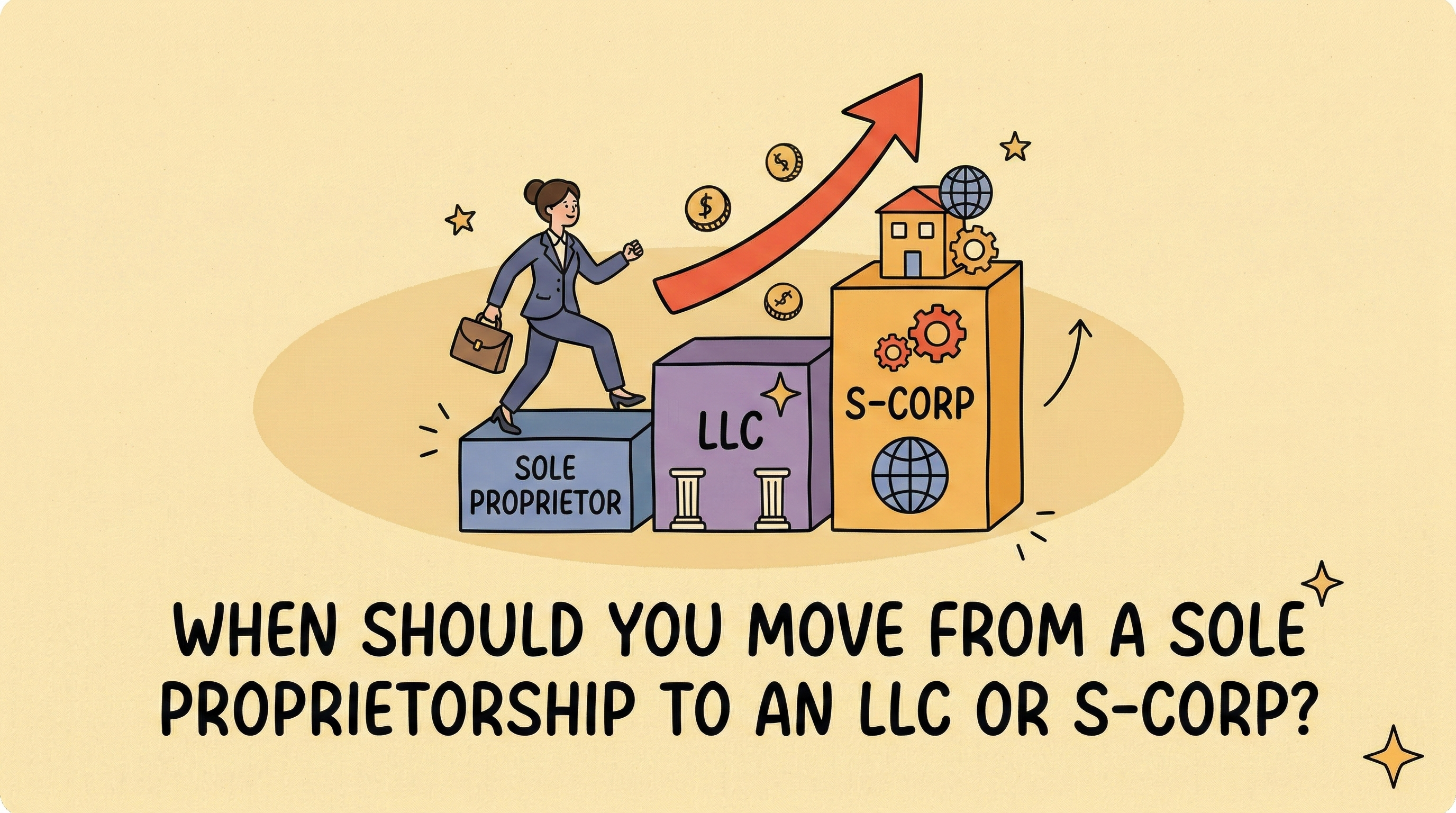
When you first go full-time as a freelancer, your focus is naturally on delivery—landing contracts, hitting deadlines, and refining your craft. Legal paperwork often feels like a secondary chore, a task to be addressed “eventually.” However, the structure you choose today determines how much of your hard-earned profit you actually keep and how well your personal life is protected if a project ever faces a legal challenge. If you are billing significant amounts without a formal entity, you may be unintentionally risking your personal savings for the sake of administrative convenience. Choosing a business structure is a trade-off between simplicity and security. For most freelancers, the transition from a Sole Proprietorship to an LLC or S-Corp is triggered by two specific milestones: reaching $50,000 in annual profit or taking on high-stakes contracts where a professional error could result in a personal lawsuit. In this article The Real-World Cost of Legal Exposure These risks are more than theoretical; without a legal bridge between your business and your personal life, a simple mistake can become a financial catastrophe. In both cases, an LLC would have acted as a circuit breaker, likely limiting the liability to the business’s assets rather than the freelancer’s life savings. Evaluating Your Structure Options Freelance Business Structures: A Quick Comparison Guide 1. The Sole Proprietorship This is the default setting for anyone who begins working for themselves without formal filing. It is the path of least resistance, but it offers the least protection. 2. The Limited Liability Company (LLC) An LLC is a registered entity that exists separately from you as an individual. It is the standard for professional freelancers who want to safeguard their personal finances. 3. The S-Corp Election An S-Corp is not a separate entity you register with the state, but a tax status you request from the IRS. It is the primary tool high-earning freelancers use to reduce their tax burden. Identifying the Financial Turning Point While the legal protection of an LLC is valuable at any stage, the tax benefits of an S-Corp become clear once you look at the math. Let’s compare the tax liability for a freelancer earning $100,000 in annual profit. S-Corp vs. LLC: Visualizing the Tax Savings Structure Self-Employment Tax (15.3%) Total FICA Tax Bill Standard LLC Paid on the full $100,000 $15,300 S-Corp Election Paid only on $60,000 (Salary) $9,180 Annual Tax Savings $6,120 The Milestone: As a general rule, once your annual profit clears $75,000, the tax savings of an S-Corp usually outweigh the $1,500–$2,000 cost of professional accounting and payroll software. Until you reach that mark, a standard LLC provides the most efficient balance of protection and simplicity. Maintaining Your Liability Protection Registering an LLC is only the first step. If you treat your business account like a personal fund, a lawyer can argue in court that the business and the individual are one and the same. To keep your protection intact, adopt these three habits: Common Q&A 1. Does an LLC protect me if I personally make a mistake on a project? An LLC is not a “get out of jail free” card for professional negligence. If you are personally responsible for a major error—like accidentally deleting a client’s database—you can still be held liable. This is why the most professional approach is a “two-tier” strategy: use a Business Structure for debt and contract protection, and Professional Liability Insurance for your actual work-product. 2. I am just starting out—can I change my structure later? Yes, and most freelancers do exactly that. It is common to start as a Sole Proprietorship for the first few months, register an LLC once contracts grow larger, and elect S-Corp status once profits stabilize above the $75,000 mark. Your legal structure should evolve alongside your income. 3. Do I need a lawyer to set this up? For a single-member LLC, many freelancers file directly with their Secretary of State or use a registration service. However, if you have business partners or are moving toward an S-Corp, a 30-minute consultation with a CPA is a wise investment to ensure you are meeting all federal and local tax requirements. 4. How does my structure affect my ability to get a mortgage? Lenders generally view S-Corp and LLC owners similarly as self-employed individuals. They typically look at your “net income” over the last two years. The main difference is that an S-Corp provides you with W-2s, which can sometimes make the application process feel slightly more traditional to a loan officer. Scaling with Confidence Choosing a business structure is essentially a trade-off between simplicity and security. As your income grows, your legal setup should evolve from the simplicity of a sole proprietorship to the robust protection and tax efficiency offered by an LLC or S-Corp. By making these decisions before you reach critical financial milestones, you ensure your business is built to safeguard your personal life today while fueling your professional growth for tomorrow. About the Author Isabella Jones started her career at Deloitte, where she worked on tax compliance for some of the country’s fastest-growing companies. She later joined Fynlo as Senior Financial Strategist, bringing that experience to freelancers and small business owners who need practical financial guidance without the corporate complexity. With an Accounting degree from Villanova University, Isabella focuses on making financial planning easier to understand and apply in day-to-day business. She works closely with freelancers and small businesses on areas like taxes, cash flow, and building more stable financial systems.
LLC vs. S-Corp in 2026: How to Save $10,000 in Self-Employment Tax
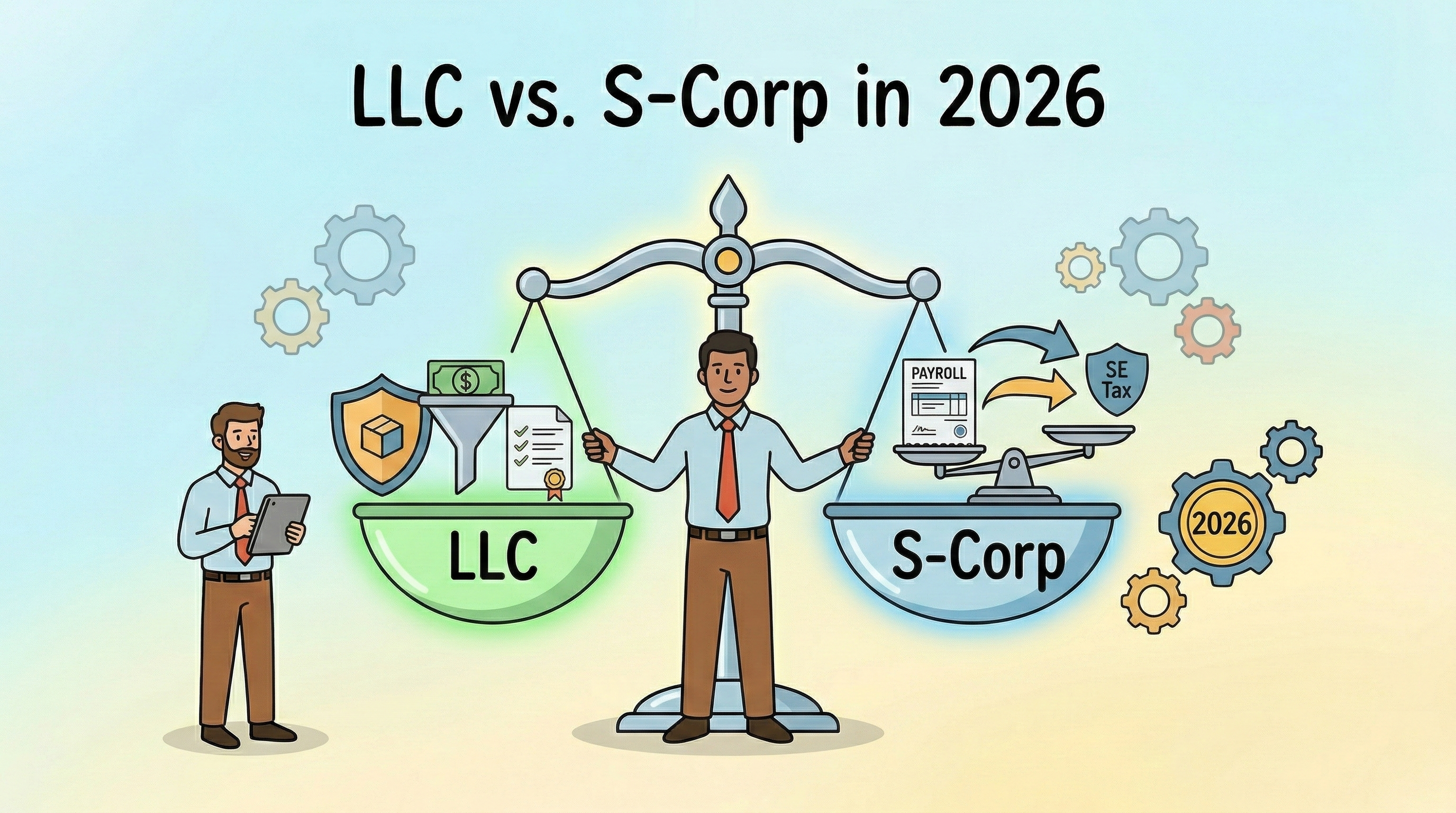
If you’ve successfully scaled your business past the six-figure mark, you’ve reached a significant milestone. Yet, as your revenue grows, the business structure that served you as a lean startup may no longer be the most efficient vehicle for your success. In 2026, many high-performing founders are discovering that staying in their “default” setup is a choice that costs them thousands of dollars in unnecessary tax leakage every single year. Most freelancers stay in a basic LLC because it’s easy. While simplicity has its merits in the beginning, relying on it indefinitely often leads to a massive missed opportunity for wealth building. In a six-figure business, that “simplicity” isn’t free—it represents capital that could be better spent on a strategic new hire, upgrading your technology stack, or funding your retirement. In this article Understanding the Self-Employment Tax Threshold To understand how to save money, we first have to look at how the IRS views a standard LLC. In the eyes of the tax man, you and your LLC are a “disregarded entity”—meaning you are essentially the same person. This results in 100% of your net profit being hit with a 15.3% self-employment tax to cover Social Security and Medicare. As you scale, this math becomes painful. By electing S-Corp status, you fundamentally change the relationship between you and your money. You become an employee of your own business, allowing you to pay yourself a “reasonable salary” (which is taxed) while taking the remaining profit as a distribution. These distributions are exempt from that 15.3% tax, which is exactly where the five-figure savings come from. Business Structure Comparison Between LLC vs S-Corp vs C-Corp Selecting a structure is more than just tax optimization; it is about ensuring your legal framework aligns with your long-term strategic vision. While the S-Corp is often the ideal choice for service-based founders, the C-Corp (or “Inc.”) remains the gold standard for those intending to scale globally or raise outside capital. In fact, approximately 95% of venture capital is directed toward C-Corps because they support the unlimited shareholders and complex stock classes that institutional investors demand. Feature Standard LLC S-Corp Election C-Corp (Inc.) Tax Filing Personal 1040 (Schedule C) 1120-S + K-1 Form 1120 (Corporate) Payroll Requirement None Mandatory W-2 salary Mandatory for active owners Self-Employment Tax 15.3% on 100% of profit 15.3% on salary only None (on dividends) Management Style Flexible; Member-managed; no board required Formal; Requires Board of Directors and Officers Strict; Board oversight with mandatory annual minutes Audit Risk Higher; Schedule C filings often draw IRS scrutiny Lower; Formal structure and payroll reduce “red flags” Moderate; Professional compliance is expected Primary Benefit Maximum simplicity Tax savings for $100k+ earners Scalability & VC funding Primary Drawback High tax as revenue scales Compliance & payroll costs Potential double taxation Finding the Salary Sweet Spot for Maximum Savings The biggest “catch” with an S-Corp is that you must pay yourself a “reasonable salary”. If you pay yourself $0 to avoid all taxes, the IRS will audit you; if you pay yourself your entire profit, the S-Corp becomes a useless expense. We generally look at three tiers of profit to find that “sweet spot”: Maximizing the 20% Qualified Business Income Deduction The Qualified Business Income (QBI) deduction allows many business owners to deduct up to 20% of their business income from their taxes. For S-Corp owners, this deduction is calculated on your profit after your salary is paid. While powerful, the 20% Qualified Business Income (QBI) deduction is subject to limits once your total taxable income rises above the annual thresholds (for example, around $203,000 for single filers and $406,000 for married filing jointly, indexed for inflation). Above these levels, the deduction is gradually restricted based on the type of business you operate and how much you pay in W-2 wages or own in qualified business property. For specified service businesses (such as consulting, legal, medical, and similar fields), the deduction phases out completely as income increases. For other businesses, the deduction can still apply but is capped using wage and property formulas. The key planning strategy is to set a salary that meets IRS “reasonable compensation” rules without unnecessarily reducing the pool of business profit that may qualify for the 20% QBI deduction. Protecting Your Assets by Maintaining the Corporate Veil Both LLCs and Corporations offer a layer of protection for your personal assets, shielding them from business debts and lawsuits. However, this protection depends on maintaining a clear separation between personal and business activity. Implementation Checklist & Deadlines Transitioning to an S-Corp requires discipline in your accounting and adherence to strict IRS timelines. 1. The March 15th DeadlineTo be taxed as an S-Corp for the 2026 calendar year, you must file IRS Form 2553 by March 15, 2026. If you miss this date, your election typically won’t take effect until the following tax year, though “Late Election Relief” is sometimes available for businesses with a valid reason for the delay. 2. Formalize Your BookkeepingBecause the S-Corp is a separate tax entity, “co-mingling” funds (using business money for personal groceries) is a significant compliance risk. You must maintain pristine records and clear separation between business and personal accounts. 3. Set Up Monthly PayrollYou cannot simply “take money out” as an S-Corp owner. You must use a payroll provider (like Gusto or Rippling) to withhold taxes from your salary and issue yourself a W-2 at the end of the year. Moving Toward an Optimized Structure The move from a standard LLC to an S-Corp is a sign of business maturity. It shifts your focus from simply maintaining operations to strategically optimizing for wealth. If your business is consistently netting over $100,000, continuing as a basic LLC is no longer a matter of simplicity—it’s a matter of unnecessary expense. About the Author Isabella Jones started her career at Deloitte, where she worked on tax compliance for some of the country’s fastest-growing companies. She later joined Fynlo as Senior Financial Strategist, bringing that experience to freelancers and small business owners who need practical financial guidance without the corporate complexity. With an Accounting degree from Villanova University, Isabella focuses on making financial planning easier to understand and apply in day-to-day business. She works closely with freelancers and small businesses on areas like taxes, cash flow, and
The 2026 Profit Guide: 7 States That Help You Retain More Revenue
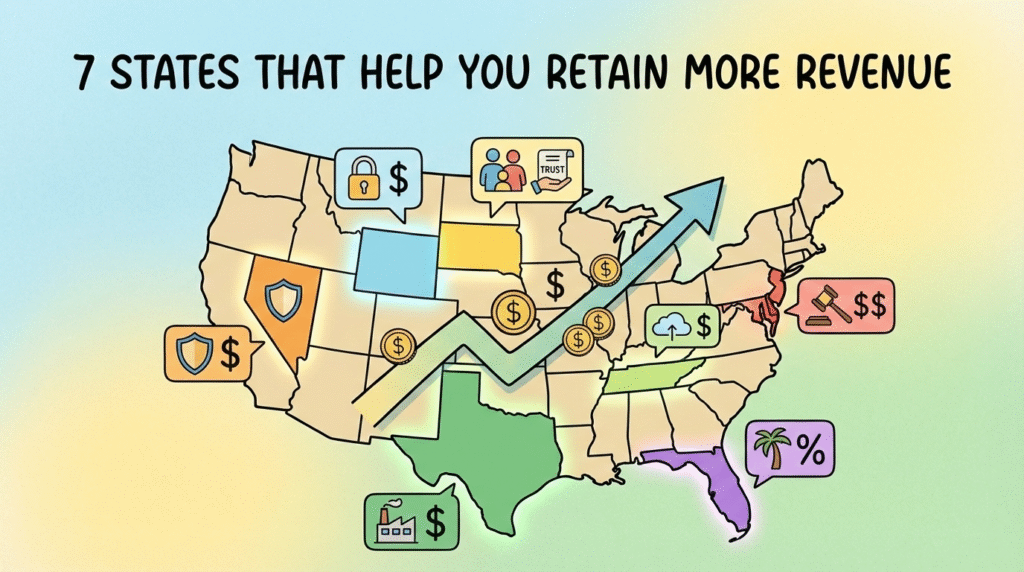
Most founders start their journey with a focus on top-line growth, but as the business matures, the focus shifts to the bottom line. In 2026, where your business “lives” is just as important as what it sells. Between state-level taxes, franchise fees, and administrative overhead, your choice of location can change your net profit by thousands of dollars annually. With the 2026 economy favoring remote-first structures, you have more flexibility than ever to choose a home base that aligns with your financial goals. Here is a detailed look at seven states designed for high retention and low friction. In this article Quick Comparison: 2026 Top Tax-Friendly States Selecting the right home for your business in 2026 requires balancing immediate fees against long-term strategic goals. Use the decision matrix below to identify your path, then verify the technical thresholds in the comparison table. State Annual Base Fee Tax-Exempt Threshold (2026) Privacy & Asset Protection Primary Strategic Advantage Wyoming $60 100% Tax-Free Elite: No member names in public records; strong charging order. The “Lean” Leader: Lowest combined maintenance and setup costs in the U.S. Delaware $300 100% Tax-Free (Non-DE income) Standard: Member names are generally private; expert court system. VC/IPO Ready: The mandatory standard for institutional investment. Texas $0 $2,650,000 (Revenue threshold) Standard: Publicly accessible officer names; stable pro-business courts. Scale Hub: Massive infrastructure and labor pool for large operations. Florida $138.75 100% Tax-Free (Personal income) Moderate: High transparency; aggressive business-first legislation. Growth Epicenter: Top migration destination for tech founders in 2025-2026. Nevada $350 $4,000,000 (Revenue threshold) Ultra: Strongest “Exclusive Remedy” charging order protection in the U.S. Maximum Shield: Preferred for high-liability professional or real estate assets. S. Dakota $55 100% Tax-Free (No income/capital gains) Dynasty Tier: Permanent court seal for trusts; generational privacy. Legacy Focus: Designed for multi-generational wealth and asset management. Tennessee $300+ $50,000 (Excise deduction) Moderate: Standard corporate disclosure; business-friendly climate. Remote Incentive: Asset-light agencies benefit from 2024 franchise tax repeal. 1.Wyoming: The Efficiency Leader Wyoming maintains a regulatory environment centered on administrative simplicity and established legal precedent. As the first state to codify the LLC structure in 1977, it has a long-standing history of prioritizing legislative stability for business entities. In 2026, Wyoming continues to hold the #1 rank on the Tax Foundation’s State Tax Competitiveness Index, a position it retains due to its lack of complex entity-level taxes. 2. Delaware: The Global Standard for Scaling Delaware remains the definitive ecosystem for companies with national or international ambitions. It is the legal home for over 65% of the Fortune 500 and approximately 79% of all U.S. initial public offerings (IPOs). Its reputation is anchored by the Court of Chancery, a specialized court that has spent over 200 years refining the case law that governs modern corporate life. 3. Florida: The Strategic Hub for Growth Florida has moved beyond its reputation as a retirement destination, recently overtaking traditional tech hubs like Austin and Seattle as the primary destination for founders. This shift is backed by massive state investment in high-speed connectivity and a “Business-First” legislative agenda that has matured significantly by 2026. 4. Nevada: Advanced Protection for Business Assets Nevada is often compared to Wyoming, but its positioning in 2026 is distinct: it is the jurisdiction of choice for high-liability industries or founders seeking the most aggressive legal “shield” available in the U.S. While Wyoming leads in efficiency, Nevada leads in asset defense. 5. Texas: The Choice for Large-Scale Operations Texas has moved beyond its reputation for traditional industry to become a global hub for technology and high-volume logistics. For founders planning to scale from a lean startup to a significant enterprise, the state offers a predictable fiscal environment designed to support high-growth operations. 6. South Dakota: Privacy for Long-Term Wealth South Dakota is a powerhouse for financial privacy and generational wealth preservation, often favored by founders whose strategy involves multi-generational longevity rather than a short-term exit. In 2026, it remains a global leader in trust and asset protection laws, frequently compared to international hubs like Switzerland for its commitment to confidentiality. 7. Tennessee: The Incentive for Remote Innovation Tennessee has become a favorite for the creative and tech-heavy remote workforce, particularly after completing the full repeal of its final income tax on interest and dividends in 2021. As of 2026, it is one of only nine states with no personal income tax of any kind. 2026 Business Location Checklist Before finalizing your choice, ensure you have addressed these three critical factors: Disclaimer: This guide is for informational purposes only and does not constitute legal, tax, or financial advice. While we strive to provide the most current data as of early 2026, tax laws and state fees are subject to change. Always consult with a qualified professional before making business formation or tax-related decisions. About the Author Isabella Jones started her career at Deloitte, where she worked on tax compliance for some of the country’s fastest-growing companies. She later joined Fynlo as Senior Financial Strategist, bringing that experience to freelancers and small business owners who need practical financial guidance without the corporate complexity. With an Accounting degree from Villanova University, Isabella focuses on making financial planning easier to understand and apply in day-to-day business. She works closely with freelancers and small businesses on areas like taxes, cash flow, and building more stable financial systems.
Wyoming vs. Delaware LLC: A Strategic Look at Your Business Home in 2026
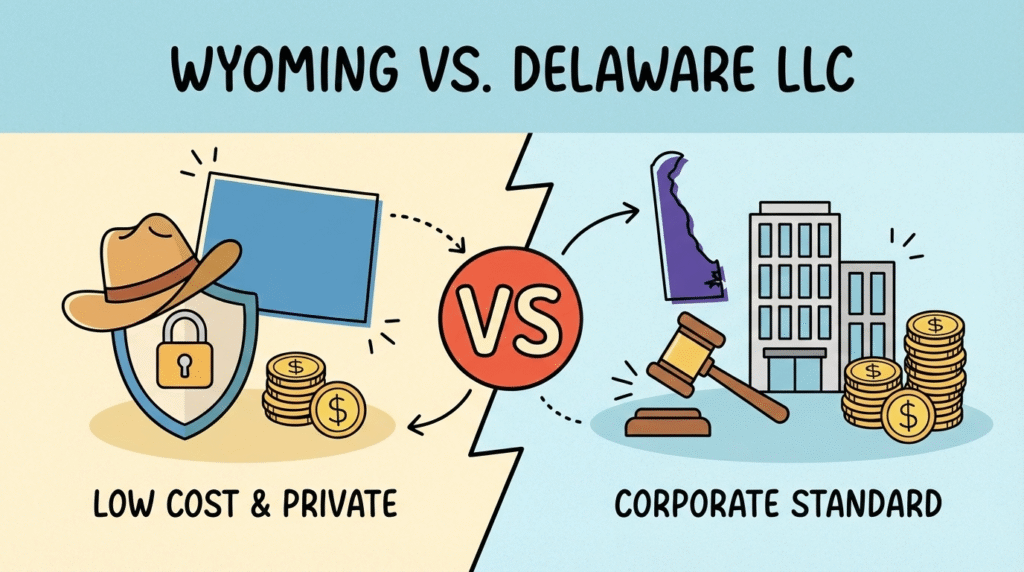
I recently caught up with a founder who was set on registering her digital agency in Delaware. When I asked why, her answer was simple: “It’s what everyone does.” After we walked through her three-year plan, it turned out she was about to take on administrative costs and legal layers that her current model didn’t actually need. Picking a state for your LLC isn’t a one-size-fits-all choice anymore. In 2026, with state filing systems going digital and federal reporting—like the Corporate Transparency Act—getting more specific, the right choice depends on your funding path, your need for privacy, and where you actually sit at your desk. Let’s look at the actual numbers and the logic behind both states so you can make a call based on what fits your business today. In this article 2026 Maintenance and Compliance Overview To see the long-term impact on your bank account, you need to look at the recurring costs. While starting an LLC costs roughly the same in both states, the yearly bills look quite different. Category Wyoming LLC Delaware LLC Yearly Maintenance Fee $60 (Annual Report) $300 (Franchise Tax) Late Filing Penalty No late fee; but non-filing = dissolution. $200 Flat Fee + 1.5% Interest State Income Tax 0% 0% (unless the LLC has Delaware-source income) Setup Cost (State Fee) $100 $110 Privacy Rank (2026) Top Tier Mid Tier 1. Why Delaware is the “Legal Standard” Delaware’s biggest selling point isn’t its tax rate; it’s the legal system. The state is home to the Court of Chancery, a specialized court that only hears business disputes. Because judges (not juries) decide these cases, the outcomes are incredibly predictable. This predictability is exactly why over 65% of Fortune 500 companies are incorporated in Delaware. If you plan to raise venture capital or offer stock options to employees, most investors will expect a Delaware entity. It’s the “legal language” they already speak, which can save you a lot of time during a fundraising round. 2. The Annual Cost of Doing Business in Delaware While the legal benefits are a major draw, they come with a fixed price tag. Every Delaware LLC pays a $300 Annual Franchise Tax. Think of this as a mandatory subscription fee to keep your company active. In 2026, the state remains very strict about its June 1st deadline. If you’re even a day late, a $200 penalty hits your account. Over a five-year stretch, you’re looking at a minimum of $1,500 in state taxes just to exist in Delaware. For a bootstrapped startup, that is capital that could have been spent on your first marketing campaign or hardware. 3. The Wyoming Advantage: Privacy and Lower Overhead If you aren’t chasing Wall Street investors, Wyoming is often the smarter move for lean operations. They don’t have a franchise tax; they just have a $60 Annual Report Fee. Beyond the savings, Wyoming is famous for its privacy. In 2026, data security is a top concern for founders. Wyoming allows you to keep the names of your LLC’s members and managers off the public record. In a world where your personal info is often just a Google search away, this “anonymity by default” is a huge plus for many business owners. 4. Asset Protection: The “Charging Order” Shield One technical detail you’ll appreciate is Wyoming’s Charging Order Protection. This is a legal shield that prevents a personal creditor from seizing your business assets or forcing you to sell the company to pay a personal debt. Wyoming was the first state to give this protection to single-member LLCs, and their laws are still among the strongest in the country. Delaware offers great protection too, but Wyoming’s statutes are often preferred by legal experts for smaller, closely-held businesses that want to keep their professional and personal lives strictly separate. 5. Registering “Away from Home”: The Foreign Qualification Rule This is the part where many founders accidentally double their workload. If you live in a state like California or New York but register your LLC in Wyoming to save on taxes, you usually have to register as a “Foreign LLC” in your home state anyway. This process often involves: Industry data suggests that roughly 30% of founders who incorporate out-of-state eventually pay significantly more in multi-state compliance fees than they would have by simply incorporating in their home state. Unless you have a specific legal or privacy reason to be in Wyoming or Delaware, incorporating where you live is often the path of least resistance. Which State Fits Your Business? Deciding on a state usually comes down to your “exit strategy” and where you actually spend your time. Choosing Your Foundation Don’t pick a state just because it’s “what everyone does”. Whether you need Delaware’s legal prestige for future investors or Wyoming’s low-cost privacy, the real win is in keeping your personal and business records strictly separate. By staying organized from day one, you ensure your legal foundation actually protects your assets instead of just adding to your administrative workload. About the Author Isabella Jones started her career at Deloitte, where she worked on tax compliance for some of the country’s fastest-growing companies. She later joined Fynlo as Senior Financial Strategist, bringing that experience to freelancers and small business owners who need practical financial guidance without the corporate complexity. With an Accounting degree from Villanova University, Isabella focuses on making financial planning easier to understand and apply in day-to-day business. She works closely with freelancers and small businesses on areas like taxes, cash flow, and building more stable financial systems.
10 Absurdly Clever Tax Deductions That Got Approved
The IRS has seen some pretty wild tax deduction attempts over the years, and some of them actually worked! Check out our list of the 10 craziest tax deductions you have ever heard of! And if you’re a freelancer, don’t miss our other blog: “The Freelancer’s Guide to Tax Deductions.” Table of Contents 10 Wild Tax Deductions Legit Deduction or Wishful Thinking? Let’s Find Out! Now that you’ve seen some of the most surprising tax deductions that actually got approved, it’s time to test your own deduction savvy. Below are a few expenses. For each, one scenario is deductible, and the other isn’t. Can you determine which is which? Cat FoodScenario 1: Junkyard owner buys food for rat-patrolling felinesScenario 2: Snack for a pet cat Guard DogScenario 1: Business guard dog expensesScenario 2: Pet dog expenses TutorsScenario 1: Specialized tutor for a child with a diagnosed learning disability, as recommended by their doctorScenario 2: Reading tutor for general academic improvement African SafariScenario 1: Dairy business owners on a wild animal-focused tripScenario 2: Family vacation Private AirplaneScenario 1: Condo owners flying themselves to check on their rental propertyScenario 2: Vegas private jet ride Personal TrainerScenario 1: Trainer for a professional athleteScenario 2: Gym-goer getting ready for summer Clown CostumesScenario 1: Professional clown costumeScenario 2: Halloween costume Sun ProtectionScenario 1: Sunscreen for carpenters/gardenersScenario 2: Sunscreen for beach trip Absolutely right! Scenario 1 is deductible, but Scenario 2 isn’t. Many of these cases are based on real stories, proving that the same expense can be approved or denied depending on the context and whether it meets the IRS rule of ‘ordinary and necessary.’ “Ordinary” means it’s common in your line of work, and “necessary” means it’s helpful and appropriate for your business—not just something you want. Tax deductions come with rules. For example, guard dog expenses are only deductible for the time the dog is actually working, and medical deductions are subject to limitations like the 7.5% AGI rule. Because tax laws are complex, it’s always best to consult a professional when in doubt. Itemized Deduction vs. Standard Deduction These unusual (and sometimes surprisingly successful) deductions highlight the importance of understanding the rules and keeping meticulous records. Navigating the tax code can be tricky, and knowing what qualifies as a legitimate deduction is crucial for any taxpayer. This is especially crucial when deciding whether to itemize or take the standard deduction. The TCJA changed the tax landscape, making the standard deduction the better option for most taxpayers. But if you have significant deductible expenses, itemizing can still work in your favor. The good news? The old deduction limit is gone, so you can claim the full amount if eligible. That said, with fewer people itemizing, the IRS is paying closer attention to those who do. If you’re planning to itemize, make sure your records are solid. About the Author Isabella Jones started her career at Deloitte, where she worked on tax compliance for some of the country’s fastest-growing companies. She later joined Fynlo as Senior Financial Strategist, bringing that experience to freelancers and small business owners who need practical financial guidance without the corporate complexity. With an Accounting degree from Villanova University, Isabella focuses on making financial planning easier to understand and apply in day-to-day business. She works closely with freelancers and small businesses on areas like taxes, cash flow, and building more stable financial systems.
Fund Accounting for Nonprofits: A 2026 Guide to Grant Compliance and Audit Protection

If you have successfully scaled your organization’s mission, you already know that landing a major grant is only half the battle. The real work begins when that money hits your bank account and the clock starts ticking on compliance. In 2026, donors and grantors are demanding more than just impact stories. They want surgical precision in how every dollar is tracked and spent. Most growing nonprofits reach a point where a single bank account is no longer enough. If you are still using one general ledger to manage three different restricted grants, you increase the risk of reporting inconsistencies that can attract additional scrutiny from regulators or auditors. Fund accounting provides the structural firewall you need to keep your tax-exempt status safe. Under U.S. nonprofit accounting standards (FASB ASC 958), organizations must clearly report how funds with donor restrictions are used. Implementing a proper fund accounting system helps ensure that reporting aligns with requirements found in filings such as IRS Form 990 and grantor financial reports. In this Article The Core Difference: Why Standard Bookkeeping Fails Nonprofits Standard accounting is built to show how much profit a company made. Fund accounting exists to prove accountability. Since your goal is mission delivery rather than the bottom line, your financial system must treat different revenue sources as separate entities. When a donor gives $10,000 specifically for a youth scholarship, that money cannot pay for office rent. In a standard setup, those dollars get buried in your general cash balance. With fund accounting, that $10,000 stays in its own self-balancing universe. This level of separation is what allows you to look a major foundation in the eye and prove exactly where their money went. This is why fund accounting is widely used by nonprofits managing multiple grants, donor-restricted gifts, or government funding. It creates a transparent structure that simplifies donor reporting and grant compliance. Beyond keeping your finances in order, fund accounting empowers your nonprofit to earn donor trust, attract funding, and advance your mission. By keeping finances clear and leveraging data, you can take your nonprofit to new heights. Categorizing Your Assets: The Three Tiers of Funds To keep your records clean, you must categorize every dollar based on the specific legal “strings” attached to it. Here is how that looks in practice. Modern nonprofit reporting standards refer to these as “Net Assets With Donor Restrictions” and “Net Assets Without Donor Restrictions.” However, many nonprofits and grant agreements still use the traditional terms “unrestricted,” “temporarily restricted,” and “permanently restricted.” Understanding both sets of terms helps nonprofit leaders interpret financial reports, grant agreements, and accounting guidance more accurately. Unrestricted Funds In modern nonprofit financial statements, unrestricted funds are reported as “Net Assets Without Donor Restrictions.” These are your most flexible assets, usually coming from general individual donations or fundraising events. You can use these to pay for salaries, utilities, or emergency repairs. Example: A $50 gift from a monthly donor that you use to pay the office internet bill. Temporarily Restricted Funds What were historically called “temporarily restricted funds” are now reported under “Net Assets With Donor Restrictions” when the restriction relates to time or purpose. These funds are earmarked for a specific timeframe or a specific project. Once the goal is met or the date passes, the restriction is “released” and the money moves into your unrestricted pool for general use. Example: A $25,000 government grant for a summer literacy program. These funds can only be spent on tutors and books through August; any leftover balance typically becomes flexible cash unless the contract requires its return. Permanently Restricted Funds Permanently restricted funds are also reported under “Net Assets With Donor Restrictions,” but they typically involve endowments where the principal must remain intact. These are typically endowments where the principal amount must remain untouched forever. The nonprofit is usually only permitted to spend the interest or investment income generated by that principal. Example: A $100,000 endowment established by a founder. You keep the $100,000 in a high-yield account and use the $4,500 in annual interest to fund a yearly community award. Compliance Risks: Mistakes That Trigger IRS Reviews The most frequent error we see is inconsistent allocation. If you change how you split overhead costs like rent or insurance halfway through the fiscal year, your reports will look unreliable. Professional fund accounting requires a fixed, defensible method for shared costs. Another major risk is delayed tracking. Waiting until the end of a quarter to log grant expenses makes errors almost inevitable. By the time you realize a restricted fund was used for a general expense, the damage is already done. For organizations receiving federal or large foundation grants, accurate allocation and documentation are particularly important because grantors often review financial reports alongside your IRS Form 990 or audited financial statements. Maintaining daily records is the only way to move your organization into a formal compliance category that carries a lower audit risk. Step-by-Step: Moving to a Formal Fund Structure Setting up a formal fund structure is a deliberate process. It involves more than just opening a new bank account. It requires reconfiguring your entire bookkeeping logic to prioritize transparency. 1. Conduct a Revenue InventoryStart by reviewing every grant agreement and major donation letter from the past year. You need to identify exactly which funds have a purpose restriction, such as building a new community center, versus a time restriction, like funds earmarked specifically for the 2026 fiscal year. 2. Update Your Chart of Accounts with DimensionsInstead of a flat list of expenses, you must transition to a multi-dimensional system. This means every transaction is tagged with a fund code and a functional code like Program, Management, or Fundraising. This setup allows your software to track a single invoice across multiple grants simultaneously, removing the need for side-spreadsheets that often lead to errors. 3. Define a Consistent Cost Allocation MethodEstablish a documented method for allocating shared costs such as rent, utilities, software subscriptions, or insurance across programs and grants. Many nonprofits allocate based on staff hours, square footage, or program budgets. Consistency is critical because auditors and grantors expect to see the same allocation methodology applied throughout the fiscal year. 4. Implement Grant-Level Expense TrackingEach grant or restricted
Should You Lease or Buy Equipment? A Financial Breakdown
Every small business owner hits a wall where their old equipment just won’t cut it anymore. Maybe it’s time for a faster work truck, a major new piece of machinery, or simply upgrading every laptop in the office. This decision isn’t just about whether you have the cash today; it’s one of the most important financial choices you’ll make all year. The question of whether to lease (rent) or buy (own) directly impacts your immediate cash flow, your tax bill, and the overall look of your company’s financial health. Understanding the difference is the first step toward making a profitable move. In this article The Case for Buying (Financing or Ownership) When a business buys equipment, it usually means taking out a loan to cover the cost. You own the asset outright, and it immediately goes onto your Balance Sheet. The Tax Advantage: Depreciation The biggest financial benefit of buying is that you get to claim the entire purchase price as an expense over the asset’s useful life. This is called depreciation. It’s a wonderful non-cash deduction that essentially gives you a massive tax break. For example, in the United States, rules like Section 179 allow you to deduct the full purchase price of some assets immediately. No one wants a surprise bill from the tax authorities, and claiming depreciation is a straightforward way to reduce your taxable income. Cash Flow and Final Cost While the upfront cost might be higher or require a significant down payment, the long-term benefit is that you build equity. Once the loan is fully paid off, the asset is yours free and clear. If you use the equipment for ten years, your total cost of ownership (after taxes) can often be lower than renting it for the same period. The Case for Leasing (Renting or Operating) Leasing is essentially renting the equipment for a set period, typically three to five years. This option is popular because it minimizes risk and keeps things simple. Flexibility and Low Upfront Cost The primary appeal of leasing is the minimal initial expense. You usually don’t need a large down payment, making it ideal if your business needs to preserve cash liquidity for other operating expenses, like marketing or inventory. Because you don’t own the asset, when the lease is up, you simply hand the old equipment back and upgrade to the newest model, which is perfect for rapidly changing technology like computers or software licenses. Accounting Simplicity From an accounting perspective, leasing is straightforward. Your monthly lease payment is treated as a simple operating expense, similar to paying rent. It goes directly onto your Profit and Loss (P&L) Statement, reducing your gross profit immediately. This process is far less complicated to track than the depreciation schedules required when you buy. Decision Matrix: Choosing the Right Path The ideal choice depends entirely on your company’s needs and long-term outlook. When to Buy (Stability is Key): When to Lease (Flexibility is Key): Accounting Impact: How Each Choice Affects Your Statements Regardless of which path you choose, you need an organized system to track the financial consequences correctly. Buying is more complex to track. When you buy, you must record the full asset value and the corresponding liability (the loan) on your Balance Sheet. Then, your accounting system needs to correctly calculate and post the depreciation entries monthly or annually, following local tax rules. This meticulous tracking is essential if you ever need to apply for a loan, as banks will heavily scrutinize your Debt-to-Equity ratio. Example 1: Buying (The Balance Sheet Impact) When you buy a $10,000 piece of equipment with a loan, your books change immediately and permanently: Account Effect Statement Value Equipment Asset Increases Balance Sheet + $10,000 Loan Payable Liability Increases Balance Sheet + $10,000 Annual Depreciation Expense Increases P&L Statement + $1,000 Accumulated Depreciation Asset Value Decreases Balance Sheet + $1,000 The Takeaway: Buying creates a complex tracking relationship between the Balance Sheet (Asset/Loan) and the P&L (Depreciation). Leasing keeps your Balance Sheet clean. Since leasing is treated as an operating expense, the monthly payment only touches your P&L statement. It avoids adding large debt obligations to your books, which can sometimes be advantageous if your company is trying to stay lean to secure a future loan or meet specific financial covenants required by lenders. Example 2: Leasing (The P&L Simplicity) When you pay a $300 monthly lease payment, the transaction is simple and only affects two things: Account Effect Statement Value Lease Expense Expense Increases P&L Statement + $300 Cash Asset Decreases Balance Sheet – $300 The Takeaway: The cost is immediate, transparent, and easy to track, requiring no complex depreciation schedules. Your Strategic Decision The decision to lease or buy equipment is a strategic one, balancing immediate cash needs against long-term tax and ownership benefits. It requires careful tracking of depreciation schedules, loan balances, and expense categories. Don’t let these complex entries be a source of error or confusion. You need a system that ensures your fixed assets are tracked accurately, your depreciation is automatically calculated, and your financial reports are audit-ready, whether you are owning an asset or simply renting its use. Ready to gain control over your assets and deductions? Schedule a quick demo today to see how Fynlo simplifies fixed asset management, expense tracking, and financial reporting for growing businesses.
12 Costly Mistakes U.S. Small Businesses & Freelancers Make (And How to Easily Avoid Them)
Running your own business comes with freedom, creativity, and pride. But it also comes with rules — thousands of them. And if you break those rules, even by accident, you can get slapped with fines that derail your finances. The numbers show how high the stakes can be. In fiscal year 2022, the IRS assessed $73.6 billion in civil penalties, and compliance missteps remain one of the biggest obstacles for entrepreneurs. According to the MetLife & U.S. Chamber of Commerce Small Business Index (Q4 2024), 51% of small businesses reported that regulatory requirements are actively hindering their growth. And when you’re already juggling sales, clients, and payroll, the last thing you need is a surprise bill from the government. The good news? Most of these fines are avoidable once you know where the landmines are. Here’s a breakdown of 12 common small business fines, what they cost, and how to protect your business from these costly mistakes. Table of Contents 1. Late-Filing Penalty (Income Tax) This is one of the most common pitfalls for new entrepreneurs. Missing the deadline to file your business or personal tax return can trigger a significant penalty from the IRS. The penalty is typically 5% of the unpaid taxes for each month or part of a month that the return is late, with a maximum cap of 25%. How to Avoid It: 2. Underpayment Penalty (Estimated Taxes) As a freelancer or sole proprietor, you are required to pay income and self-employment taxes in four quarterly installments throughout the year. If you don’t pay enough by the due date for each quarter, the IRS can impose an underpayment penalty. This often catches new business owners by surprise, as they may assume they can simply pay their entire tax bill in April. How to Avoid It: For a detailed breakdown of deadlines and calculations, read our blog: The Freelancer’s Guide to the 2025 Self-Employed Quarterly Tax Schedule. 3. Misclassification Fine Misclassifying a worker as an independent contractor when they should be an employee is a major red flag for both the IRS and the Department of Labor (DOL). While using contractors can be more flexible for your business, the government has strict rules. If they determine you’ve misclassified a worker, you could face severe fines and be required to pay back taxes, interest, and other penalties. Some states impose fines of tens of thousands of dollars per misclassified worker. How to Avoid It: 4. Forgotten 1099-NEC Penalty If you pay a contractor $600 or more in a single tax year, you are required to file a Form 1099-NEC with the IRS and provide a copy to the contractor. Many small business owners overlook this crucial step. The fines for late or incorrect filing can be steep, ranging from $60 to $330 per form, with a penalty of $660 per form for intentional disregard. The deadline is typically January 31st. How to Avoid It: 5. OSHA Workplace Safety Fine Even if you run a small office or a creative studio, you are legally required to provide a safe working environment for your employees. The Occupational Safety and Health Administration (OSHA) can inspect your premises and issue fines for violations. For 2024, the penalty for a “serious” violation can be up to $16,550 per violation, while a “willful” or “repeated” violation can reach a maximum of $165,514. Don’t think you’re too small to be noticed; many businesses are fined for common oversights like failing to have a clear exit path or not providing basic safety equipment. How to Avoid It: 6. ADA Website Accessibility Fine In today’s digital world, your website is considered a “public accommodation” under the Americans with Disabilities Act (ADA). This means it should be accessible to people with disabilities who rely on screen readers, keyboard navigation, or other assistive technologies. The ADA doesn’t publish a fixed fine schedule for websites. Instead, enforcement usually happens through lawsuits or settlements. These cases can be costly—legal fees and settlements often run into the tens of thousands of dollars, and in some cases much higher. The Department of Justice can also impose civil penalties, which currently range up to $75,000 for a first violation and $150,000 for subsequent violations—but in practice, the real financial impact often comes from litigation costs. How to Avoid It: 7. Data Privacy Violation Fine If your business collects any customer data—even just names and email addresses—you have a legal responsibility to protect it. With new laws like California’s CCPA, fines for data breaches or mishandling can be astronomical. Violations can range from tens of thousands of dollars to much more, depending on the severity and number of people affected. How to Avoid It: 8. Unpaid Sales Tax Fine For businesses that sell physical goods (or certain taxable services), collecting and remitting sales tax is legally required. Many small businesses run into trouble because they’re unaware of their state’s nexus laws—the thresholds or connections (sales volume, number of transactions, physical presence) that trigger sales tax obligations. Penalties and interest for late or unpaid sales tax vary widely by state and situation. In typical cases, fines might be 10–30% of the tax owed, plus interest. But in more serious cases—such as fraud, willful evasion, or repeat violations—some states may impose penalties ranging up to 50% or more of the unpaid tax. How to Avoid It: 9. Trademark/Copyright Infringement Fine Using a protected logo, image, song, or slogan without permission can quickly turn into a legal nightmare. Many small business owners run into this problem by pulling images or music from the internet, assuming they’re “free to use.” In reality, infringement lawsuits are often far more expensive than simply licensing the material. How to Avoid It: 10. Unlicensed Business Fine Depending on your industry and location, you may need a specific business license to operate legally. This can be anything from a home-based business license to a professional license for a service provider. Operating without the necessary license can result in fines from city, county, or