

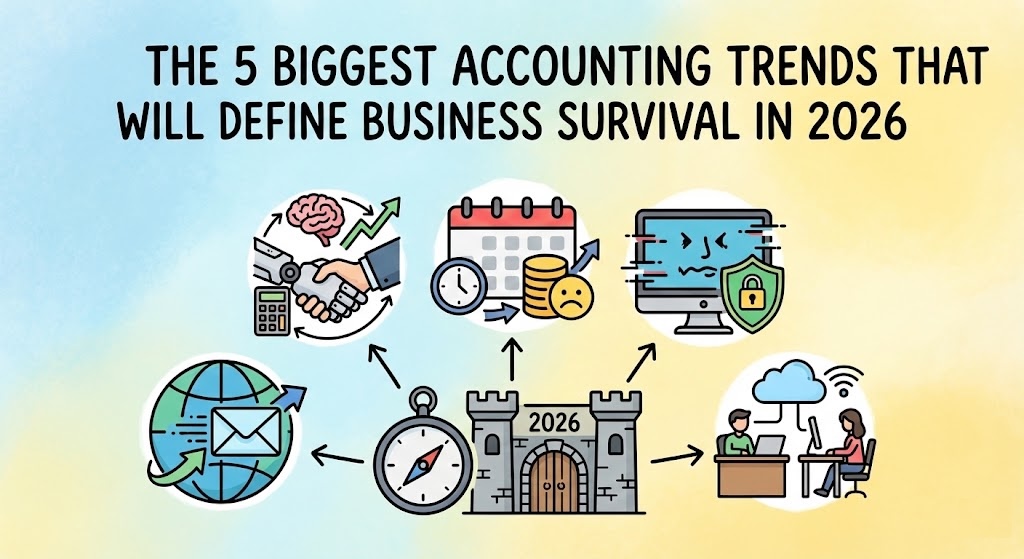

If you feel like the rules of doing business are changing faster than you can keep up, you aren’t alone. For freelancers and small business owners, 2026 is shaping up to be a turning point. We are finally moving away from the era of “I’ll get to that paperwork later” and into a world where automation is the standard and compliance is non-negotiable.
We have dug into the latest government budgets and global industry reports to bring you the five biggest shifts hitting the accounting world in 2026. Here is what you need to know to stay ahead.
In this article
- 1. Mandatory E-Invoicing Is Going Global
- 2. AI Will Supercharge Your Financial Productivity
- 3. Late Filing Penalties Are Increasing
- 4. The Rise of Deepfakes is Creating New Cybersecurity Risks
- 5. Remote Work is the New Standard (But It’s Hybrid)
- Future-Proof Your Business with Fynlo
1. Mandatory E-Invoicing Is Going Global
First, let’s clear up a common misconception: E-invoicing is not just emailing a PDF.
When you send a PDF, it is essentially a digital piece of paper—a human still has to open it, read it, and type the numbers into their system. True e-invoicing is data, not a document. It involves sending structured files (like XML) directly from your software to your client’s software (or the government’s), where it is read and processed instantly without human hands touching it.
Governments love this because it closes tax gaps, and now they are making it the law across the globe.
- Malaysia is expanding phased mandatory e-invoicing. According to LHDN’s implementation timeline, taxpayers with annual turnover of RM1m–RM5m must start from 1 January 2026, with smaller businesses phased in later (micro-businesses and those below the RM500,000 exemption threshold have different dates and treatment).
From 1 January 2026 the option to issue consolidated invoices for transactions over RM10,000 will be removed — each such sale will need a separate e-invoice. Check LHDN guidance for full banding details.
- Meanwhile, Europe is tightening the net significantly. Poland is launching its mandatory KSeF system for large taxpayers in February 2026 and most other businesses by April 2026. At the same time, France begins its major rollout in September 2026—requiring all businesses to be able to receive e-invoices, even if they aren’t yet required to issue them.
Note: KSeF (National e-Invoicing System) is essentially a central government “cloud” where you upload invoices. Instead of sending an invoice to your client, you send it to the government first, they validate it, and then it goes to the client.
If you work with clients in these regions, your current method of invoicing might become obsolete. You will likely need software that generates these specific machine-readable formats automatically to ensure you can still get paid.
2. AI Will Supercharge Your Financial Productivity
Ignore the doom-and-gloom headlines about robots taking jobs. In 2026, AI is less about replacing you and more about giving you your weekends back. The technology has matured from a “cool experiment” to a daily essential for cutting down busy work.
- The numbers back this up. Recent data shows that finance automation can cut the time spent on routine tasks by 40%, while decreasing reporting errors by 30%.
- It doesn’t just “do math.” AI handles the tasks that usually eat up your evening:
- Auto-categorization: It looks at a receipt from “Starbucks” and instantly knows it’s “Meals & Entertainment,” not “Office Supplies.”
- Anomaly Detection: It spots if you accidentally paid the same vendor twice or if a bill looks suspiciously higher than usual.
- Cash Flow Forecasting: It analyzes your spending habits to warn you, “Hey, based on your history, you might be short on cash in March,” before it happens.
- Auto-categorization: It looks at a receipt from “Starbucks” and instantly knows it’s “Meals & Entertainment,” not “Office Supplies.”
3. Late Filing Penalties Are Increasing
Governments are getting smarter. They are using better data to spot mistakes faster, and the leniency we saw in previous years is disappearing.
- Tax authorities around the world are moving toward “automated compliance. From the IRS in the US to the ATO in Australia, systems are being updated to trigger penalties the moment a deadline is missed. In this automated landscape, pleading ignorance is fast becoming a costly mistake.
- We are already seeing this in the UK. The government confirmed in its Autumn Budget 2025 that Corporation Tax late filing penalties will double for returns filed on or after April 1, 2026.
- Small businesses are often the most vulnerable. We have seen estate agents and small firms fined millions collectively for Anti-Money Laundering (AML) breaches, often just for failing to register paperwork on time. With penalties doubling, the cost of being disorganized is about to skyrocket.
4. The Rise of Deepfakes is Creating New Cybersecurity Risks
Small businesses often think they are too small to be targeted by hackers. Unfortunately, as large corporations tighten their security, attackers are pivoting to smaller, easier targets using terrifyingly realistic tech.
- Take the landmark 2024 case in Hong Kong. In this now-infamous scam, an engineering firm lost $25 million after an employee was tricked by a “deepfake” video call. The employee thought they were on a call with their CFO and other colleagues, but everyone else on the screen was an AI-generated fake.
- Deepfakes aren’t just for movies anymore. Scammers can now clone voice and video to impersonate suppliers or bosses, asking for “urgent” bank transfers. In 2026, verifying who you are paying is just as important as the payment itself.
5. Remote Work is the New Standard (But It’s Hybrid)
The concept of having your accountant “down the street” is fading. Business owners are increasingly prioritizing talent and tech-savviness over physical proximity.
- Flexibility is winning. Industry analysis projects that by the end of 2026, remote and hybrid arrangements will represent the dominant model for 80 – 85% of accounting positions.
- This allows you to hire the best. You can find financial experts for your specific industry regardless of where they live. It also means your financial data needs to be accessible securely from the cloud, anytime and anywhere.
Future-Proof Your Business with Fynlo
The common thread across all these trends is technology. Whether it is meeting new e-invoicing mandates, staying on top of deadlines to avoid steeper penalties, or leveraging AI to save time, you need tools that evolve as fast as the world does.
That is why we are excited to introduce the recently launched Fynlo AI.
We built Fynlo AI to directly address the productivity and accuracy challenges mentioned above. It allows you to simply upload receipts or bank statements, and our engine takes over from there. Fynlo AI extracts the data, categorizes every entry, and updates your financial reports in real-time with 100% accuracy.
No more manual data entry errors, no more late nights classifying expenses, and no more guessing where your business stands.
Ready to get ahead of the 2026 trends? Schedule a demo today and experience the future of automated accounting.