
The 2026 Profit Guide: 7 States That Help You Retain More Revenue
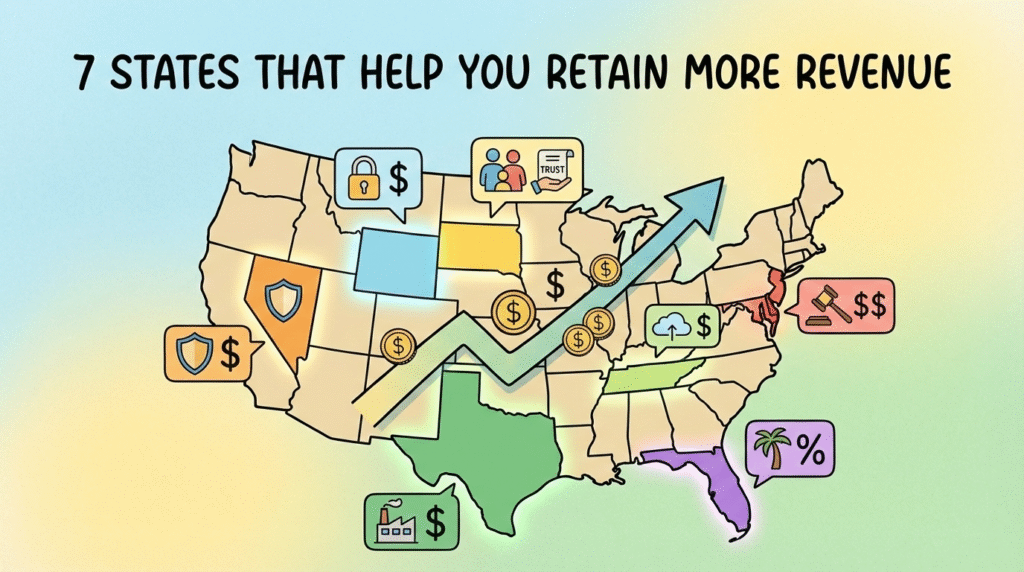
Most founders start their journey with a focus on top-line growth, but as the business matures, the focus shifts to the bottom line. In 2026, where your business “lives” is just as important as what it sells. Between state-level taxes, franchise fees, and administrative overhead, your choice of location can change your net profit by thousands of dollars annually. With the 2026 economy favoring remote-first structures, you have more flexibility than ever to choose a home base that aligns with your financial goals. Here is a detailed look at seven states designed for high retention and low friction. In this article Quick Comparison: 2026 Top Tax-Friendly States Selecting the right home for your business in 2026 requires balancing immediate fees against long-term strategic goals. Use the decision matrix below to identify your path, then verify the technical thresholds in the comparison table. State Annual Base Fee Tax-Exempt Threshold (2026) Privacy & Asset Protection Primary Strategic Advantage Wyoming $60 100% Tax-Free Elite: No member names in public records; strong charging order. The “Lean” Leader: Lowest combined maintenance and setup costs in the U.S. Delaware $300 100% Tax-Free (Non-DE income) Standard: Member names are generally private; expert court system. VC/IPO Ready: The mandatory standard for institutional investment. Texas $0 $2,650,000 (Revenue threshold) Standard: Publicly accessible officer names; stable pro-business courts. Scale Hub: Massive infrastructure and labor pool for large operations. Florida $138.75 100% Tax-Free (Personal income) Moderate: High transparency; aggressive business-first legislation. Growth Epicenter: Top migration destination for tech founders in 2025-2026. Nevada $350 $4,000,000 (Revenue threshold) Ultra: Strongest “Exclusive Remedy” charging order protection in the U.S. Maximum Shield: Preferred for high-liability professional or real estate assets. S. Dakota $55 100% Tax-Free (No income/capital gains) Dynasty Tier: Permanent court seal for trusts; generational privacy. Legacy Focus: Designed for multi-generational wealth and asset management. Tennessee $300+ $50,000 (Excise deduction) Moderate: Standard corporate disclosure; business-friendly climate. Remote Incentive: Asset-light agencies benefit from 2024 franchise tax repeal. 1.Wyoming: The Efficiency Leader Wyoming maintains a regulatory environment centered on administrative simplicity and established legal precedent. As the first state to codify the LLC structure in 1977, it has a long-standing history of prioritizing legislative stability for business entities. In 2026, Wyoming continues to hold the #1 rank on the Tax Foundation’s State Tax Competitiveness Index, a position it retains due to its lack of complex entity-level taxes. 2. Delaware: The Global Standard for Scaling Delaware remains the definitive ecosystem for companies with national or international ambitions. It is the legal home for over 65% of the Fortune 500 and approximately 79% of all U.S. initial public offerings (IPOs). Its reputation is anchored by the Court of Chancery, a specialized court that has spent over 200 years refining the case law that governs modern corporate life. 3. Florida: The Strategic Hub for Growth Florida has moved beyond its reputation as a retirement destination, recently overtaking traditional tech hubs like Austin and Seattle as the primary destination for founders. This shift is backed by massive state investment in high-speed connectivity and a “Business-First” legislative agenda that has matured significantly by 2026. 4. Nevada: Advanced Protection for Business Assets Nevada is often compared to Wyoming, but its positioning in 2026 is distinct: it is the jurisdiction of choice for high-liability industries or founders seeking the most aggressive legal “shield” available in the U.S. While Wyoming leads in efficiency, Nevada leads in asset defense. 5. Texas: The Choice for Large-Scale Operations Texas has moved beyond its reputation for traditional industry to become a global hub for technology and high-volume logistics. For founders planning to scale from a lean startup to a significant enterprise, the state offers a predictable fiscal environment designed to support high-growth operations. 6. South Dakota: Privacy for Long-Term Wealth South Dakota is a powerhouse for financial privacy and generational wealth preservation, often favored by founders whose strategy involves multi-generational longevity rather than a short-term exit. In 2026, it remains a global leader in trust and asset protection laws, frequently compared to international hubs like Switzerland for its commitment to confidentiality. 7. Tennessee: The Incentive for Remote Innovation Tennessee has become a favorite for the creative and tech-heavy remote workforce, particularly after completing the full repeal of its final income tax on interest and dividends in 2021. As of 2026, it is one of only nine states with no personal income tax of any kind. 2026 Business Location Checklist Before finalizing your choice, ensure you have addressed these three critical factors: Disclaimer: This guide is for informational purposes only and does not constitute legal, tax, or financial advice. While we strive to provide the most current data as of early 2026, tax laws and state fees are subject to change. Always consult with a qualified professional before making business formation or tax-related decisions. About the Author Isabella Jones started her career at Deloitte, where she worked on tax compliance for some of the country’s fastest-growing companies. She later joined Fynlo as Senior Financial Strategist, bringing that experience to freelancers and small business owners who need practical financial guidance without the corporate complexity. With an Accounting degree from Villanova University, Isabella focuses on making financial planning easier to understand and apply in day-to-day business. She works closely with freelancers and small businesses on areas like taxes, cash flow, and building more stable financial systems.