
5 Business Tasks You Should Outsource to Scale Faster
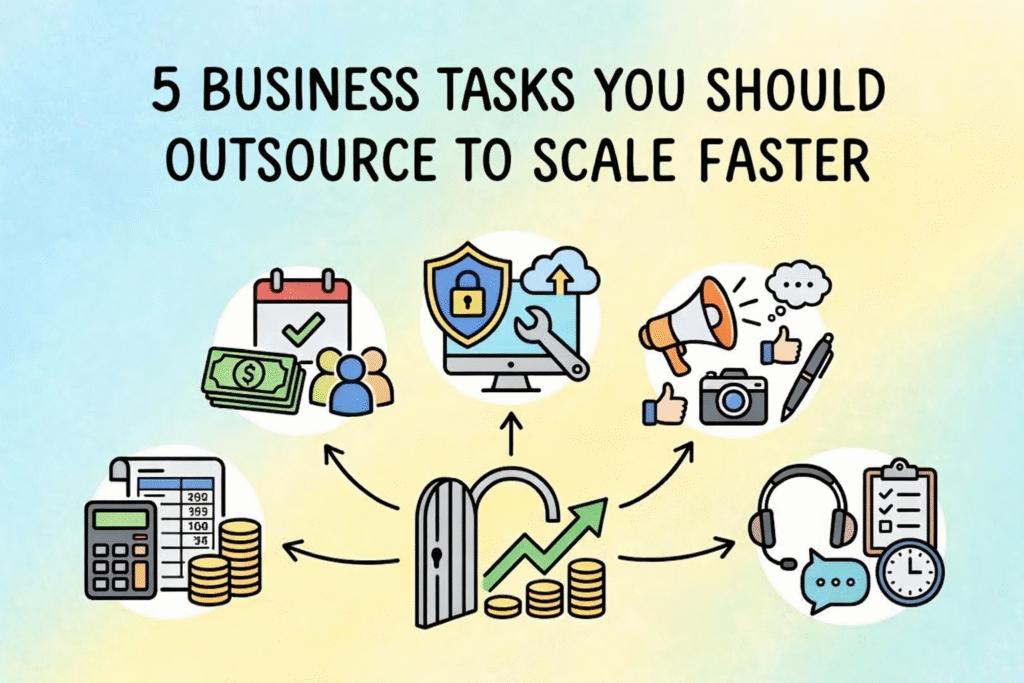
Most of us start our businesses with a “DIY” mindset. It works at first, but eventually, you hit a wall where there just aren’t enough hours in the day. Trying to handle everything yourself isn’t just exhausting—it actually stops your business from growing. Strategic outsourcing is about taking the specialized or repetitive stuff off your plate so you can focus on the work that actually moves the needle. In this Article Framework: How to decide which task to outsource first Before you hire anyone, you need to know where you’re currently wasting your energy. Take a look at your to-do list from the last week and plot your tasks into this simple grid: Task Profile Examples Action Low Skill / High Time Data entry, scheduling, basic emails Outsource these immediately. These are the “time-thieves” keeping you from big-picture work. High Skill / High Risk Tax filings, legal contracts, cybersecurity Outsource to experts. Don’t try to “wing it” here; the cost of a mistake is way too high. High Skill / High Growth Strategy, sales, closing big deals Keep these for yourself. This is the core of your business. 1. Moving from “Doer” to “CEO” in your finances The biggest hurdle for growing companies is the owner still acting as the daily bookkeeper. If you’re spending your Sunday nights categorizing expenses, you’re performing a job that pays much less than your actual worth as a business owner. By handing this off, you shift from “doing” the data entry to “reviewing” the financial health of your company. Modern tools like Xero, Quickbook, and Fynlo automate a lot of this, so your books stay clean without you ever touching a spreadsheet. This lets you spend your brainpower on sales and strategy—the things that actually increase your bank balance. 2. Staying on the right side of the IRS (Tax & Compliance) Tax rules change constantly, and trying to keep up with them is a full-time job in itself. If you’re handling your own filings or using a “cheap” service, you might not notice an error until you get a scary letter from the IRS. Outsourcing your tax and compliance work gives you a layer of protection. These experts track deadlines for payroll taxes and corporate returns so you don’t have to worry about interest or penalties. It’s less about “saving time” and more about moving that risk off your shoulders and onto a professional. 3. Reclaiming your calendar with admin support Admin tasks like managing your inbox, scheduling meetings, and updating your CRM are necessary, but they don’t bring in new revenue. As you grow, these “little things” multiply and start causing decision fatigue. If you’re buried under 50 unread emails, you aren’t in the right headspace to make big business moves. A Virtual Assistant can easily reclaim 10 to 15 hours of your week. Imagine what you could do with an extra two workdays every month. The goal is to make sure that every hour you spend working is spent on something that only you can do. 4. Protecting your business with managed IT Small businesses are huge targets for hackers because they usually don’t have the same defenses as the big guys. Managing your own cybersecurity is a massive liability. If your system crashes or you get hit by a data breach, it can shut you down for weeks. Outsourced IT providers offer 24/7 monitoring and backup plans. For most businesses, a monthly subscription for IT support is a lot cheaper than trying to recover from a ransomware attack or a total system failure. It’s basically an insurance policy for your data. 5. Scaling your brand with marketing experts You probably know your industry inside and out, but that doesn’t mean you’re an expert in SEO or social media algorithms. Marketing moves fast, and trying to keep up with every new trend is an inefficient use of your time. By outsourcing your marketing to an agency or a pro freelancer, you get high-level strategy and content that actually looks professional. They have the tools to track what’s working and what isn’t, making sure your marketing budget is actually bringing in new leads instead of just disappearing. A better way to scale Outsourcing isn’t about “giving up” on parts of your business; it’s about being smart with your resources. When you delegate things like bookkeeping, IT, and admin, you lower the chance of human error and get your life back. Fynlo is designed to help with this transition. We give you the financial clarity you need to manage your business from the top down, while the experts handle the day-to-day details. Ready to scale? [Schedule a call]
7 Tips to Build a Seven-Figure Business for Freelancers and Small Business Owners

Growing a business beyond the early stages is a constant evolution. In the beginning, success comes from sheer hustle, saying yes to every opportunity, learning on the fly, and doing whatever it takes to get paid. But at some point, the same approach that helped you grow becomes the very thing that holds you back. The truth is, the jump from six to seven figures is not about working more hours. It is about shifting how you think, how you operate, and how you structure your business so it can grow without depending on you for every task. This is the moment when you stop being the person who does the work and start becoming a builder of a business that can scale. Here are seven practical, human, and sometimes uncomfortable tips to guide you toward the one million dollar milestone. Tip 1: Treat Adaptability as a Daily Habit If there’s one thing guaranteed in business, it’s change. The strategy that helped you thrive two years ago might barely move the needle today. AI has transformed how service businesses operate, client expectations are evolving, and new competitors appear overnight. A seven-figure business isn’t built by clinging to what used to work. It grows because the owner stays curious, open, and willing to adjust. Adaptability doesn’t mean chasing every trend; it means evolving your offers, systems, and approach before the market forces you to. Tip 2: Be Honest With Yourself (Even When It’s Uncomfortable) A powerful trait shared by successful founders is intellectual honesty. It’s the ability to look at your business with clear eyes, even when the truth stings a little. Review your numbers and ask the hard questions: • Which clients are truly profitable? • Where are we losing time, money, or energy? • Is this offer still relevant? Honest evaluation doesn’t make you pessimistic. It makes you intentional, and that precision fuels smarter decisions as your business scales. Tip 3: Make Clients Feel Seen, Not Sold To You don’t need the flashiest sales pitch to grow; you need empathy that makes clients feel genuinely understood. Before a meeting, don’t just rehearse your offer. Learn about the client, their industry, their recent wins or challenges, and what truly matters to them. Ask thoughtful questions. Listen more than you talk. Tailor your solution like it was built just for them. Clients stay longer, spend more, and refer better when they feel seen and supported, not pushed. Tip 4: Write Things Down (Your Future Team Will Thank You) A freelancer sells time. A business sells a repeatable experience that doesn’t depend on one person. The moment you find yourself repeating a task, it’s ready to be documented. Create simple Standard Operating Procedures (SOPs) so anyone can deliver the same level of client experience. SOPs reduce errors, speed up onboarding, and turn your know-how into real business value. Someday, these processes might be what makes your company sellable or scalable. Tip 5: Start Delegating Before You Feel Ready If you’re doing everything yourself, growth will always hit a ceiling. Delegation isn’t about handing off tasks; it’s about handing off ownership. Instead of hiring someone to “help with admin” or “post on social media,” look for people who can manage an entire function. Free up your time for what only you can do: strategy, relationships, product innovation, and growth. That’s where seven-figure leaps are made. Tip 6: Say What You Mean and Follow Through High-trust communication is one of the most underrated growth engines. In a world where many over-promise and under-deliver, doing what you said you would do instantly sets you apart. Clients remember how you make them feel. Teams stay when they feel respected. Partners refer you when they trust you. Marketing gets attention, but relationships build momentum. Tip 7: Treat Failure as Feedback, Not a Full Stop Not every offer will sell. Not every hire will work out. Not every idea will land. That’s normal for any business growing to seven figures. The difference is how you respond. Instead of letting a setback derail you, ask: • What did this teach me about timing, audience, offer, or pricing? • What would I adjust next time? Resilience isn’t avoiding mistakes; it’s refusing to repeat them. Your Next Move: Get Clarity Behind the Scenes Many founders stay stuck not because of lack of ambition, but because their financial picture feels overwhelming or unclear. The moment you understand your numbers, everything becomes easier: pricing, hiring, investments, and planning for growth. You don’t need to untangle it alone. Schedule a Fynlo demo and get a clear view of your finances so you can scale with confidence and less stress.