
LLC vs. S-Corp in 2026: How to Save $10,000 in Self-Employment Tax
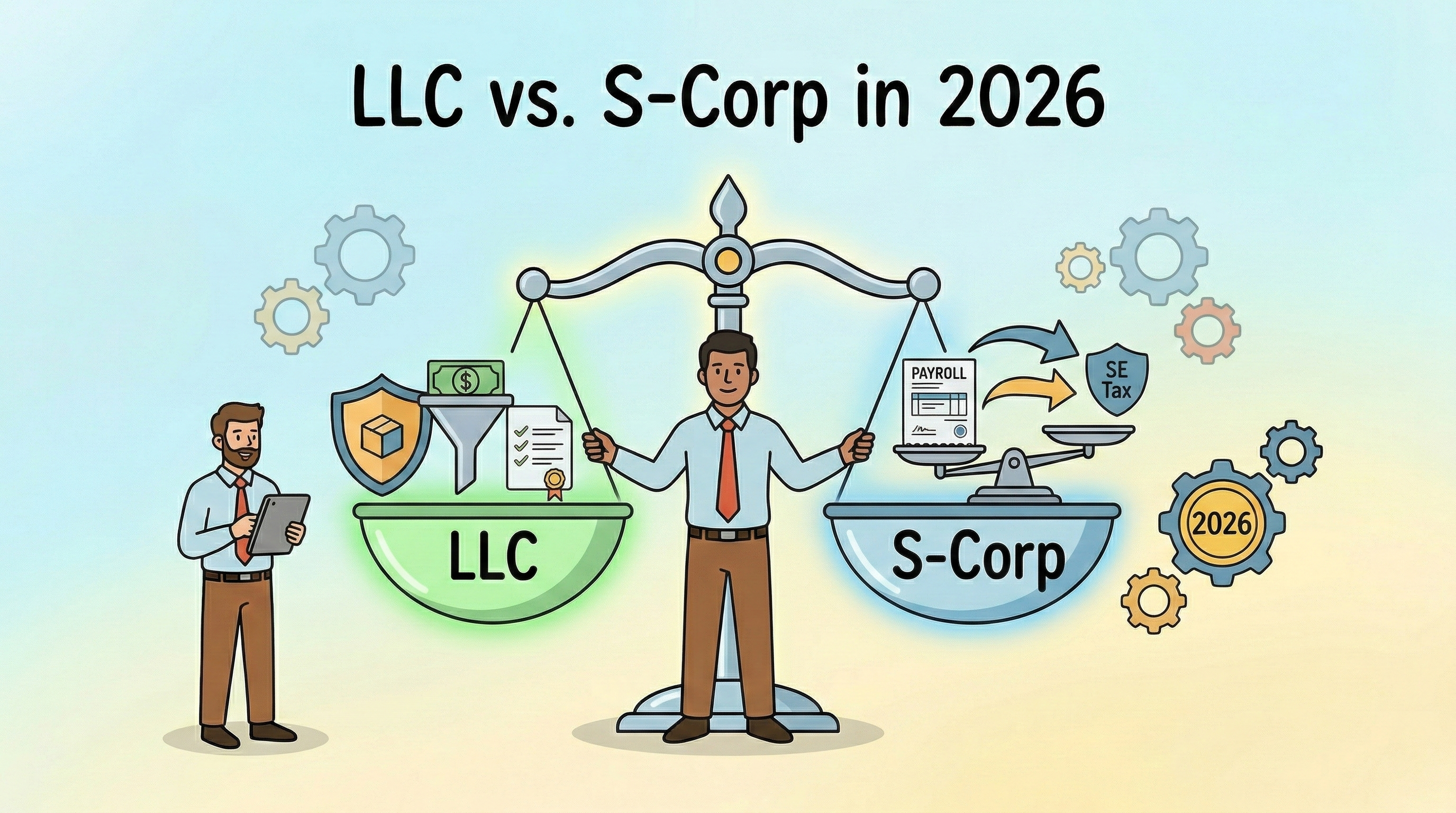
If you’ve successfully scaled your business past the six-figure mark, you’ve reached a significant milestone. Yet, as your revenue grows, the business structure that served you as a lean startup may no longer be the most efficient vehicle for your success. In 2026, many high-performing founders are discovering that staying in their “default” setup is a choice that costs them thousands of dollars in unnecessary tax leakage every single year. Most freelancers stay in a basic LLC because it’s easy. While simplicity has its merits in the beginning, relying on it indefinitely often leads to a massive missed opportunity for wealth building. In a six-figure business, that “simplicity” isn’t free—it represents capital that could be better spent on a strategic new hire, upgrading your technology stack, or funding your retirement. In this article Understanding the Self-Employment Tax Threshold To understand how to save money, we first have to look at how the IRS views a standard LLC. In the eyes of the tax man, you and your LLC are a “disregarded entity”—meaning you are essentially the same person. This results in 100% of your net profit being hit with a 15.3% self-employment tax to cover Social Security and Medicare. As you scale, this math becomes painful. By electing S-Corp status, you fundamentally change the relationship between you and your money. You become an employee of your own business, allowing you to pay yourself a “reasonable salary” (which is taxed) while taking the remaining profit as a distribution. These distributions are exempt from that 15.3% tax, which is exactly where the five-figure savings come from. Business Structure Comparison Between LLC vs S-Corp vs C-Corp Selecting a structure is more than just tax optimization; it is about ensuring your legal framework aligns with your long-term strategic vision. While the S-Corp is often the ideal choice for service-based founders, the C-Corp (or “Inc.”) remains the gold standard for those intending to scale globally or raise outside capital. In fact, approximately 95% of venture capital is directed toward C-Corps because they support the unlimited shareholders and complex stock classes that institutional investors demand. Feature Standard LLC S-Corp Election C-Corp (Inc.) Tax Filing Personal 1040 (Schedule C) 1120-S + K-1 Form 1120 (Corporate) Payroll Requirement None Mandatory W-2 salary Mandatory for active owners Self-Employment Tax 15.3% on 100% of profit 15.3% on salary only None (on dividends) Management Style Flexible; Member-managed; no board required Formal; Requires Board of Directors and Officers Strict; Board oversight with mandatory annual minutes Audit Risk Higher; Schedule C filings often draw IRS scrutiny Lower; Formal structure and payroll reduce “red flags” Moderate; Professional compliance is expected Primary Benefit Maximum simplicity Tax savings for $100k+ earners Scalability & VC funding Primary Drawback High tax as revenue scales Compliance & payroll costs Potential double taxation Finding the Salary Sweet Spot for Maximum Savings The biggest “catch” with an S-Corp is that you must pay yourself a “reasonable salary”. If you pay yourself $0 to avoid all taxes, the IRS will audit you; if you pay yourself your entire profit, the S-Corp becomes a useless expense. We generally look at three tiers of profit to find that “sweet spot”: Maximizing the 20% Qualified Business Income Deduction The Qualified Business Income (QBI) deduction allows many business owners to deduct up to 20% of their business income from their taxes. For S-Corp owners, this deduction is calculated on your profit after your salary is paid. While powerful, the 20% Qualified Business Income (QBI) deduction is subject to limits once your total taxable income rises above the annual thresholds (for example, around $203,000 for single filers and $406,000 for married filing jointly, indexed for inflation). Above these levels, the deduction is gradually restricted based on the type of business you operate and how much you pay in W-2 wages or own in qualified business property. For specified service businesses (such as consulting, legal, medical, and similar fields), the deduction phases out completely as income increases. For other businesses, the deduction can still apply but is capped using wage and property formulas. The key planning strategy is to set a salary that meets IRS “reasonable compensation” rules without unnecessarily reducing the pool of business profit that may qualify for the 20% QBI deduction. Protecting Your Assets by Maintaining the Corporate Veil Both LLCs and Corporations offer a layer of protection for your personal assets, shielding them from business debts and lawsuits. However, this protection depends on maintaining a clear separation between personal and business activity. Implementation Checklist & Deadlines Transitioning to an S-Corp requires discipline in your accounting and adherence to strict IRS timelines. 1. The March 15th DeadlineTo be taxed as an S-Corp for the 2026 calendar year, you must file IRS Form 2553 by March 15, 2026. If you miss this date, your election typically won’t take effect until the following tax year, though “Late Election Relief” is sometimes available for businesses with a valid reason for the delay. 2. Formalize Your BookkeepingBecause the S-Corp is a separate tax entity, “co-mingling” funds (using business money for personal groceries) is a significant compliance risk. You must maintain pristine records and clear separation between business and personal accounts. 3. Set Up Monthly PayrollYou cannot simply “take money out” as an S-Corp owner. You must use a payroll provider (like Gusto or Rippling) to withhold taxes from your salary and issue yourself a W-2 at the end of the year. Moving Toward an Optimized Structure The move from a standard LLC to an S-Corp is a sign of business maturity. It shifts your focus from simply maintaining operations to strategically optimizing for wealth. If your business is consistently netting over $100,000, continuing as a basic LLC is no longer a matter of simplicity—it’s a matter of unnecessary expense. About the Author Isabella Jones started her career at Deloitte, where she worked on tax compliance for some of the country’s fastest-growing companies. She later joined Fynlo as Senior Financial Strategist, bringing that experience to freelancers and small business owners who need practical financial guidance without the corporate complexity. With an Accounting degree from Villanova University, Isabella focuses on making financial planning easier to understand and apply in day-to-day business. She works closely with freelancers and small businesses on areas like taxes, cash flow, and
Advanced LLC Strategy: How to Structure for Growth and Asset Protection in 2026
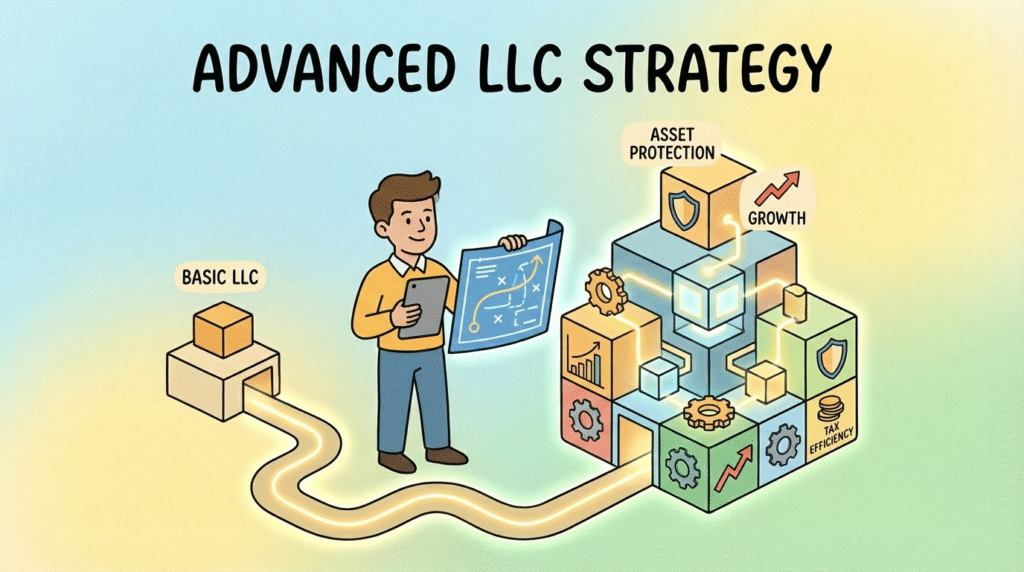
Most founders start with a single LLC because it is the simplest path to getting a tax ID. But as your revenue grows or you begin developing your own products, a single-entity setup may no longer be the most efficient choice. In 2026, the goal is to build a structure that protects your personal assets while remaining flexible enough to scale. Here is how experienced founders structure their businesses to manage risk and optimize for long-term growth. In this article The “Parent & Child” Strategy (Holding Companies) When all your business assets—client contracts, intellectual property (IP), and equipment—live in one LLC, they are all exposed to the same risks. If a client dispute leads to a lawsuit against that LLC, every asset inside it is potentially at risk. The Solution: A Two-Tiered Structure Strategic State Selection: Where to Place Your Entities When choosing where to register your “Parent” or “Child” companies, you can take advantage of specific state rules to manage your tax burden and maximize protection. Wyoming: The Ideal “Parent” Home Wyoming is frequently chosen for the Parent company because it does not require the names of owners to be listed in public records. In 2026, this state-level anonymity provides a layer of data security. Additionally, Wyoming has strong Charging Order laws, meaning if you face a personal lawsuit, it is very difficult for a creditor to seize your business assets. Texas: Scaling the “Child” Company For an Operating Company with a physical presence, Texas offers a significant threshold for small businesses. While Texas has a “Margin Tax,” businesses with total revenue below $2,650,000 in 2026 generally owe $0 in state franchise tax. This allows you to utilize Texas’s vast talent pool and infrastructure without a state-level tax bill until you reach a significant scale. Nevada: High-Level Liability Protection If your business operates in a high-liability field, Nevada is a strong choice for your Operating Company. Nevada law provides an “Exclusive Remedy” protection. This means that a charging order is the only way a creditor can pursue a member’s interest, preventing them from ever seizing business assets or forcing the company to shut down to pay a debt. Tennessee: The “Asset-Light” Advantage Tennessee recently overhauled its tax code, which is highly beneficial for remote agencies and freelancers. In the past, the state taxed businesses based on the value of the physical property they owned (the “property measure”). As of 2026, that rule has been eliminated. Now, the franchise tax is calculated at 0.25% of your apportioned net worth. For example, if your business has a net worth of $200,000 and 50% of your activity is in Tennessee, you are taxed on $100,000 ($250 per year). Additionally, a $50,000 standard deduction now applies to the excise tax, which exempts many small businesses with modest profits from paying that portion of the tax entirely. Planning for an Institutional Exit Even if you do not plan to sell your business immediately, keeping your entity “exit-ready” ensures you don’t lose value during a future sale or funding round. The “Delaware Flip”Most startups begin in Wyoming or their home state to save on costs. Institutional investors, though, almost exclusively require a Delaware entity because of its sophisticated court system. “Flipping” to Delaware involves a legal process called a Statutory Conversion. In this process, you file “Articles of Conversion” in both your current state and Delaware. This legally transforms your existing LLC into a Delaware Corporation while maintaining your business’s history, EIN, and contracts. Doing this 12 months before a planned sale ensures that your legal foundation is already in the format buyers expect, preventing delays in the deal. The Financial Impact of Professional Record-KeepingDuring a sale, buyers perform “due diligence” to verify your business’s health. If your financial records are unorganized or personal and business expenses are blurred, it increases the buyer’s risk. Professionally maintained books signal a mature, low-risk operation, which often results in a higher final valuation for the founder. The Strategic Path Forward Moving beyond a single-entity setup is a clear signal that your business has transitioned from a proof-of-concept to a scaling enterprise. While the administrative weight of managing a “Parent and Child” structure or maintaining multi-state compliance in Wyoming and Delaware can feel significant, it is the most effective way to decouple your hard-earned assets from daily operational risks. Building this legal “firewall” today ensures that when you reach the point of an institutional exit or a major funding round, your foundation is already in the format that sophisticated buyers expect. By prioritizing professional record-keeping and clear entity separation now, you turn your corporate structure into a silent partner that supports your growth instead of a liability that limits it. About the Author Isabella Jones started her career at Deloitte, where she worked on tax compliance for some of the country’s fastest-growing companies. She later joined Fynlo as Senior Financial Strategist, bringing that experience to freelancers and small business owners who need practical financial guidance without the corporate complexity. With an Accounting degree from Villanova University, Isabella focuses on making financial planning easier to understand and apply in day-to-day business. She works closely with freelancers and small businesses on areas like taxes, cash flow, and building more stable financial systems.
Wyoming vs. Delaware LLC: A Strategic Look at Your Business Home in 2026
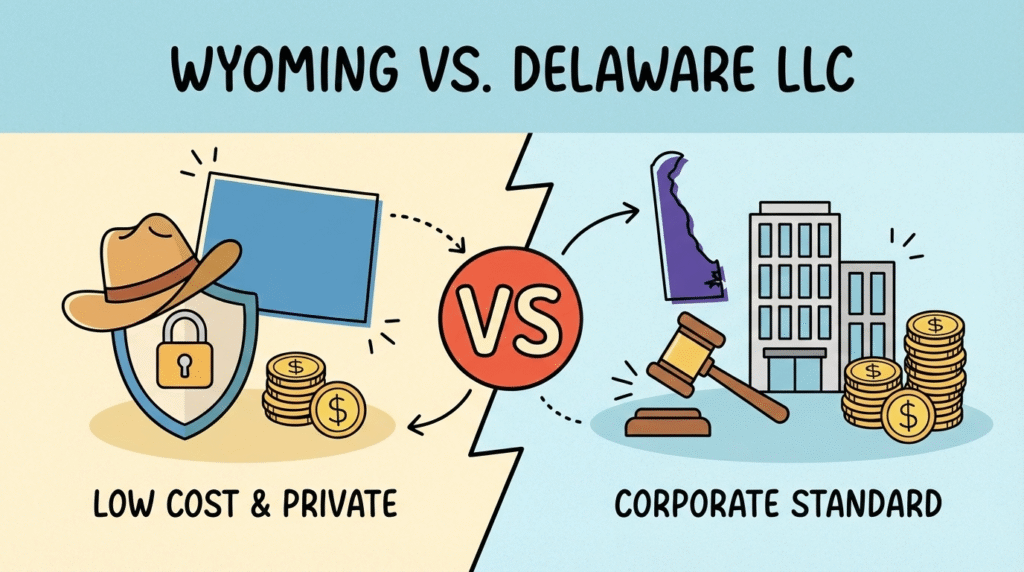
I recently caught up with a founder who was set on registering her digital agency in Delaware. When I asked why, her answer was simple: “It’s what everyone does.” After we walked through her three-year plan, it turned out she was about to take on administrative costs and legal layers that her current model didn’t actually need. Picking a state for your LLC isn’t a one-size-fits-all choice anymore. In 2026, with state filing systems going digital and federal reporting—like the Corporate Transparency Act—getting more specific, the right choice depends on your funding path, your need for privacy, and where you actually sit at your desk. Let’s look at the actual numbers and the logic behind both states so you can make a call based on what fits your business today. In this article 2026 Maintenance and Compliance Overview To see the long-term impact on your bank account, you need to look at the recurring costs. While starting an LLC costs roughly the same in both states, the yearly bills look quite different. Category Wyoming LLC Delaware LLC Yearly Maintenance Fee $60 (Annual Report) $300 (Franchise Tax) Late Filing Penalty No late fee; but non-filing = dissolution. $200 Flat Fee + 1.5% Interest State Income Tax 0% 0% (unless the LLC has Delaware-source income) Setup Cost (State Fee) $100 $110 Privacy Rank (2026) Top Tier Mid Tier 1. Why Delaware is the “Legal Standard” Delaware’s biggest selling point isn’t its tax rate; it’s the legal system. The state is home to the Court of Chancery, a specialized court that only hears business disputes. Because judges (not juries) decide these cases, the outcomes are incredibly predictable. This predictability is exactly why over 65% of Fortune 500 companies are incorporated in Delaware. If you plan to raise venture capital or offer stock options to employees, most investors will expect a Delaware entity. It’s the “legal language” they already speak, which can save you a lot of time during a fundraising round. 2. The Annual Cost of Doing Business in Delaware While the legal benefits are a major draw, they come with a fixed price tag. Every Delaware LLC pays a $300 Annual Franchise Tax. Think of this as a mandatory subscription fee to keep your company active. In 2026, the state remains very strict about its June 1st deadline. If you’re even a day late, a $200 penalty hits your account. Over a five-year stretch, you’re looking at a minimum of $1,500 in state taxes just to exist in Delaware. For a bootstrapped startup, that is capital that could have been spent on your first marketing campaign or hardware. 3. The Wyoming Advantage: Privacy and Lower Overhead If you aren’t chasing Wall Street investors, Wyoming is often the smarter move for lean operations. They don’t have a franchise tax; they just have a $60 Annual Report Fee. Beyond the savings, Wyoming is famous for its privacy. In 2026, data security is a top concern for founders. Wyoming allows you to keep the names of your LLC’s members and managers off the public record. In a world where your personal info is often just a Google search away, this “anonymity by default” is a huge plus for many business owners. 4. Asset Protection: The “Charging Order” Shield One technical detail you’ll appreciate is Wyoming’s Charging Order Protection. This is a legal shield that prevents a personal creditor from seizing your business assets or forcing you to sell the company to pay a personal debt. Wyoming was the first state to give this protection to single-member LLCs, and their laws are still among the strongest in the country. Delaware offers great protection too, but Wyoming’s statutes are often preferred by legal experts for smaller, closely-held businesses that want to keep their professional and personal lives strictly separate. 5. Registering “Away from Home”: The Foreign Qualification Rule This is the part where many founders accidentally double their workload. If you live in a state like California or New York but register your LLC in Wyoming to save on taxes, you usually have to register as a “Foreign LLC” in your home state anyway. This process often involves: Industry data suggests that roughly 30% of founders who incorporate out-of-state eventually pay significantly more in multi-state compliance fees than they would have by simply incorporating in their home state. Unless you have a specific legal or privacy reason to be in Wyoming or Delaware, incorporating where you live is often the path of least resistance. Which State Fits Your Business? Deciding on a state usually comes down to your “exit strategy” and where you actually spend your time. Choosing Your Foundation Don’t pick a state just because it’s “what everyone does”. Whether you need Delaware’s legal prestige for future investors or Wyoming’s low-cost privacy, the real win is in keeping your personal and business records strictly separate. By staying organized from day one, you ensure your legal foundation actually protects your assets instead of just adding to your administrative workload. About the Author Isabella Jones started her career at Deloitte, where she worked on tax compliance for some of the country’s fastest-growing companies. She later joined Fynlo as Senior Financial Strategist, bringing that experience to freelancers and small business owners who need practical financial guidance without the corporate complexity. With an Accounting degree from Villanova University, Isabella focuses on making financial planning easier to understand and apply in day-to-day business. She works closely with freelancers and small businesses on areas like taxes, cash flow, and building more stable financial systems.
LLC Tax Filing Checklist: Your Guide to Staying Compliant
Navigating tax season for a Limited Liability Company (LLC) can feel like a maze. While an LLC provides legal liability protection, when it comes to taxes, its structure is incredibly flexible, offering different paths you can take. This flexibility is a huge advantage but also means you need to know exactly which route is right for you. This checklist is designed to help freelancers and small business owners in the USA understand their LLC tax filing requirements. We’ll break down the forms you need, the documents you must gather, and the critical deadlines to keep you on the right side of the IRS. Table of Contents LLC Taxation Explained This is where things get interesting. Unlike an S-Corp, an LLC doesn’t have its own tax classification. Instead, the IRS sees an LLC as a “disregarded entity” by default. This means the IRS “disregards” the LLC and taxes its owner(s) based on the business structure they’d otherwise be. This gives you a few different options: This flexibility is a huge benefit, but the first step is knowing which classification your LLC falls under. The Most Important Deadline to Know Your tax deadline depends entirely on how your LLC is taxed. These deadlines apply to LLCs with a calendar-year fiscal year. LLCs with a fiscal year ending on a different date have deadlines based on their tax year-end (e.g., the 15th day of the third month after the fiscal year for Partnerships and S-Corps, or the fourth month for C-Corps). Consult a tax professional to confirm your specific deadlines. No matter your classification, if you need more time, you can file for an extension using the appropriate form (e.g., Form 4868 for a Sole Proprietorship or Form 7004 for a Partnership or Corporation). This gives you an additional six months to file, but remember, an extension to file is not an extension to pay. The LLC Tax Filing Checklist Let’s get down to business. Here are the items you’ll need to prepare for your LLC tax filing, based on your classification. 1. Essential Financial Records Start by getting your financial house in order. Make sure invoices and receipts are organized and complete. This is the foundation of every tax return. 2. Key IRS Forms Feeling a bit overwhelmed by the list of forms? Don’t worry—you don’t have to be a tax expert to understand the essentials. Here’s a breakdown of the most important forms you’ll encounter and a heads-up on what to watch out for. Form 1040 & Schedule CFor single-member LLCs, this is the main event. You will file Schedule C, Profit or Loss from Business, as part of your personal Form 1040. This form reports all your business income and expenses. A common mistake here is mixing personal and business expenses, which can lead to messy audits. Form 1065 & Schedule K-1For multi-member LLCs, this is the main informational return. Your LLC will file Form 1065, U.S. Return of Partnership Income. This form reports the business’s overall financial activity. You’ll then use Schedule K-1 to report each partner’s individual share of the profits and losses, which they then use to file their personal returns. A frequent error is miscalculating each member’s ownership percentage, which can lead to incorrect allocations. Form 1099-NEC: Nonemployee CompensationThis form is for reporting payments to freelancers or independent contractors who are not employees. You must file a 1099-NEC for each person you paid $600 or more during the year. The most common mistake with this form is missing the filing deadline, which is January 31, 2026. Since that date falls on a weekend, the due date is the next business day, which is Monday, February 2, 2026. The penalties for late filing of returns due in 2025 are tiered. The penalty is $60 per form if filed within 30 days after the due date, $120 if more than 30 days late but filed by August 1, 2025, and $310 if filed after August 1, 2025, or not filed at all. Penalties for 2026 returns due in 2027 may increase due to inflation adjustments; check IRS updates for exact amounts. Note that businesses filing 10 or more returns in 2026 must e-file and obtain a Transmitter Control Code (TCC) by November 1, 2025. Another frequent error is using the wrong form (e.g., using a 1099-MISC instead of a 1099-NEC for non-employee compensation) or entering an incorrect Taxpayer Identification Number (TIN), so be sure to double-check that information. 3. Don’t Forget These Details! A few small mistakes can lead to big problems. Double-check these items before filing. The Cost of Missing a Deadline The penalties for filing late depend on your LLC’s tax classification. Get Ready for a Smoother Tax Season Preparing for an LLC’s tax filing can feel like a big responsibility. But with a clear plan and the right tools, it’s entirely manageable. By proactively gathering your documents and paying close attention to deadlines, you can minimize stress and avoid costly penalties. Disclaimer: The information provided in this guide is for informational purposes only and does not constitute legal or tax advice. For specific tax situations, always consult with a professional accountant or tax advisor. This is where having a reliable accounting system can make all the difference. When all your financials—from income and expenses to payroll—are organized and synced in one place, generating the reports you need for your tax professional (or for filing yourself) becomes a streamlined process. Fynlo is designed to simplify these tasks, so you can focus on what you do best: running your business. Ready to see how Fynlo can transform your tax prep? Schedule a call with our experts to find out more!
Tax Filing Guide for S Corp, C Corp and LLC
Picking the right business structure is a big deal, and taxes are a huge part of that decision. In this article, we’re breaking down the tax filing side of things for C Corps, S Corps, and LLCs, so freelancers and business owners can get a handle on the forms and deadlines for each. If you’re looking for a broader comparison, Choosing the Best Business Structure for Freelancers is a solid starting point! The article was last updated as of 4 March 2025. Keep in mind that tax rules and limits can change, so be sure to watch out for updates or consult a tax professional for the latest information. Table of Contents Brief Highlights: Comparing C Corp, S Corp and LLC Here’s a quick rundown of the three business structures to give you the big picture. In the next sections, we’ll break down the details of tax treatment and the specific forms you’ll need to know. It’ll all come together as we go. Category S Corporation (S Corp) C Corporation (C Corp) Limited Liability Company (LLC) Tax Forms – Form 1120-S– Shareholders file Schedule K-1 on personal returns – Form 1120 – Shareholders report dividends on personal returns Depends on tax classification. See LLC section. Filing Deadlines March 15 2025*; extensions available April 15 2025*; extensions available Depends on tax classification. See LLC section. State Taxes Varies; some states do not recognize S Corp status Subject to state corporate income taxes Subject to state taxes depending on classification Eligibility Requirements – Must be a domestic business– Up to 100 shareholders – Individuals only – No limit on shareholders– Can include foreign and corporate owners – No ownership restrictions – Flexible member structure Ownership Restrictions – Max 100 shareholders– One class of stock– U.S. citizens/residents only – Unlimited shareholders– Can issue multiple stock classes – No restrictions– Members can be individuals, corporations, or foreign entities Compliance Requirements – Annual meetings– Shareholder voting– File annual reports – Annual meetings– Corporate governance– Strict record-keeping – Varies by state– Fewer formalities than corporations Average Formation Costs# ~$1,200 ~$633 ~$50-$500 depending on state Fundraising Ability – Limited– Cannot issue preferred stock – High– Can issue both common and preferred stock Limited unless electing C Corp tax treatment Dividend Taxation Distributions taxed once at shareholder level Dividends taxed twice (corporate and shareholder level) Not applicable unless taxed as C Corp Payroll Tax Implications Must pay reasonable salary to shareholder-employees Corporate officers are employees subject to payroll taxes Members typically pay self-employment tax unless S Corp election made Passive Income Limits (such as rent, interest, or certain royalties) Passive income limited to 25% of gross receipts No passive income limitations No passive income restrictions Liability Protection Protects shareholders’ personal assets Protects shareholders’ personal assets Protects members’ personal assets Conversion Flexibility Can convert to C Corp; changing to LLC requires dissolution Can convert to S Corp or LLC with filings and approvals Can elect S Corp/C Corp taxation; conversions depend on state rules Foreign Ownership Not allowed Allowed Allowed Administrative Burden Higher than LLC; less than C Corp High due to strict governance requirements Low; fewer formalities required Key Tax Advantages – Avoids double taxation– QBI deduction available – Potential for certain deductions not available to pass-through entities– Can deduct health insurance premiums for employees – Flexible tax treatment (can choose to be taxed as a partnership, S corp, or C corp)– Simpler tax compliance than C-corp if taxed as a partnership Key Tax Disadvantages – Reasonable salary requirement– Limitations on QBI deduction for certain businesses – Double taxation– More complex tax compliance – Members subject to self-employment tax (unless taxed as C-corp)– Less established than C-corps in some states Best For Small businesses seeking tax savings through pass-through taxation Larger businesses seeking growth through investment and stock issuance Startups, freelancers, or small businesses needing flexibility * For calendar-year corporations, Form 1120 is due on April 15, and Form 1120-S is due on March 15. For fiscal-year corporations, the deadline is the 15th day of the fourth month (1120) or third month (1120-S) after the fiscal year ends. # Formation costs vary by state and the scope of professional services. S Corporations Tax Filing S corps offer a unique tax structure, blending the legal benefits of a corporation with the tax advantages of a partnership. This pass-through taxation model avoids the double taxation burden of C corporations, making it an attractive option for many small businesses. Pass-Through Taxation One of the most significant advantages of an S corporation is its pass-through taxation model. Unlike C corporations, which are subject to double taxation (taxed at both the corporate and shareholder levels), S corps do not pay federal income tax at the corporate level. Instead, the corporation’s profits and losses are passed through to the shareholders, who report them on their individual tax returns (Form 1040). This structure avoids the double taxation burden and can result in significant tax savings for business owners. Form 1120-S Form 1120-S, the U.S. Income Tax Return for an S Corporation, is the primary form S corps use to report income, deductions, gains, and losses to the IRS. It ensures the corporation’s financial activity is accurately reported and provides shareholders with the information needed to complete their individual tax returns. The form is due by March 15th for calendar-year taxpayers (or the 15th day of the third month after the fiscal year ends). If additional time is needed to prepare the return, S corps can request an extension using Form 7004, which grants an automatic six-month extension. However, it’s important to note that an extension to file does not extend the deadline for paying any taxes owed. Estimated tax payments must still be made by the original due date to avoid penalties and interest. Schedule K-1 Schedule K-1 details each shareholder’s individual share of the corporation’s income, deductions, credits, and other tax items. Shareholders use this information to complete their individual Form 1040. W-2 Salary, Distributions, and Form 1040 (The Owner’s Perspective) If you own and work for an S corp, you must