
Why “Cheap” Bookkeeping is the Most Expensive Risk Your Business Can Take
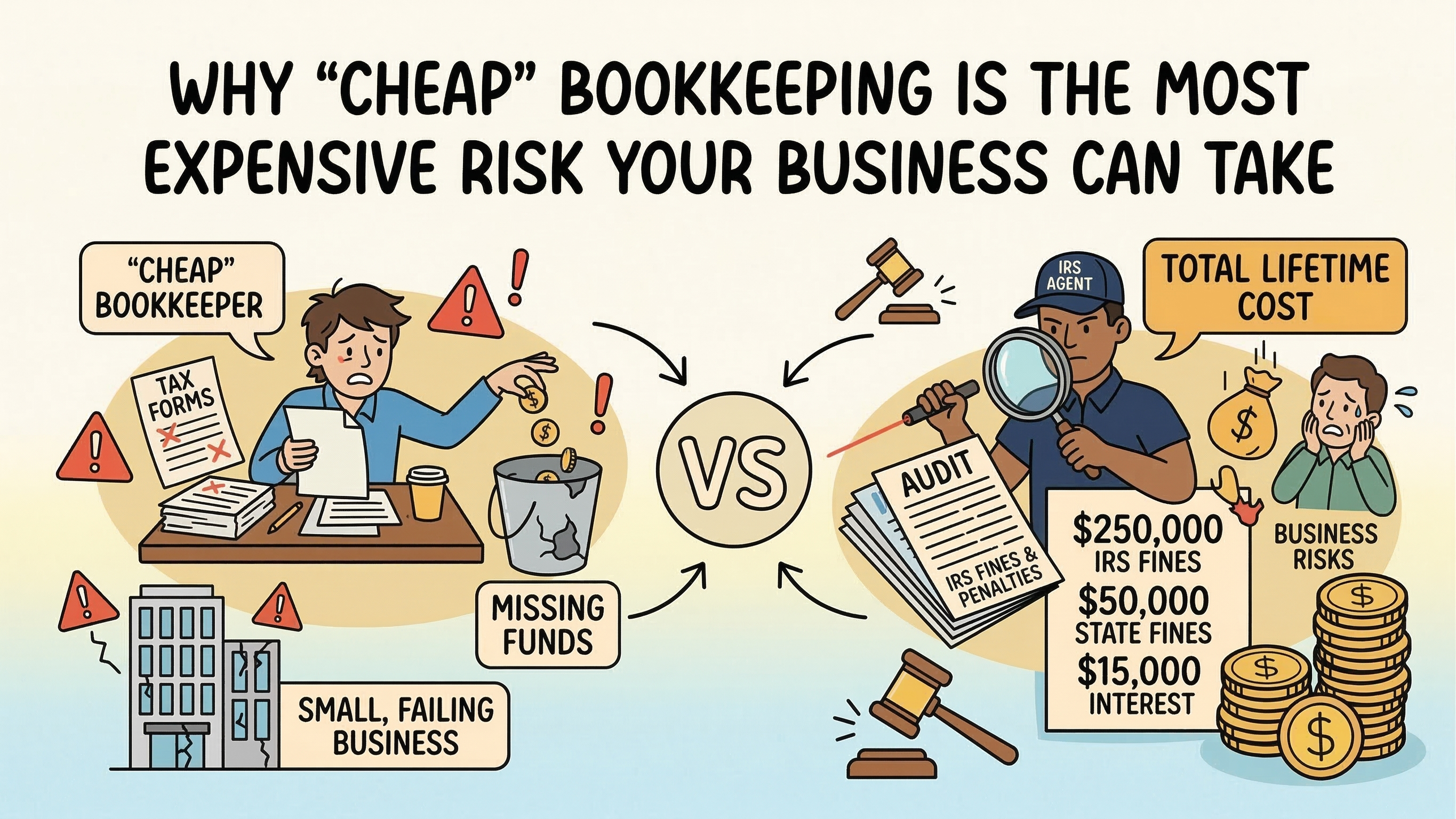
TL;DR: A growing trucking company hired a budget bookkeeper to save on overhead. Two years later, the business was insolvent due to nearly $300,000 in unremitted payroll taxes and IFTA fraud. This post-mortem explores the “Price of Cheap” and the specific red flags that preceded a total business collapse. In this Article Why “saving money” on bookkeeping backfires It started with a simple desire to protect the bottom line. As the owner of a growing trucking service, John knew that every cent was spoken for. Between rising diesel prices, insurance premiums, and constant fleet maintenance, the overhead was suffocating. When he found a local bookkeeper who promised to handle the entire operation for a few hundred dollars a month—roughly a fifth of what established firms quoted—it didn’t feel like a risk. It felt like a win. For the first eighteen months, the “win” seemed real. The reports arrived on time, the bank balances looked healthy, and the bookkeeper was always a friendly voice on the phone. John used the “saved” money to buy a new rig and hire two more drivers. He was scaling. He thought he was safe. The early warning signs John missed The first sign of trouble wasn’t a roar; it was a whisper. John received a notice from the state regarding a discrepancy in his International Fuel Tax Agreement (IFTA) filings. When he questioned his bookkeeper, the answer was smooth: “It’s just state bureaucracy, John. They probably lost a page. I’ll send a corrected copy.” A month later, a second notice arrived—this time from the IRS regarding payroll tax underpayments. Again, the bookkeeper had a plausible explanation. He blamed a software “glitch” and promised it was handled. In the fast-paced world of logistics, where trucks run 24/7, John took him at his word. He had a fleet to manage; he didn’t have time to audit the auditor. When the bookkeeper went radio silent The “glitches” turned into a nightmare when the IRS triggered a formal audit. For the first time, John heard a flicker of panic in his bookkeeper’s voice. Then came the silence. Voicemails went unreturned. Emails began to bounce. When John finally drove to the bookkeeper’s small rented office, he found the lights off and the desk cleared. The “affordable” professional had vanished, leaving behind three years of digital records that were nothing more than a house of cards. What we found when we looked at the books When a reputable accounting firm finally stepped in to perform the forensic cleanup, the reality was horrifying. The “professional” reports John had received every month were complete fabrications. The bookkeeper hadn’t been filing the returns at all. Instead, he was making the bare minimum payments to the IRS—just enough to keep the automated “Final Notice” letters from being triggered—while pocketing the remainder of the tax escrow money. By the time the audit was finished, the bill was staggering: The penalties and interest alone were more than a year’s worth of profit. The business—the dream John had spent a decade building—was legally and financially insolvent. He had to sell his fleet and close his doors. How to spot a bad bookkeeper early If you see these signs, investigate immediately: Comparing budget services vs. professional firms To understand how this happens, we have to look at the math. A “cheap” service is often cheap because it lacks the multi-layer oversight and insurance that protects a business owner. Expense Category Budget “Solo” Bookkeeper Established Professional Firm Typical Monthly Fee $250 – $400 $1,200 – $2,500 Staffing Structure One person (no backup) Team of CPAs & Specialized Staff Internal Controls None (they hold the keys) Multi-person review & verification Compliance Liability High (you are responsible) Low (covered by errors/omissions) Total Cost of Ownership Infinite Risk Predictable Overhead Protecting your business John’s story is a cautionary tale, but it’s one that can be avoided. Before you entrust your life’s work to someone, do your due diligence. Check credentials, call references, and never hand over the reins completely. Maintain oversight by reviewing your financial statements monthly and ensuring you have “view-only” access to your tax accounts. The most expensive service you can buy is the one that doesn’t actually do the job. About the Author Isabella Jones started her career at Deloitte, where she worked on tax compliance for some of the country’s fastest-growing companies. She later joined Fynlo as Senior Financial Strategist, bringing that experience to freelancers and small business owners who need practical financial guidance without the corporate complexity. With an Accounting degree from Villanova University, Isabella focuses on making financial planning easier to understand and apply in day-to-day business. She works closely with freelancers and small businesses on areas like taxes, cash flow, and building more stable financial systems.
Bookkeeping Services for Small Businesses: How to Choose Right and Avoid Costly Mistakes

When you decided to run your own business, you stepped into a role that requires managing every moving part—from client relationships to cash flow. One of the hardest but most important jobs you have is keeping your finances in order. While you may not be a certified accountant, maintaining accurate financial records is the single most important action you can take to ensure business stability and tax compliance. This guide breaks down what high-quality bookkeeping services truly entail in the modern era, what essential features you must demand from any system (or provider), and the critical, non-obvious errors that could hurt your financial visibility and cash flow. By the end, you will know exactly how to establish an expert-level foundation for your small business finances. Table of Contents What Exactly Are Bookkeeping Services? A Modern Definition and Supporting Evidence Bookkeeping is the structured process of recording and classifying every financial transaction that flows through your business. It transforms raw data—your invoices, receipts, and bank statements—into organized, accurate financial records that serve as the foundation for all strategic and tax-related decisions. The Real Cost of Inefficiency The core reason to professionalize your financial system isn’t just about compliance—it’s about protecting your time and profit. Inefficient bookkeeping directly drains both. The Bookkeeper’s Core Responsibilities Without accurate bookkeeping, you can’t make confident business decisions. Cash flow insights, tax planning, and even investor confidence all depend on organized financial data. In other words, bookkeeping isn’t just compliance—it’s strategy. Here are the four pillars of effective modern bookkeeping: What Good Bookkeeping Should Expertly Offer In today’s market, reliance on spreadsheets is no longer effective. Whether you hire a firm or use a powerful, integrated accounting platform, your “bookkeeping service” must deliver these expert-level capabilities: A. Integrated, Real-Time Data Flow A top-tier system doesn’t rely on weekly or monthly imports. It utilizes secure, API connections to your bank and credit accounts, providing a continuous, real-time feed of transactions. This automation is key to achieving instant financial visibility and virtually eliminating the need for manual data entry. B. Intelligent Categorization and Workflow Automation The system must go beyond simple logging. It should use AI-driven logic to suggest the correct category for each transaction based on vendor name and historical data. Crucially, it must handle the entire expense workflow: C. Superior Compliance and Tax Readiness Your system should not just record; it should prepare. It needs to track expenses according to the specific rules of the applicable tax code. Look for integrated features that: D. Seamless Invoicing and Accounts Receivable Management For many freelancers and small businesses, cash flow is everything. An expert solution integrates invoicing directly into the books. When you send an invoice, it’s immediately logged as revenue due; when the payment clears the bank feed, the system instantly marks the invoice paid and performs the reconciliation—all without manual intervention. Common Bookkeeping Mistakes to Avoid These mistakes move beyond the obvious (like not separating accounts) and focus on the technical errors that often trip up small business owners, leading to confusion and unnecessary tax exposure. Mistake 1: Neglecting the Sales Tax Liability Account If your business collects sales tax from customers, that money is not your income; it’s a liability you owe the state. A common error is recording collected sales tax as part of gross revenue. This overstates your income, leading to higher income tax liability and inaccurate P&L Statements. You must correctly classify collected sales tax into a dedicated liability account on your Balance Sheet until it is paid. Mistake 2: Misclassification of Fixed Assets Many businesses immediately categorize large purchases—such as a new $3,000 laptop or specialized business software with a lifespan over a year—as a regular expense. However, these are fixed assets. Failing to capitalize them (recording them as assets) and using the appropriate depreciation method distorts your true profitability and can lead to incorrect calculations for your tax basis. Mistake 3: Failing to Regularly Review Unapplied Customer Payments This error happens when a customer pays an amount that doesn’t exactly match an outstanding invoice, or they pay before the service is invoiced. The money sits in a temporary “Unapplied Customer Payments” account. If left unreviewed, this money can be missed, leading to inaccurate Accounts Receivable totals and future confusion during account reconciliation. Regularly clearing this account ensures your books reflect your true client payment status. Mistake 4: Improperly Handling Owner Draws and Contributions For sole proprietors and partnerships, taking money out of the business is called an Owner’s Draw, and putting personal money in is a Contribution. A common error is mistakenly recording these movements as business expenses or revenue. This will seriously skew your P&L Statement. These transactions must be logged against the Owner’s Equity accounts on the Balance Sheet, ensuring your income and expenses remain clean for tax filing. Mistake 5: The Expense vs. Capital Improvement Dichotomy If you own property, be careful classifying renovation costs. Routine repairs (like fixing a broken window) are immediately deductible operating expenses. However, improvements that increase the property’s value or useful life (like installing a new HVAC system) must be capitalized and depreciated over time. Incorrectly classifying a capital improvement as an expense can lead to immediate tax authority scrutiny and adjustments to your taxable income. The Path to Expert-Level Financial Control The takeaway is clear: efficient, accurate bookkeeping is not a luxury; it’s a necessary component of your professional toolkit. By choosing a system that provides the integrated, automated, and expert-level features detailed above, you move past basic data entry and gain a powerful strategic advantage. You secure your compliance, optimize your tax position, and gain the ultimate peace of mind. Fynlo is an intuitive, all-in-one accounting platform engineered for the small business owner and freelancer who demands both simplicity and subject matter expertise. We provide a single, integrated solution that delivers automated transaction flow, intelligent categorization, effortless tax readiness, and real-time financial reporting—empowering you to take full control of your business accounting without needing a finance degree. Ready to implement an expert-level
The Small Business & Freelancer Guide to Expense Tracking and Management
If you’re a freelancer or a small business owner in the U.S., you’ve likely been there: you just landed a big project, you’re focused on delivering your best work, and meanwhile a small but persistent stack of receipts starts piling up. Gas, software subscriptions, client meals, marketing costs—they all add up, and before you know it, there’s a pile growing on your desk. That pile isn’t just clutter. Left unchecked, it creates stress, eats away at your time, and can even impact your bottom line. Manual expense tracking often leads to lost deductions, mistakes, and hours that could be better spent growing your business. In this guide, we’ll break down expense management software for freelancers and small business owners—what it is, why it’s becoming essential, the features that actually matter, and how the right system can help you boost profitability and stay compliant with ease. Table of Contents What is Expense Management Software, and How Does It Actually Work? In simple terms, expense management software is a digital system that automates the entire process of tracking, recording, approving, and reporting business spending. It is the modern replacement for spreadsheets and shoeboxes of receipts. For a small business, a dedicated tool is far simpler and more accurate than trying to make basic accounting methods handle the detailed, real-time needs of expense tracking. The power of this software lies in its four steps: 1. Capture: From Paper to Digital Proof Instead of manually saving paper receipts, the software uses mobile technology and email integration. 2. Synchronization: Building the Audit Trail This step connects the captured receipt proof to your bank records. 3. Categorization: Making Sense of Spending This is where raw data is turned into useful financial information. 4. Reporting: The Roadmap to Profitability Expense software doesn’t just store data; it organizes it for actionable insights and compliance. Why Manual Expense Tracking is a Financial Risk As an entrepreneur, your time is finite and valuable. Spending hours on manual expense tracking is a costly gamble that often backfires. Lost Time and RevenueEvery hour spent sorting receipts, reconciling statements, or fixing spreadsheet errors is an hour not spent on billable work or growing your business. This inefficiency translates directly into lost revenue. Audit and Deduction ExposureThe U.S. tax code requires proof for every expense. Lost or faded receipts mean lost deductions and a higher tax bill. In an audit, missing or disorganized records can result in disallowed deductions, back taxes, interest, and penalties. The Essential Features Your Expense Management Software Must Have For freelancers and growing small businesses, the best solution focuses on automation, simplicity, and tight integration. Look for these critical functions: Mobile Access and OCR Receipt CaptureYour work happens everywhere, not just at your desk. The software must have a robust mobile app that allows you to capture receipts instantly, anytime, anywhere. This immediate digitization, powered by OCR, ensures that every piece of paper is processed and stored securely before you even leave the vendor’s location, ensuring no deduction is missed. Automatic Bank and Credit Card IntegrationA modern system must seamlessly connect to your U.S. financial accounts to import transactions in real-time. This integration is crucial for the automated matching process, creating the transparent, end-to-end audit trail that gives you peace of mind during tax season. Smart, Customizable Expense CategorizationThe software should go beyond basic tags. It needs to learn your spending patterns and allow you to fully customize categories to align with your Schedule C or business accounting needs. This intelligence saves immense time and ensures that your books are consistently accurate from one month to the next. Integrated Mileage TrackingIf you use your personal vehicle for business travel (client visits, supply runs, etc.), tracking mileage is mandatory for claiming the per-mile deduction. The best software includes a GPS-based feature that automatically logs trips and calculates the IRS-compliant deduction, maximizing this often-overlooked write-off without requiring a separate app or manual logbook. Secure Cloud StorageCompliance requires you to keep records for years. Your software must securely store every single digital receipt and financial transaction in the cloud. This centralization provides indefinite, searchable access to all your records, making it simple to pull up documentation whether you’re working on taxes or simply reviewing a quarterly budget. CPA-Ready ReportingThe software is not a replacement for your tax professional, but it should make their job easier. It must be capable of generating standardized, clean, and organized reports that summarize all your expenses by category, date, and vendor, ensuring your tax preparer has all the necessary data in a format they can easily understand and use. Choosing the Right Tool: The Landscape of Expense Management When searching for the best tool, it’s critical to look for a solution where expense management is baked directly into the accounting software, rather than requiring a separate app. This approach avoids messy data imports and ensures that every categorized expense immediately updates your Profit & Loss statement, giving you the clearest, most accurate view of your financial health possible. For U.S. freelancers and small business owners, the following major accounting platforms are widely known for offering strong, built-in expense features: Accounting Software Key Expense Management Feature Focus Small Business Fit QuickBooks Online Robust integration with U.S. banking, strong receipt capture via mobile, and highly detailed report customization for tax forms. Excellent for businesses that already rely on QuickBooks for payroll and tax filing; highly comprehensive but can be complex. Xero Beautiful bank feed integration, excellent use of rules and machine learning for automated categorization, and clean, intuitive reporting. Great for businesses seeking a modern, visually appealing interface that emphasizes automation and simplicity. FreshBooks Built specifically around the needs of service-based businesses and freelancers; offers time tracking and project expense tracking alongside receipt capture. Ideal for solopreneurs and firms that bill clients based on time and expenses, prioritizing ease of use over deep corporate features. Fynlo Seamless, all-in-one platform focusing on instant receipt capture and real-time P&L updates without recurring bookkeeping fees. Perfect for U.S. freelancers and small teams
Accounting Services for Small Business: A Comprehensive Guide to Whether You Need an Accountant, a Bookkeeper, or Just Better Software
If you’re running a small business or working as a busy freelancer, you know the feeling: the bookkeeping pile is growing, tax deadlines are looming, and you’re suddenly asking Google, “What accounting services for small business do I actually need?” It’s one of the biggest questions entrepreneurs face. On one hand, you don’t want to overspend on services you could handle yourself. On the other, getting the finances wrong can lead to costly mistakes, missed opportunities, and—worst of all—IRS penalties. The truth is, “accounting services” isn’t a single thing—it’s a spectrum of financial help. The right choice depends entirely on your business’s size and complexity. For most small operations, you can handle the basics with smart tools, saving the expense of a human expert for complex strategy and tax filing. To help you decide where to focus your resources, here’s a quick look at the four main tiers of financial help available, followed by a deeper dive into each role. Table of Contents Accounting Software vs. Professional Services: Where to Invest Your Money When should you hire a human professional, and when is dedicated software your best financial partner? The ideal mix helps you achieve full compliance without overspending. Tier of Service Can Software Handle It? When to Hire a Human Expert Bookkeeping (Tier 1) Yes. Automated accounting software can handle 90% of routine categorization, expense tracking, and reconciliation. Your business has high transaction volume (500+ per month), manages multiple currencies, or handles complex inventory. Accounting (Tier 2) Partially. Software generates the reports, but a human must review them for strategic insight. You need help interpreting metrics like Gross Profit Margin or preparing financial statements for a loan application. Tax Preparation (Tier 3) Yes, for the basic returns (e.g., Schedule C). Your business is an S-Corp or C-Corp, or you have complicated state tax nexus issues. Strategy (Tier 4) No. Forecasting and consulting require human judgment, market knowledge, and expertise. You need advice on pricing, mergers, acquisitions, or long-term growth financing. The Spectrum of Financial Help: 4 Tiers of Accounting Services When you look for professional help with your business finances, the service you need typically falls into one of these four essential categories: Tier 1: Bookkeeping—The Day-to-Day Foundation Bookkeeping is the foundation of all business finance. If you’re looking for professional bookkeeping services for small business, this is where you start. This involves the accurate recording of all financial transactions—sales, purchases, receipts, and payments. It’s the daily chore that provides the raw data for all your other financial reports. Tier 2: Accounting—Reporting and Financial Review Accounting takes the raw data created by the bookkeeper and organizes it into meaningful financial statements (Profit & Loss, Balance Sheet, Cash Flow Statement). When engaging Certified Public Accountant (CPA) services, they take the lead on interpreting these reports to ensure accuracy, compliance, and strategic planning. For more info, read our another blog “Financial Statements: A Comprehensive Guide.” Tier 3: Tax Preparation—The Annual Filing This is the specialized service most businesses use at least once a year. When seeking small business tax services, a tax preparer (often a CPA or Enrolled Agent) ensures your tax return is filed correctly and on time, minimizing your liability while staying compliant with IRS rules. Tier 4: Financial Consulting & Strategy (The Growth Partner) This is the most advanced tier of service. A financial consultant or Fractional CFO works with you throughout the year to help you make major business decisions, such as budgeting for expansion or planning an exit strategy. Your Solution for Smart, Simple Accounting The overwhelming majority of small businesses—especially service-based ones and freelancers—find the sweet spot is automating Tiers 1 and 2 (Bookkeeping and basic Reporting) using robust software, and hiring a CPA only for Tier 3 (Tax Filing). This model saves thousands of dollars annually in unnecessary bookkeeping fees while ensuring you maintain accurate financial records that minimize your tax burden and keep you audit-ready. You don’t need a full-time accountant to tell you where your money is going; you need a tool that shows you, instantly. This is where a solution like Fynlo comes in. Our platform is designed specifically to make running your books simple, providing the automated categorization and real-time reporting you need to handle Tier 1 and 90% of Tier 2 services yourself. With Fynlo, you gain the clarity of professional small business accounting without the recurring fees, ensuring your data is always organized and ready for your CPA come tax season. Ready to take control of your accounting and get professional-grade insights without the professional price tag? Schedule a demo with us or sign up today.
5 Areas You Need to Automate Your Finance
It’s 9 in the morning, and after that first essential cup of coffee, the busy day begins. You gather all those slips of paper and digital documents, which already feels like a full task in itself. After carefully reviewing every detail, you finally finish creating invoices, recording financial transactions, and confirming payment statuses. Before you know it, it’s almost noon. The tedious accounting tasks have already consumed half your day, and you’re still not finished. Does any of this sound familiar? When you’re handling finances manually, things can quickly pile up, leading to those frustrating errors, the anxiety of delayed payments, and that constant feeling of your valuable time and energy just disappearing. If this resonates with your experience, read on to discover the power of automated finances and invoicing, especially when integrated with your accounting software and invoicing software. Table of Contents Is Your Manual Finance Process a Struggle? Here’s a quick check to see if automated finances might be necessary for you: If you recognize two or more of these pain points, you’ll likely be eager to learn more about what automated finances can offer: Don’t worry, these struggles are common. In fact, you’re like the majority of small businesses and freelancers still navigating the complexities of manual finances. Let’s explore how automation can change that. The Power of Automated Finances and Invoicing Automated finances and invoicing use technology to handle everyday financial tasks. This includes things like creating invoices, sending payment reminders, tracking payments, and managing cash flow – without needing you to do it all manually. It replaces time-consuming spreadsheets, repetitive data entry, and paper-heavy processes with smooth, digital workflows. Essentially, financial automation lets your financial tasks run like a well-oiled machine in the engine room, operating consistently without constant attention. This ensures invoices go out on time, reminders are sent automatically, and financial data is recorded accurately, all without you having to chase. Why It’s Powerful Key Areas of Financial Automation Financial automation goes beyond invoicing. It touches nearly every part of your financial workflow. When routine tasks are handled by smart systems, you save time, reduce errors, and gain clearer insights. Your Action Plan for Financial Automation Ready to move beyond the manual invoicing process? Here’s a simple roadmap to get you started: Ready to Streamline Your Financial Workflow? Let’s talk. We’ll help you find the right automation tools, like invoicing systems that integrate directly with your accounting platform, simplify your process, and set your business up for scalable success.
10 Signs of a Bad Bookkeeper to Absolutely Avoid
Whether you’re a startup or a growing small business, knowing your financial status is key to keeping your business on track. Whether you work with bookkeeping software that offers support, a part-time bookkeeper, or external accountants, it’s crucial to ensure they are doing their job properly, making your life easier, not harder. Good bookkeepers are your financial peace of mind, keeping things organized and making sure you are compliant. But bad ones can drain your profits and intensify your tax nightmares. Is your bookkeeper the right fit? Read on for 10 troubling signs that it may be time to find a new bookkeeping solution. 10 signs of a Bad Bookkeeper Why Fynlo is a Trusted Solution If you’ve recognized one (or more) of the signs of a bad bookkeeper in your current service, it’s time to consider a reliable alternative. At Fynlo, we understand the challenges of financial management firsthand. That’s why we’ve built an intuitive platform designed to simplify your financial life and put you back in control. Fynlo provides access to seasoned accounting professionals. Our junior accountants bring over five years of experience, while our senior accountants boast more than ten years, most honed at top-tier firms like the Big Four, Baker Tilly, BDO, and Grant Thornton. We also prioritize confidentiality and data security. Every client relationship includes a signed Non-Disclosure Agreement (NDA), so your sensitive financial data is protected at all times. Here’s how Fynlo can benefit your business: Click here to schedule a call with our expert and take the stress out of bookkeeping. Fynlo team can handle everything from categorizing your transactions and reconciling your accounts to delivering precise, tax-ready financial statements.