
Why “Cheap” Bookkeeping is the Most Expensive Risk Your Business Can Take
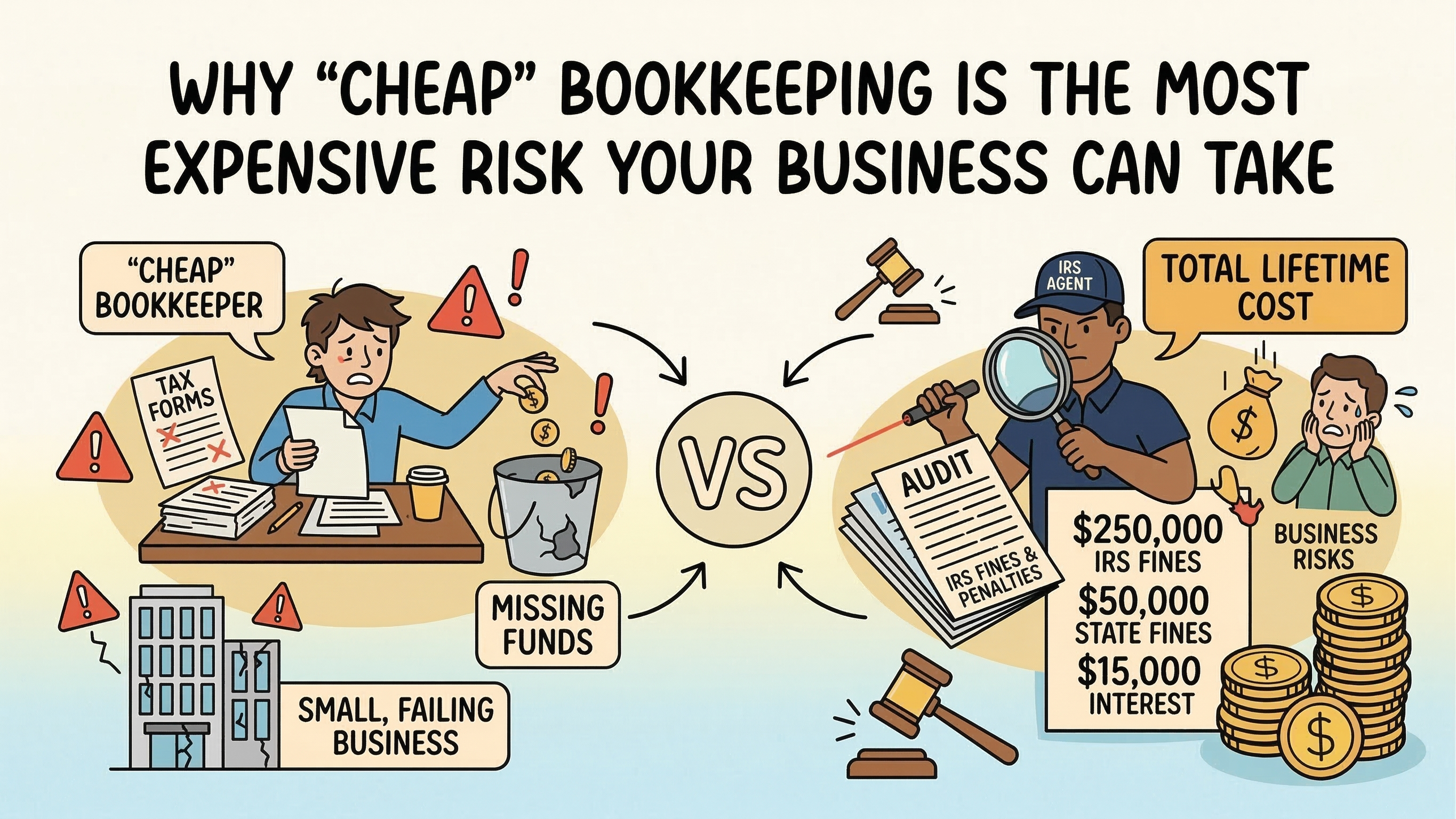
TL;DR: A growing trucking company hired a budget bookkeeper to save on overhead. Two years later, the business was insolvent due to nearly $300,000 in unremitted payroll taxes and IFTA fraud. This post-mortem explores the “Price of Cheap” and the specific red flags that preceded a total business collapse. In this Article Why “saving money” on bookkeeping backfires It started with a simple desire to protect the bottom line. As the owner of a growing trucking service, John knew that every cent was spoken for. Between rising diesel prices, insurance premiums, and constant fleet maintenance, the overhead was suffocating. When he found a local bookkeeper who promised to handle the entire operation for a few hundred dollars a month—roughly a fifth of what established firms quoted—it didn’t feel like a risk. It felt like a win. For the first eighteen months, the “win” seemed real. The reports arrived on time, the bank balances looked healthy, and the bookkeeper was always a friendly voice on the phone. John used the “saved” money to buy a new rig and hire two more drivers. He was scaling. He thought he was safe. The early warning signs John missed The first sign of trouble wasn’t a roar; it was a whisper. John received a notice from the state regarding a discrepancy in his International Fuel Tax Agreement (IFTA) filings. When he questioned his bookkeeper, the answer was smooth: “It’s just state bureaucracy, John. They probably lost a page. I’ll send a corrected copy.” A month later, a second notice arrived—this time from the IRS regarding payroll tax underpayments. Again, the bookkeeper had a plausible explanation. He blamed a software “glitch” and promised it was handled. In the fast-paced world of logistics, where trucks run 24/7, John took him at his word. He had a fleet to manage; he didn’t have time to audit the auditor. When the bookkeeper went radio silent The “glitches” turned into a nightmare when the IRS triggered a formal audit. For the first time, John heard a flicker of panic in his bookkeeper’s voice. Then came the silence. Voicemails went unreturned. Emails began to bounce. When John finally drove to the bookkeeper’s small rented office, he found the lights off and the desk cleared. The “affordable” professional had vanished, leaving behind three years of digital records that were nothing more than a house of cards. What we found when we looked at the books When a reputable accounting firm finally stepped in to perform the forensic cleanup, the reality was horrifying. The “professional” reports John had received every month were complete fabrications. The bookkeeper hadn’t been filing the returns at all. Instead, he was making the bare minimum payments to the IRS—just enough to keep the automated “Final Notice” letters from being triggered—while pocketing the remainder of the tax escrow money. By the time the audit was finished, the bill was staggering: The penalties and interest alone were more than a year’s worth of profit. The business—the dream John had spent a decade building—was legally and financially insolvent. He had to sell his fleet and close his doors. How to spot a bad bookkeeper early If you see these signs, investigate immediately: Comparing budget services vs. professional firms To understand how this happens, we have to look at the math. A “cheap” service is often cheap because it lacks the multi-layer oversight and insurance that protects a business owner. Expense Category Budget “Solo” Bookkeeper Established Professional Firm Typical Monthly Fee $250 – $400 $1,200 – $2,500 Staffing Structure One person (no backup) Team of CPAs & Specialized Staff Internal Controls None (they hold the keys) Multi-person review & verification Compliance Liability High (you are responsible) Low (covered by errors/omissions) Total Cost of Ownership Infinite Risk Predictable Overhead Protecting your business John’s story is a cautionary tale, but it’s one that can be avoided. Before you entrust your life’s work to someone, do your due diligence. Check credentials, call references, and never hand over the reins completely. Maintain oversight by reviewing your financial statements monthly and ensuring you have “view-only” access to your tax accounts. The most expensive service you can buy is the one that doesn’t actually do the job. About the Author Isabella Jones started her career at Deloitte, where she worked on tax compliance for some of the country’s fastest-growing companies. She later joined Fynlo as Senior Financial Strategist, bringing that experience to freelancers and small business owners who need practical financial guidance without the corporate complexity. With an Accounting degree from Villanova University, Isabella focuses on making financial planning easier to understand and apply in day-to-day business. She works closely with freelancers and small businesses on areas like taxes, cash flow, and building more stable financial systems.
The S-Corp Secret: How to Pay Yourself a “Reasonable Salary” and Avoid an IRS Audit
Deciding to become an S-Corp is a smart move for many freelancers and small business owners. It’s a way to save on self-employment taxes, allowing you to keep more of your hard-earned money. But here’s the catch: you can’t just pay yourself a token salary and take the rest as tax-free distributions. The IRS is watching, and underpaying yourself is one of the fastest ways to land on their audit list. With great tax savings comes great responsibility. The IRS has a strict rule you can’t afford to ignore: you must pay yourself a “reasonable salary.” Paying yourself fairly isn’t just a good idea—it’s an IRS requirement. The agency is actively cracking down on S-Corps that pay owners a nominal salary just to avoid payroll taxes. Getting this wrong can lead to serious penalties and a lot of unnecessary stress. This guide will walk you through exactly what a reasonable salary means for your business, providing the facts and advice you need to stay on the right side of the law. Table of Contents Understanding Your Tax Advantage To grasp the importance of a reasonable salary, you first need to understand the S-Corp tax advantage. As a sole proprietor, your entire business profit is subject to a 15.3% self-employment tax. An S-Corporation is a “pass-through” entity, meaning it does not pay federal income tax on its profits. Instead, the profits are passed through to you, the owner, to be taxed on your personal return. You can legally split your income into two categories: This powerful tax strategy hinges entirely on your ability to prove that the salary you pay yourself is “reasonable” in the eyes of the IRS. How the IRS Defines “Reasonable” The IRS doesn’t provide a magic number or a fixed formula. You may have heard advice about splitting your income using a simple ratio, like 50/50 or 60/40. The IRS does not approve of these simple formulas, as they don’t reflect the true market value of the work you do. Instead, they require your salary to be what you would pay an unrelated person to perform your job. In fact, IRS guidance and case law point to nine factors they often weigh: your training and experience, duties and responsibilities, time devoted to the business, dividend history, payments to non-shareholder employees, timing and manner of bonuses, comparable industry salaries, use of a formula for determining pay, and your business’s overall performance. In practice, these boil down to a few key areas: Illustrating the Impact: A Tax Comparison To see the real-world difference, let’s look at two freelance photographers who both operate as S-Corps and net $90,000 in profit. Photographer A (Reasonable Salary) Photographer B (Unreasonably Low Salary) Net Business Profit $90,000 $90,000 Salary Paid $55,000 $25,000 Owner’s Distribution $35,000 $65,000 FICA Tax on Salary (15.3%) $8,415 $3,825 FICA Tax on Distribution $0 $0 Total FICA Tax Bill $8,415 $3,825 Photographer B’s total FICA tax bill is much lower, but by paying an unreasonably low salary, they expose themselves to an IRS audit. If an audit occurs, the IRS can reclassify the distributions as wages and require them to pay the back taxes, plus penalties and interest. This proves that a defensible salary is the safest and smartest long-term strategy. The High Cost of Non-Compliance Ignoring the reasonable salary rule is a serious risk. If the IRS audits your business and finds your salary to be unreasonably low, they can reclassify your distributions as wages. This will lead to: There are plenty of cautionary tales. In Barron v. Commissioner, an Arkansas accountant paid himself no salary at all, taking all earnings as distributions. The IRS determined a reasonable salary should have been around $45K–$49K, and he was hit with back taxes. Similarly, in David E. Watson, P.C. v. United States, an Iowa CPA set his salary at just $24,000 while taking over $200,000 in distributions. The court sided with the IRS, which reclassified $175,000 as wages, resulting in nearly $27,000 in payroll taxes owed. The IRS has publicly stated that S-Corp owner compensation remains a “compliance priority” in 2025. They continue to flag unusually low salaries as an audit trigger — a reminder that this issue is very much alive today. Frequently Asked Questions (FAQ) 1. Can I pay myself only distributions in an S-Corp? No. The IRS requires shareholder-employees to take a reasonable salary before distributions. Skipping salary is one of the fastest ways to trigger an audit. 2. What if my business isn’t making much profit yet? If profits are low, your salary can be modest, as long as it reflects your role and time spent in the business. The key is to keep documentation. 3. How do I prove my salary is reasonable? Use market data (BLS, Glassdoor, Salary.com), document your duties and hours, and keep board minutes or memos showing how you set compensation. 4. What happens if the IRS reclassifies my distributions? You’ll owe back payroll taxes, plus penalties and interest. In rare cases, the IRS can revoke your S-Corp election altogether. Ready to Simplify Your S-Corp? Navigating the rules of an S-Corp can feel complex, but it doesn’t have to be a source of anxiety. Building smart financial habits and having the right tools can help you confidently run your business and enjoy the tax savings you’ve worked hard for. This is where a tool like Fynlo comes in. Our easy-to-use software is built for freelancers and small business owners, making it simple to run payroll for your S-Corp, track your income and expenses, and maintain the clean, audit-ready records you need to protect your business. We take the guesswork out of bookkeeping, so you can focus on what you do best. Ready to take control of your S-Corp finances? Schedule a call with us to see how Fynlo can help your business thrive.