
Self‑Employed FICA Taxes Explained: Rates, Rules, and Smart Savings
If you’re a freelancer or a small business owner, you’ve likely seen a line item on your tax forms that makes your eyes water: “Self-Employment Tax.” This isn’t just another tax; it’s your contribution to Social Security and Medicare, essentially covering both the employee and employer portions that traditional employees split with their boss. For the self-employed, this all falls on your shoulders, and it can be a significant bite out of your income. In fact, many self-employed people in the U.S. don’t even realize they need to make quarterly tax payments, which leads to millions in penalties each year. This highlights the crucial importance of accurate bookkeeping and tax planning. But here’s the good news: understanding how FICA tax (or self-employment tax, as it’s specifically called for you) works is the first step to managing it effectively. This isn’t just about paying what you owe; it’s about making smart choices to potentially lower your tax burden and ensure you’re on solid financial ground. This guide will break down everything you need to know, from how it’s calculated to strategies for reducing what you pay. Table of Contents What is FICA Tax for the Self-Employed? When we talk about “FICA tax” for self-employed individuals, we’re actually referring to Self-Employment Tax (SE Tax). FICA stands for Federal Insurance Contributions Act, and it funds Social Security and Medicare. This tax applies to your net earnings from self-employment, which is your gross income minus your allowable business deductions. You actually calculate it on 92.35% of your net earnings. This 7.65% reduction effectively accounts for the “employer’s share” that you’re paying. For 2025, the Social Security portion (12.4%) only applies to net earnings up to $176,100. There’s no wage base limit for the Medicare portion (2.9%), meaning it applies to all your net earnings. In addition, high earners may also owe an extra 0.9% Medicare surtax once income exceeds $200,000 (single filers) or $250,000 (married filing jointly). Who Pays Self-Employment Tax? If you’re a freelancer, independent contractor, sole proprietor, or a partner in a partnership, and your net earnings from self-employment are $400 or more in a given year, you are generally required to pay self-employment tax. This also includes income from side gigs, even if you have a full-time job where FICA taxes are already being withheld. The IRS doesn’t care if it’s your primary income or a small side hustle; if you hit that $400 net earnings threshold, you’re in the game. How to Calculate Your Self-Employment Tax Let’s walk through a simple example for the 2025 tax year: Imagine a freelance writer, Alex, who had $70,000 in gross income and $10,000 in deductible business expenses. This $8,477.73 is Alex’s total self-employment tax bill. The FICA Tax Half-Deduction Explained The deduction for half of your self-employment tax is a way for the government to make things fair. Here’s a simpler way to think about it: Imagine you’re both an employee and an employer. As an employee, you have to pay your share of Social Security and Medicare taxes (FICA). As an employer, you also have to pay a matching share. This means you’re paying both halves of the tax. To put you on a level playing field with other businesses, the government lets you deduct the “employer’s half” of that tax. This deduction reduces your overall taxable income, which in turn lowers the amount of income tax you owe. It’s a simple tax break that helps offset the burden of paying both parts of the FICA tax yourself. In Alex’s example, he could deduct $4,238.87 ($8,477.73 / 2) from his income, reducing his overall income tax liability. Paying Your SE Tax and Estimated Tax Unlike traditional employees whose FICA taxes are withheld from every paycheck, the self-employed are responsible for paying their self-employment tax (along with income tax) directly to the IRS. This is done through quarterly estimated tax payments. The IRS generally requires you to pay estimated taxes if you expect to owe at least $1,000 in tax for the year. Missing these payments or underpaying can lead to penalties. The due dates for 2025 estimated taxes are: Based on our example, Alex’s total estimated tax for the year would include both his self-employment tax and his income tax. Assuming a simplified income tax rate of 12% for his income level, his total estimated tax bill would be approximately $15,169.07. To meet his quarterly obligations, Alex should pay $3,792.27 by each of the four deadlines listed above. Strategies to Lower Your Self-Employment Tax While you can’t escape SE tax entirely (it’s how you qualify for Social Security and Medicare benefits!), there are legitimate ways to reduce your taxable net earnings, and thus your SE tax bill: Don’t Let Self-Employment Tax Overwhelm You Understanding and managing your FICA tax (self-employment tax) is a fundamental part of being a successful freelancer or small business owner. It’s not just about compliance; it’s about smart financial planning that allows you to keep more of what you earn and build a secure future. This is where a tool like Fynlo comes in. Our easy-to-use software is designed for freelancers and small business owners, making it simple to track your income and expenses, identify all your eligible deductions, and stay on top of your estimated tax payments. We take the guesswork out of bookkeeping, so you can focus on what you do best. Ready to take control of your self-employment taxes? Schedule a call with us to see how Fynlo can help your business thrive.
Stop Overpaying the IRS: Your 2025 Guide to Freelance Tax Write-Offs
Freelancing is more than just a job; it’s a business. And one of the biggest perks of being your own boss is the ability to lower your tax bill by legally deducting business expenses. Every missed deduction is lost cash — and most freelancers are giving money away without realizing it. IRS data shows that nearly 70% of self-employed filers underclaim business expenses. Misplaced receipts, fear of audits, and assuming “it’s not worth it” are some of the most common reasons. I’ll admit, in my early days I made the same mistakes and missed out on valuable write-offs simply because I didn’t know what to look for or how to track them. It’s like leaving free money on the table, and who wants to do that? This isn’t just a list of deductions. Think of it as your personal guide to navigating the ins and outs of freelance finances for the 2025 tax year. We’ll cover everything from the home office to health insurance, helping you keep more of your hard-earned money and avoid a last-minute scramble. Ultimately, a stress-free tax season starts with good record-keeping, and the journey to a lower tax bill begins today. Table of Contents What’s the Big Deal with Tax Deductions? Think of a tax deduction as a way to reduce your taxable income. The more you can legally deduct, the lower your taxable income becomes, which means you pay less in income tax. For example, if you earn $60,000 in freelance income and have $10,000 in eligible business expenses, you’ll only be taxed on $50,000. That’s a huge difference! However, it’s not just about what you deduct—it’s about doing it correctly. The IRS is known for its strict rules, and getting it wrong can lead to penalties. The IRS requires you to file a tax return if you have net earnings from self-employment of $400 or more. It’s crucial to file on time and accurately report all income and expenses. The Most Common Tax Write-Offs for Freelancers Here are some of the most popular tax deductions that freelancers and gig workers can claim. It’s vital to remember the golden rule of tax deductions: an expense must be “ordinary and necessary” for your business. 1. Home Office Deduction This is one of the most significant tax benefits for freelancers who work from home. You can deduct a portion of your home-related expenses if you use a part of your home “exclusively and regularly” as your principal place of business. This includes: There are two ways to calculate this deduction: 2. Vehicle Expenses If you use your car for business — whether that’s meeting clients, attending conferences, or hauling equipment — those costs are deductible. It’s worth noting that you can’t deduct your normal commute from home to a regular office, but if you travel between temporary worksites or make trips that are directly tied to your business, those miles count. 3. Health Insurance Premiums Health insurance can be one of the biggest expenses for freelancers, but the good news is that you can deduct the full cost if you’re self-employed and not covered by a plan through your employer or your spouse’s job. That means 100% of what you pay in premiums for medical, dental, and even long-term care insurance can be written off. This deduction is especially valuable because it directly lowers the income you’re taxed on, not just as part of itemized deductions. In other words, every dollar you spend on health insurance premiums reduces the income the IRS uses to calculate your taxes — which can make a real difference at tax time. 4. Business Supplies and Equipment The tools of your trade are fully deductible. This includes: 5. Advertising and Marketing Every successful freelance business needs clients, and getting your name out there comes with costs. The good news is that advertising and marketing expenses are 100% deductible. This can cover a wide range of things you might already be using to grow your business: 6. Education and Training Investing in yourself is a smart business move, and the IRS agrees. If the education or training you pay for helps you maintain or improve the skills you already use in your current business, those costs are deductible. This can include: Keep in mind that you can only deduct training that builds on the work you already do. If the education prepares you for a completely new career, it doesn’t qualify. For instance, a freelance writer could deduct a course on copywriting, but not the cost of a degree in accounting. rates and access discounted prices. Take advantage of flat-rate boxes, which can be cheaper for heavier, smaller items. What You Can’t Deduct Knowing what doesn’t qualify is just as important as knowing what does. Mixing in personal expenses is one of the most common mistakes new freelancers make, and it can be a red flag for the IRS. Here are some things that may feel work-related but don’t actually count: Simple Money Habits That Save You Stress When I first started out, I used to dread tax season. Every March I’d find myself scrolling through old bank statements, trying to remember if that random coffee shop charge in July was a client meeting or just me needing caffeine. If that sounds familiar, you’re not alone. So many freelancers end up scrambling and, as a result, miss out on deductions and peace of mind. The truth is, managing your finances doesn’t have to be a source of anxiety. With a few simple habits built into your routine, you can save yourself hours of stress and keep more of what you earn. Here are some of the most valuable lessons I’ve learned along the way: Don’t Let Tax Season Overwhelm You Taxes for freelancers don’t have to be a source of stress. By understanding what you can deduct and diligently tracking your expenses throughout the year, you’ll not only save money but also feel in control of your business’s financial health. This
The Freelancer’s Guide to the 2025 Self-Employed Quarterly Tax Schedule
One of the best parts of being self-employed is the freedom it brings. You’re the boss, setting your own hours and charting your own course. But with that freedom comes a responsibility that new freelancers and business owners often discover the hard way: you’re also the payroll department. Unlike a traditional job where taxes are automatically withheld from each paycheck, when you work for yourself, you’re responsible for paying your own taxes directly to the IRS. This isn’t done in one lump sum at the end of the year. Instead, the U.S. operates on a “pay-as-you-go” system, which for the self-employed, means paying estimated taxes four times a year. Although it may seem daunting, staying on top of your quarterly payments is manageable. Missing a deadline can lead to underpayment penalties that often catch self-employed individuals off guard. By familiarizing yourself with the due dates and the required steps, you can avoid surprises and keep your cash flow on track. Table of Contents TL;DR Summary What Are Estimated Taxes? Think of these as the self-employed version of the tax withholding (W-4) you had at a traditional job. They are periodic payments you make throughout the year to cover your tax liability. These payments cover two main things: By paying quarterly, you avoid a massive tax bill in April and stay compliant with IRS requirements. Who Needs to Pay Estimated Taxes? The rule of thumb from the IRS is straightforward. You generally must pay estimated taxes if you expect to owe at least $1,000 in tax for the year 2025 after subtracting any withholding or credits. This applies to most freelancers, independent contractors, and small business owners who operate as: If you also earn W-2 wages, you may be able to avoid estimated tax payments by simply having your employer withhold more tax from your regular paycheck. The 2025 Quarterly Tax Deadline Schedule The quarterly deadlines are not evenly spaced every three months, which is a common point of confusion. It’s essential to mark these dates on your calendar. The next deadline is Sept. 15, 2025, for income earned from June 1 to Aug. 31. Here are the deadlines for paying your 2025 estimated taxes: Quarter For Income Earned Between: Deadline Q1 Jan 1–Mar 31, 2025 April 15, 2025 Q2 Apr 1–May 31, 2025 June 16, 2025 (Note: June 15 is a Sunday) Q3 Jun 1–Aug 31, 2025 Sept 15, 2025 Q4 Sep 1–Dec 31, 2025 Jan 15, 2026 Note: Deadlines that fall on a weekend or holiday are moved to the next business day. How to Calculate Your Estimated Tax Payment Calculating your payment requires a bit of forecasting, but it can be broken down into simple steps. Step 1: Estimate Your Total Net Income for the YearStart with your projected gross income (everything you expect to earn). Then, subtract your estimated business expenses (software, supplies, home office costs, etc.). This gives you your net self-employment income. This is why diligent, year-round tracking of income and expenses is so critical. Step 2: Calculate Your Self-Employment (SE) Tax For 2025, the SE tax rate is 15.3% on the first $176,100 of net earnings. This breaks down into 12.4% for Social Security and 2.9% for Medicare. If you earn more than that, you continue to pay only the 2.9% Medicare tax on the excess, plus a 0.9% Additional Medicare Tax if your earnings exceed $200,000 (single) or $250,000 (married filing jointly). Step 3: Calculate Your Estimated Income Tax Take your net income, subtract the deduction for one-half of your SE tax, and then apply the appropriate federal income tax bracket based on your filing status (single, married filing jointly, etc.). Step 4: Add It Up and Divide by Four Add your estimated income tax and your self-employment tax together to get your total estimated tax for the year. Divide this number by four to get your quarterly payment amount. Pro-Tip: The “Safe Harbor” Rule Worried your estimate will be off? The IRS offers a “safe harbor” rule to help you avoid underpayment penalties. You are generally protected from penalties if you pay, through withholding and estimated payments, at least: Many freelancers use the 100% rule for simplicity if their income is stable, as it’s based on a known number from last year’s tax return. Worked Example Here’s how to calculate quarterly taxes for a freelancer expecting $100,000 in net earnings (after expenses) in 2025: Note: Your actual tax rate depends on your filing status; check IRS brackets or consult a professional. How to Pay Your Estimated Taxes The IRS makes it easy to pay online. Here are the most common methods: What If My Income Is Uneven? What if you have a huge project in the spring and a slow winter? If your income fluctuates significantly, you can use the annualized income installment method. This allows you to adjust your payments based on the income you earned in each specific period, rather than paying four equal installments. It’s more complex and may require Form 2210 and professional assistance, but modern accounting tools like Fynlo can help you track income by period to make this calculation easier. Don’t Fear the Deadlines. Systemize Them Quarterly estimated taxes are a fundamental part of self-employment, but they don’t have to be a source of anxiety. The key is to move from reactive, last-minute calculations to a proactive, organized system. When you have a clear, real-time picture of your income and expenses throughout the year, calculating your payments becomes a simple check-in, not a frantic scramble. Ready to swap tax-season anxiety for year-round financial clarity? Modern accounting tools like Fynlo can reduce tax prep time by up to 40–60%, according to industry benchmarks. Sign up for a free Fynlo account today or schedule a call with our team to discover how our intuitive platform can transform your business.
20 Common Accounting Terms for Freelancers
Running a business, big or small, means dealing with numbers. But for many of us with not much accounting background, those accounting terms can feel like a foreign language. Here’s the thing, Go Remotely’s Accounting Statistics say that 60% of small business owners don’t feel knowledgeable about finances and accounting. Don’t worry, you’re not alone. This guide breaks down 20 essential accounting terms every freelancer or small business owners needs to know. Let’s make sense of the numbers together. Your Financial Glossary Let’s dive into each term, starting with: 1. Revenue/Income Revenue is simply the total money your business brings in from sales or services. Think of it as your gross income, before you subtract any expenses. 2. Expenses Expenses are what you spend to keep your business running and generate revenue. Here are the main types: 3. Profit/Net Income Profit is essentially the financial gain your business achieves when your revenue, the money you bring in, surpasses your expenses, the money you spend. To put it simply, it’s what you get to keep. So, for example, if your business generated $10,000 in revenue and you incurred $6,000 in expenses, you’d end up with a profit of $4,000. 4. Loss A loss is the opposite: when your expenses are higher than your revenue. If you spent $8,000 and only made $5,000, you’ve got a $3,000 loss. This trend is not sustainable in the long term. 5. Assets Assets are anything your business owns that has value, from cash and equipment to your laptop or even your website and intellectual property. 6. Liabilities Liabilities are what your business owes to others, like loans, supplier payments, and credit card balances. 7. Equity Equity is essentially your net worth in the business. It’s what would be left if you sold all your assets and paid off all your debts. 8. Cash Flow Cash flow is the movement of money in and out of your business over a period of time. It’s about having enough cash on hand to pay the bills. Even profitable businesses can struggle with poor cash flow. (Check out our blog on Cash Flow Projection!) 9. Accounts Payable (AP) Accounts Payable (AP) represents the money your business owes to suppliers or other creditors for goods or services received but not yet paid. For instance, if you’ve received inventory or supplies on credit and haven’t paid the invoice yet, that amount is considered Accounts Payable. 10. Accounts Receivable (AR) Accounts Receivable (AR), on the other hand, is the money your customers owe your business for goods or services you’ve already delivered or provided. It’s the opposite of Accounts Payable; it’s money coming in. For example, if you’ve sent an invoice for $500 for services rendered and the customer hasn’t paid yet, that $500 is an Accounts Receivable. It’s important to track AR carefully, as it directly impacts your cash flow and ability to cover your own expenses. 11. Inventory Inventory refers to the goods your business holds for sale. It’s the items you have on hand, ready to meet customer demand. In essence, effective inventory management is crucial. You don’t want to run out of stock and lose sales, but you also don’t want too much stock sitting around, which leads to waste and ties up your capital. 12. Depreciation Depreciation is the gradual loss of value of your assets over time, like a restaurant oven getting older. It’s recorded as an expense on your income statement. 13. Cost of Goods Sold (COGS) COGS is the direct cost of producing your goods, including materials and labor. For a restaurant, it’s the cost of ingredients and food preparation. For an online shop selling handmade crafts, it’s the cost of raw materials like fabric and yarn, plus the labor involved in creating the finished products. 14. Balance Sheet A balance sheet is a financial picture of your business at a specific moment, showing what your business owns (your assets), who your business owes money to (your liabilities), and how much you, the owner, have invested (your equity). It’s based on the equation: Assets = Liabilities + Equity. (Learn more about balance sheets here.) 15. Income Statement An income statement shows your business’s revenue, expenses, and profit or loss over a specific period (e.g., a month or a year). It tells you how well your business performed during that time. So, how does it differ from a balance sheet? Well, a balance sheet provides a snapshot of your business’s financial position at a specific moment, while the income statement focuses on your performance over time. They work together to give you a full picture of your financial health. 16. General Ledger The general ledger is the comprehensive record that organizes all your business’s financial transactions. Imagine it as a detailed logbook of every financial event, categorized by type, such as sales, expenses, and asset changes. This organization makes it easy to see the complete picture of your business’s financial activity and is the backbone of your accounting system. 17. Tax Deductions Tax deductions are expenses you can subtract from your income to lower your tax bill. (Want some crazy tax deduction examples? Check out these approved deductions!) 18. Budget A budget is your financial plan for a future period, showing your estimated revenue and expenses. It’s usually re-evaluated regularly to ensure it remains accurate and reflects the current state of your business. 19. Invoice An invoice is a bill you send to your customers for goods or services you’ve provided. It details what they owe you and when it’s due. 20. Bookkeeping Bookkeeping is the essential process of recording and organizing your business’s financial transactions. It’s about keeping a detailed record of every dollar that comes in and goes out, like customer payments and vendor bills. While it used to be done in physical ledgers, modern bookkeeping is largely handled by digital software, making it more efficient and accurate. So, there you have it, 20 accounting terms you need to know as
How Ryan Robinson & Justin Welsh Scaled Freelancing into a Six-Figure Business
Let’s face it: as a freelance content marketer, you’re up against stiff competition. The field is overflowing with talented individuals vying for the same opportunities. But don’t let that discourage you! Countless freelance content marketers are not just surviving, but thriving in this competitive landscape. Want to know how they did it? In this article, we’ll dive deep into the journeys of five successful freelance content marketers, uncovering the strategies and mindsets that propelled them to the top. Get ready to be inspired and learn how you can apply their lessons to your own freelance career. Table of Contents Ryan Robinson: From Failure to a $35K/Month Blog Empire Ryan Robinson wasn’t an overnight success—he built his empire from scratch. After multiple entrepreneurial failures, he took a different approach: documenting his journey. What started as a side project—RyRob.com—soon became a go-to resource for freelancers and entrepreneurs looking to grow online. With 500,000+ monthly readers and 250,000 email subscribers, Ryan has mastered the art of SEO, affiliate marketing, and content monetization. His blog now generates $25,000 to $35,000 per month, proving that strategic content creation is a powerful business model. But he didn’t stop there—he co-founded RightBlogger, a suite of 80+ tools for bloggers, filling the gap he wished existed when he started. Beyond his blog, Ryan has worked with LinkedIn, Zendesk, Adobe, Google, and other Fortune 500 brands, helping them grow through high-impact content marketing. His expertise has been featured in Forbes, Fast Company, Business Insider, and Entrepreneur. Here are some of his most impactful insights: “It takes time to make money blogging. In fact, it takes a good deal of time to make money blogging.” “You’ll Make Mistakes with a New Blog and That’s Okay (in Fact, it’s Vital)” “Quality is Much More Important than Quantity with a New Blog.” Justin Welsh: From Corporate Burnout to Million-Dollar Solopreneur Justin Welsh wasn’t just another corporate executive—he was a high-performing leader in the SaaS world. Over the last decade, he played a pivotal role in scaling two companies past a $1 billion valuation and helped raise over $300 million in venture capital. His expertise in growth, sales, and strategy made him a powerhouse in the startup ecosystem. But despite his impressive achievements, something was missing. By 2019, burnout had taken its toll. The relentless grind, high-pressure environment, and constant chase for the next milestone left him drained. He realized that while he was helping companies succeed, he wasn’t designing a life that fulfilled him. So, he made a bold move—he and his wife quit their high-paying jobs, packed up their lives, and moved to the Catskill Mountains in New York to start fresh. Rather than jumping into another corporate role, Justin decided to build something of his own. He turned his knowledge of business, marketing, and personal branding into a thriving one-person business. Starting with LinkedIn, he crafted a strategy of sharing actionable insights, industry wisdom, and personal reflections—consistently and authentically. Over time, he grew his audience to over 700,000 followers and became one of the most influential solopreneurs on the platform. But he didn’t stop at content creation. Justin monetized his expertise through digital products and coaching, focusing on simplicity and scalable systems. His courses, including The LinkedIn Operating System, have helped thousands of professionals build their brands and businesses. His model? One niche. One clear problem. One systematized solution. No unnecessary complexity. Justin’s Key Lessons for Solopreneur Success: “You should have a very “long game’ mentality.“ Start a side project. Build it to 60% of your salary. Then go all in.” “The solopreneur playbook is simple: One niche. 1,000 true fans. One solvable problem. One systematized solution. Everything else is just overcomplication.” “The most successful people I know don’t have better ideas. They have a higher tolerance for discomfort. They’re simply willing to sit in the mess longer than everyone else.” Miranda Marquit: From $5 Articles to Six-Figure Financial Writer Miranda Marquit’s journey as a freelance writer didn’t start with six-figure clients or prestigious bylines—it began with $5 keyword-stuffed articles for content mills. Like many freelancers, she started at the bottom, taking low-paying gigs just to gain experience. But she knew she couldn’t stay there. Instead of grinding away for pennies, she made a strategic decision to specialize in a lucrative niche: personal finance. At first, Miranda wrote for independent bloggers, gradually building her portfolio and credibility. As her expertise grew, she transitioned into corporate clients—banks, fintech firms, and investment companies that valued her deep knowledge of finance. With each step, she increased her rates, moving away from the content mills and into the world of high-paying clients. But it wasn’t just her financial expertise that set her apart—it was her commitment to quality, networking, and long-term relationships. Miranda actively engaged in finance writing communities, built strong professional connections, and positioned herself as a thought leader in her niche. Over time, she secured premium clients, established herself as a go-to financial writer, and turned her freelance work into a sustainable six-figure career. Miranda’s Takeaways for Aspiring Freelance Writers: “There are so many great opportunities, and I’d hate for people to be afraid to try just because they feel they don’t have the time.” “My favorite moments are when readers email to let me know that something I wrote taught them something new or encouraged them to think about money in a different way.” “Try to make those personal connections and, most of all, try to be useful. That personal connection really does make a difference.” Bani Kaur: The Fearless Freelancer Who Faked It Until She Made It “Can you write for our SaaS?” The voice on the other end asked. Without hesitation, Bani Kaur replied, “Yes, of course.” The truth was, she had never written about SaaS before. Up until that moment, her writing experience was rooted in architectural publications. But instead of letting inexperience hold her back, she hung up the phone and immediately Googled, “What is SaaS?”—and so began her crash course into the tech industry.
How to Build a Personal Brand as a Freelance Makeup Artist
Brides, performers, actors, models, and artists browse the internet, searching for that perfect makeup artist for their special occasions. You see countless portfolios filled with stunning transformations, each makeup artist (MUA) demonstrating incredible skill and creativity. But have you ever noticed how, despite all that talent, many seem to just blend into the crowd, feeling merely “good enough” rather than truly unforgettable? What’s that missing ingredient that elevates an artist from simply skilled to utterly essential? The truth is, beyond your technical prowess, there’s a powerful, often overlooked secret weapon: your personal brand. This isn’t about slapping on a logo or just posting pretty pictures. It’s about you, authentically. It’s about why clients don’t just like your work, but why they love you, connect with your vision, and trust you implicitly. Let’s uncover why makeup artist personal branding is the absolute key to not just standing out, but truly shining in this vibrant industry. Table of Contents The Power of Personal Branding: YOU In a competitive industry, it’s easy to fall into the trap of self-doubt: The market is saturated. I’m not good enough. Imposter syndrome is creeping in. If you feel like you have to act or be someone else to succeed in your business, remember this: don’t compare your seedling to someone else’s fully grown tree. What sets you apart from the competition is your personal brand—YOU. Your personal values, mission, likes and dislikes, messaging, and even the tone you use in communication all contribute to your uniqueness. No one else can be you. Think of Apple and Steve Jobs, Elon Musk and Tesla, or Gary Vaynerchuk and VaynerMedia. People don’t just buy products or services; they buy into the people, the vision, and the story behind them. The Know, Like, Trust Factor Have you ever noticed a brand for a long time, even when you didn’t need its service, and then turned to it when you finally did?Have you ever supported a business because of its story and values?Have you ever shared a business owner’s story because it resonated with you? Behind these experiences is the marketing principle Know, Like, Trust. It’s exactly what it sounds like—people need to know who you are, like you enough to stick around, and trust you so they feel confident buying from you—once, and then again and again. Here’s a quick exercise: Which of these actions help build the Know, Like, Trust factor? Yes, you got them all right! These are all effective ways to create an emotional connection with customers. Brand Building: Where to Start Now that we know personal branding is essential, what’s next? How do we build our own brand? Brand VisualsFor a makeup artist, showcasing your work is crucial. Your website and social media needs to show off your belief in the power of makeup and transformation. Show how makeup helps people capture precious moments and memories. Show the confidence your clients gain after your work. Beyond just a logo and headshots, it’s important to display how you help clients express their beauty in their own way. Let your potential clients watch your evolution as your skills grow with experience. Brand StoryYour brand isn’t just about your portfolio—it includes your brand story and messaging. This extends to all forms of communication: emails, blog articles, social media posts. The tone, content, and even hashtags contribute to your brand’s voice. Whether your brand is serious, playful, energetic, sentimental, or introverted, it’s all okay—just be yourself. One brand story that really inspires me is Danessa Myricks’. As a single mother of two, she needed a flexible career. Through extensive research and practice, she educated herself in makeup artistry. Today, Danessa Myricks Beauty represents more than just makeup—it’s about empowering individuals to express themselves creatively and confidently. Core ValuesShow up authentically in your messaging. Your website, Instagram captions, email responses—everything should reflect you, your core values, and your personality. People should experience you online first, and then meet the same you on their makeup date. Here’s an inspiring example from Danessa: “I didn’t want to just put makeup on people. I wanted people to feel the work. Because that’s what makes it different, and that’s always been what has driven me in my artistry and in the development of my style over the years. If they’re not feeling it, it’s not good enough.” — Danessa Myricks Make Use of Social Media and Your WebsiteShow up on your social media platforms and website. Don’t just promote your services—share glimpses of your life outside of business. Post about your pets, hobbies, or quirks. Not sure what to post on Instagram? Learn from experts like Michelle Phan and Charlotte Tilbury. Experiment, find your style, and most importantly, have fun with it! Consistently Show UpTo build Know, Like, Trust, consistency is key. You can share the best story ever, but if you don’t follow up, people will move on. Life gets busy—kids, work, and everything in between can make consistency tough. But sometimes, it’s our own ego getting in the way. If you post something and hear nothing back, it’s easy to feel like no one is listening. But the truth is, you never know who’s silently paying attention. Keep showing up—you never know who’s watching and ready to connect with what you bring to the table! Worried About Putting Yourself Out There? What if people don’t like me?When you share a distinct point of view, there will always be lovers and haters. While you may turn some people away, you will also attract the right ones. Not everyone has to like you, and that’s totally okay. I think I’m not perfect…These days, perfection isn’t expected. People appreciate authenticity. They want to see who you really are—what you’re reading, where you hang out on weekends. What if my posts get low engagement?Social media moves fast. If a post flops, it will soon be forgotten. And if needed, you can always delete it. Keep going and keep creating! Time to Act! It’s time to step
My Client Wants Another Revision?! (And How I Survived)

Ugh, revisions. We’ve all been there. You nail the brief—a sleek new logo, a killer website mockup, a brochure that’s chef’s kiss—and then… the client comes back with a laundry list of “minor” tweaks. “Can we just make the logo a little bigger? And maybe try a different shade of blue? Oh, and could we see what it looks like with a completely different font?” It’s the dreaded revision cycle that never ends, especially when a client acts like “unlimited revisions” is in the contract, even if it totally isn’t. As graphic designers, we get it. You want happy clients. You want them to rave about your work. But endless revisions are a profit-killer, a creativity-drainer, and a direct path to burnout. It’s like being trapped in a never-ending PSD file of doom. So, how do you deal with clients who seem to think “just one more tweak” is their God-given right? How do you set boundaries without sounding like a jerk? And, most importantly, how do you get paid for the extra work you’re doing? Let’s break it down. Why Unlimited Revisions Are a Disaster “Unlimited” anything is a bad idea, especially in design. Here’s why: Why Clients Think They’re Entitled to Unlimited Revisions Now that we understand why unlimited revisions are problematic, let’s explore why clients may expect them. Setting Boundaries and Charging for Extra Iterations Here’s how to take back control of your time and creativity: Any requests for additional meetings or design rounds, exceeding what is defined in this contract, may necessitate a modification to the estimated price and timeline of this project. This clause sets the stage for fair boundaries. Combine it with these specific points: Detailed Proposals: Before finalizing the contract, your proposal should clearly define the project scope, deliverables, milestones, timeline, and revision policy. This helps set client expectations upfront and avoids misunderstandings later. Here’s a sample: This clear structure helps clients see where revisions fit in and keeps the project on track. “Just a friendly reminder, this revision goes beyond what was included in the original agreement. I’d be happy to proceed at my hourly rate of $50/hour. Would you like me to send over an updated estimate?” Expand the use of time-tracking tools like Toggl or Clockify to monitor all revisions, even the included ones. These tools not only help justify your fees but also refine your pricing for future projects by providing clear data on how long each revision takes. Stop letting endless revisions drain your creativity and earnings. By setting clear boundaries, using structured feedback rounds, and leveraging time-tracking tools, you can stay in control while delivering top-notch designs. You’ve got this!
How to Price Your Rates as a Freelancer (Even With Inflation!)
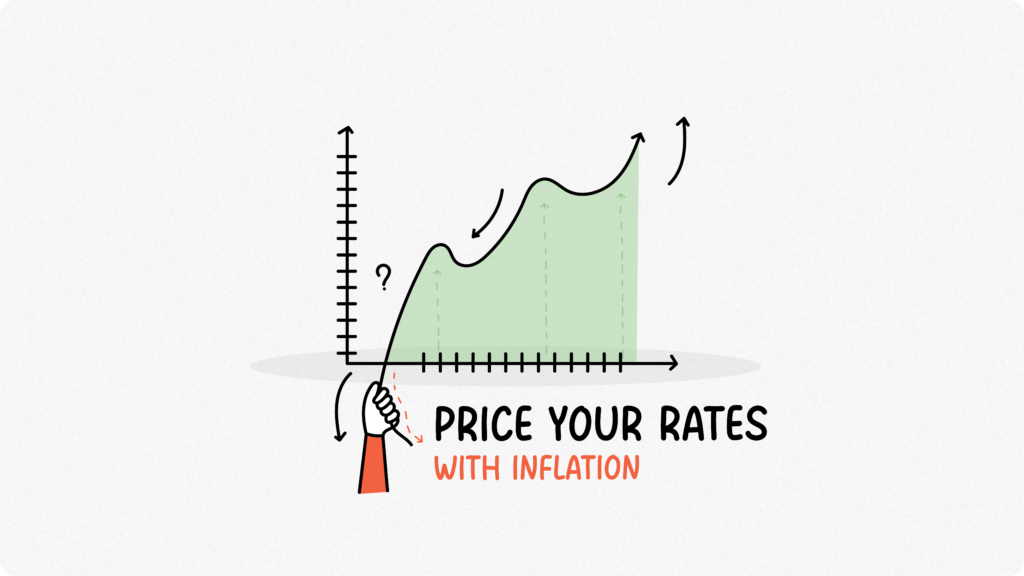
Finding the right balance between being a creative and a business owner is one of the hardest parts of freelancing. Most of us start out wanting to do great work, but eventually hit a wall when the cost of software, health insurance, and taxes begins to consume margins. If you have not adjusted your rates in the last twelve months, you are likely earning less in real terms, even if your nominal income has stayed the same. In the current 2026 economy, pricing is a core part of your business that must keep pace with the world around you. To move from simply surviving to building a sustainable career, you must shift your focus toward professional financial management. In this Article Calculating the Cost of Business Operations A professional rate must support your entire infrastructure. This includes obvious overhead like hardware and subscriptions, but also the invisible costs that traditional employees often overlook. In the U.S., for instance, freelancers are responsible for the full 15.3% self-employment tax. It is also vital to account for non-billable time. If you spend ten hours a week on administration, marketing, and pitching, your active work hours must be priced high enough to fund that unbilled labor. If your rate only covers the moments you are actively producing deliverables, you are effectively subsidising those administrative hours without compensation. The Distinction Between Living and Profiting There is a common trap in the freelance world: setting a rate that covers your bills but leaves nothing for the future. To move into a more secure financial position, your pricing should include a dedicated profit margin, ideally between 10% and 25%. Think of this margin as the research and development fund for your business. This capital pays for a new computer when yours crashes or covers expenses during a slow month. Without a dedicated profit margin, the business has no buffer for reinvestment or volatility, and operates more like a short-term contracting setup than a sustainable company. Purchasing Power and Inflation Inflation is a constant, quiet force that reduces real income over time if rates remain unchanged. With inflation in the U.S. in the mid-3% range in 2026, a project that cost $1,000 last year needs to be priced higher today just to maintain the same purchasing power. Reviewing your rates annually is standard professional maintenance. Most clients find it easier to accept a small, consistent increase each year, often adjusted in line with inflation or the Consumer Price Index, than a larger adjustment after several years of stagnation. Value-Based Communication The prospect of informing a long-term client that your prices are increasing can be stressful. The most effective strategy is to shift the conversation away from your personal expenses and toward the results you deliver. Instead of citing rising costs, focus on the return on investment (ROI) you provided over the last year. If you have helped a client grow their audience or improve their product, they are not paying for your time; they are paying for a specific outcome. Providing 30 to 60 days of notice is the professional standard for this transition, as it allows clients time to adjust their 2027 annual budgets. Freelance Pricing: Frequently Asked Questions How do I know if it is time to raise my rates? If you are constantly booked and turning away work, the market is indicating that your value has exceeded your price. Additionally, if a full year has passed without an adjustment, your real income has likely decreased due to inflation. What is the self-employment tax? In the U.S., the self-employment tax is 15.3%. This covers Social Security and Medicare. Because you are both the employer and the employee, you are responsible for the full amount. You should set this aside before calculating your actual take-home pay. What is a healthy profit margin? Most successful service-based businesses aim for a net profit margin of 10% to 25%. This is the amount remaining after you have paid yourself a fair salary and covered all business overhead. Should I lower my price if a client says I am too expensive? Rarely. If a client has a genuine budget limit, it is better to reduce the scope of the work rather than your rate. For example, if they cannot afford five blog posts, offer them three. This keeps your hourly value intact and maintains your professional standing. Is it better to charge by the hour or by the project? Hourly billing is a safe starting point, but project-based pricing is usually better for experienced professionals. As you become more efficient, hourly billing can actually penalize expertise. Project pricing allows you to be paid for the result and your experience. How do I handle legacy clients on outdated rates? You do not have to move them to your highest current rate immediately. You can offer a loyalty discount that sits between their old rate and your new market value. This acknowledges the relationship while moving the contract toward a sustainable price point. Taking Control of Your Financial Growth Setting professional freelance rates is not an aggressive act; it is a fundamental requirement for a lasting career. By accurately calculating your operational costs, building in a profit margin for reinvestment, and adjusting for economic shifts like inflation, you transition from a gig worker to a business owner. Begin by auditing your current expenses and comparing them against your income over the last twelve months. If your margins have thinned, now is the time to plan your next rate adjustment. Your expertise and the value you provide deserve to be supported by a pricing structure that allows your business to thrive, not just survive.