
The Freelancer’s Guide to Tax Deductions: A Strategic Approach

Most freelancers treat tax season as a retroactive search for receipts. However, the most successful independent professionals approach taxes as a year-round strategy for protecting their margins. In 2026, the IRS has introduced updates to mileage rates and clarified rules around meal deductibility. Without consistent record-keeping, it becomes much easier to miss legitimate deductions or make errors. This guide provides the technical clarity needed to claim every legitimate expense while avoiding common audit triggers. In this Article Home Office Deductions: Immediate Savings vs. Long-term Impact Freelancers must evaluate the long-term impact on property value before selecting a deduction method. The Actual Expense Method This approach allows for a deduction based on a percentage of actual household costs. While it often results in a higher immediate deduction, it involves Depreciation Recapture. The Simplified Method The Simplified Method allows for a standard deduction of $5 per square foot, capped at 300 square feet. Home Office: Calculating Your Business Percentage This step is required only if you choose the Actual Expense Method. To deduct a portion of shared home costs, you must first establish your Business Use Percentage. If you use the Simplified Method, you do not need this percentage; you simply multiply your office square footage (up to 300 sq. ft.) by $5. The Calculation: Divide the square footage of your dedicated office by the total square footage of your home. Example: A 150 sq. ft. office in a 1,500 sq. ft. home equals a 10% Business Use Percentage. Direct vs. Indirect Deductions Repairs vs. Capital Improvements The IRS distinguishes between “Repairs” and “Improvements.” 2026 Equipment & Section 179 Section 179 allows you to deduct the full cost of qualifying equipment in a single year rather than over time. This is a powerful tool for freelancers buying high-end tech. You cannot use Section 179 for the home office itself if you choose the Simplified Method; however, you can still use it for individual business assets like computers and furniture. As of early May 2026, the Section 179 deduction limit is $2,560,000, though it is subject to change—always confirm the current figure with the latest IRS guidance. Professional Growth & Education Continuing education is deductible if it maintains or improves your skills in your current field. Business Travel and the 2026 Standard Mileage Rate (72.5¢ per mile) For 2026, the IRS has set the standard mileage rate at 72.5 cents per mile. 2026 Expense Summary Table Category 2026 IRS Status Calculation Method Mileage 72.5¢ per mile Total business miles x Rate Home Utilities Deductible Total Cost x Business Use % Mortgage Interest Deductible Total Cost x Business Use % Equipment 100% Upfront Section 179 (Business % only) Internet / Phone Deductible Documented Business Use % Property Taxes Deductible Total Cost x Business Use % Common Audit Triggers to Avoid Even legitimate deductions can raise flags if they are not properly documented or appear inconsistent. Common issues include: Maintaining clear records and being able to explain the business purpose behind each deduction is key to defending your claims if questioned. Moving from Retroactive to Proactive You shouldn’t have to spend your weekends digging through old bank statements just to find missing deductions. By tracking your mileage and equipment upgrades as they happen, you stay prepared for tax season and ensure you’re actually keeping the money you’ve earned. This simple habit turns record-keeping into a routine part of your business rather than a major source of stress. Ultimately, staying organized is the most reliable way to protect your profit and make sure your business stays healthy for the long term. About the Author Isabella Jones started her career at Deloitte, where she worked on tax compliance for some of the country’s fastest-growing companies. She later joined Fynlo as Senior Financial Strategist, bringing that experience to freelancers and small business owners who need practical financial guidance without the corporate complexity. With an Accounting degree from Villanova University, Isabella focuses on making financial planning easier to understand and apply in day-to-day business. She works closely with freelancers and small businesses on areas like taxes, cash flow, and building more stable financial systems.
When Should You Move from a Sole Proprietorship to an LLC or S-Corp?
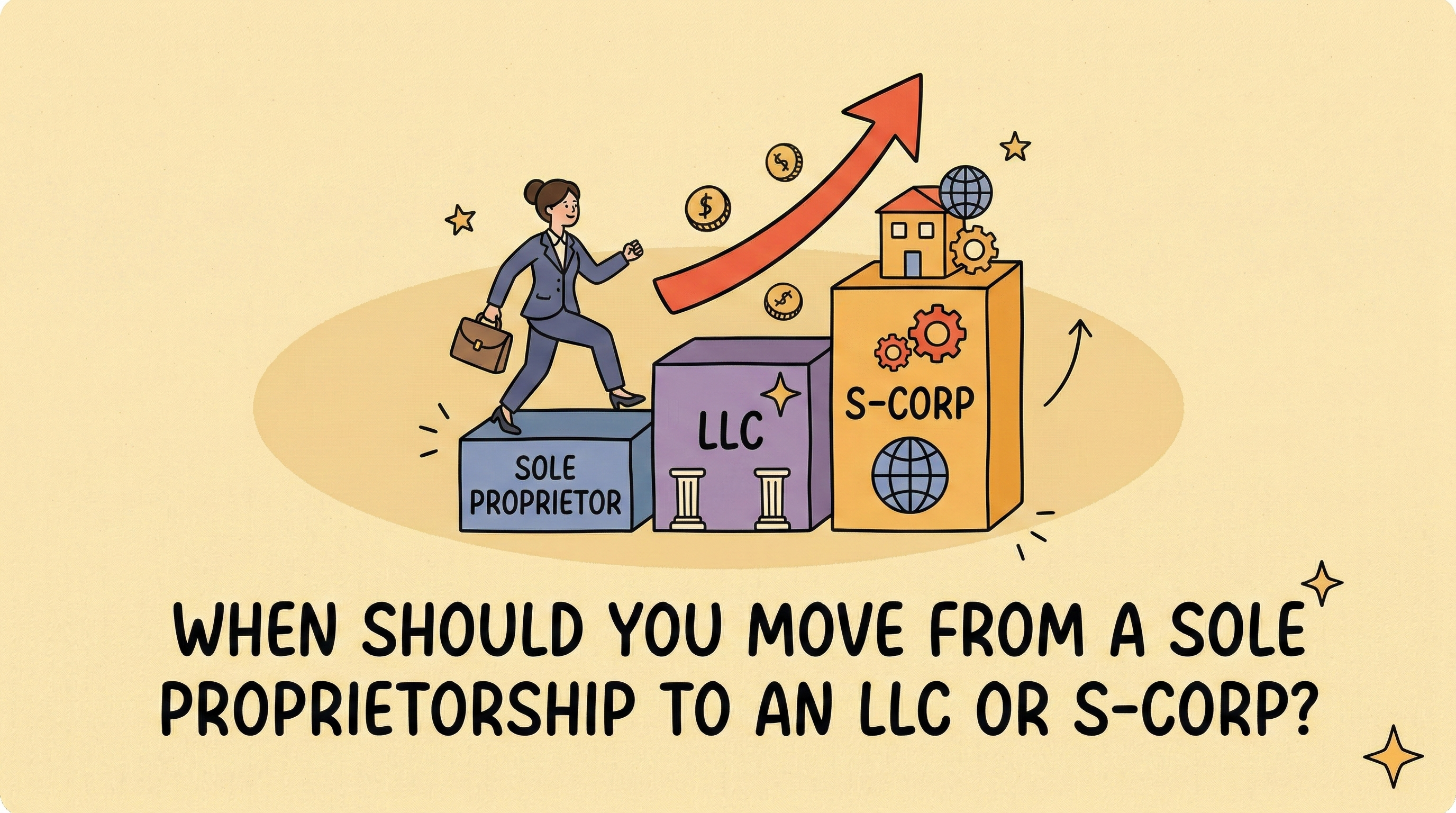
When you first go full-time as a freelancer, your focus is naturally on delivery—landing contracts, hitting deadlines, and refining your craft. Legal paperwork often feels like a secondary chore, a task to be addressed “eventually.” However, the structure you choose today determines how much of your hard-earned profit you actually keep and how well your personal life is protected if a project ever faces a legal challenge. If you are billing significant amounts without a formal entity, you may be unintentionally risking your personal savings for the sake of administrative convenience. Choosing a business structure is a trade-off between simplicity and security. For most freelancers, the transition from a Sole Proprietorship to an LLC or S-Corp is triggered by two specific milestones: reaching $50,000 in annual profit or taking on high-stakes contracts where a professional error could result in a personal lawsuit. In this article The Real-World Cost of Legal Exposure These risks are more than theoretical; without a legal bridge between your business and your personal life, a simple mistake can become a financial catastrophe. In both cases, an LLC would have acted as a circuit breaker, likely limiting the liability to the business’s assets rather than the freelancer’s life savings. Evaluating Your Structure Options Freelance Business Structures: A Quick Comparison Guide 1. The Sole Proprietorship This is the default setting for anyone who begins working for themselves without formal filing. It is the path of least resistance, but it offers the least protection. 2. The Limited Liability Company (LLC) An LLC is a registered entity that exists separately from you as an individual. It is the standard for professional freelancers who want to safeguard their personal finances. 3. The S-Corp Election An S-Corp is not a separate entity you register with the state, but a tax status you request from the IRS. It is the primary tool high-earning freelancers use to reduce their tax burden. Identifying the Financial Turning Point While the legal protection of an LLC is valuable at any stage, the tax benefits of an S-Corp become clear once you look at the math. Let’s compare the tax liability for a freelancer earning $100,000 in annual profit. S-Corp vs. LLC: Visualizing the Tax Savings Structure Self-Employment Tax (15.3%) Total FICA Tax Bill Standard LLC Paid on the full $100,000 $15,300 S-Corp Election Paid only on $60,000 (Salary) $9,180 Annual Tax Savings $6,120 The Milestone: As a general rule, once your annual profit clears $75,000, the tax savings of an S-Corp usually outweigh the $1,500–$2,000 cost of professional accounting and payroll software. Until you reach that mark, a standard LLC provides the most efficient balance of protection and simplicity. Maintaining Your Liability Protection Registering an LLC is only the first step. If you treat your business account like a personal fund, a lawyer can argue in court that the business and the individual are one and the same. To keep your protection intact, adopt these three habits: Common Q&A 1. Does an LLC protect me if I personally make a mistake on a project? An LLC is not a “get out of jail free” card for professional negligence. If you are personally responsible for a major error—like accidentally deleting a client’s database—you can still be held liable. This is why the most professional approach is a “two-tier” strategy: use a Business Structure for debt and contract protection, and Professional Liability Insurance for your actual work-product. 2. I am just starting out—can I change my structure later? Yes, and most freelancers do exactly that. It is common to start as a Sole Proprietorship for the first few months, register an LLC once contracts grow larger, and elect S-Corp status once profits stabilize above the $75,000 mark. Your legal structure should evolve alongside your income. 3. Do I need a lawyer to set this up? For a single-member LLC, many freelancers file directly with their Secretary of State or use a registration service. However, if you have business partners or are moving toward an S-Corp, a 30-minute consultation with a CPA is a wise investment to ensure you are meeting all federal and local tax requirements. 4. How does my structure affect my ability to get a mortgage? Lenders generally view S-Corp and LLC owners similarly as self-employed individuals. They typically look at your “net income” over the last two years. The main difference is that an S-Corp provides you with W-2s, which can sometimes make the application process feel slightly more traditional to a loan officer. Scaling with Confidence Choosing a business structure is essentially a trade-off between simplicity and security. As your income grows, your legal setup should evolve from the simplicity of a sole proprietorship to the robust protection and tax efficiency offered by an LLC or S-Corp. By making these decisions before you reach critical financial milestones, you ensure your business is built to safeguard your personal life today while fueling your professional growth for tomorrow. About the Author Isabella Jones started her career at Deloitte, where she worked on tax compliance for some of the country’s fastest-growing companies. She later joined Fynlo as Senior Financial Strategist, bringing that experience to freelancers and small business owners who need practical financial guidance without the corporate complexity. With an Accounting degree from Villanova University, Isabella focuses on making financial planning easier to understand and apply in day-to-day business. She works closely with freelancers and small businesses on areas like taxes, cash flow, and building more stable financial systems.
Beyond the Invoice: A Practical Guide to Business Cash Flow Projections
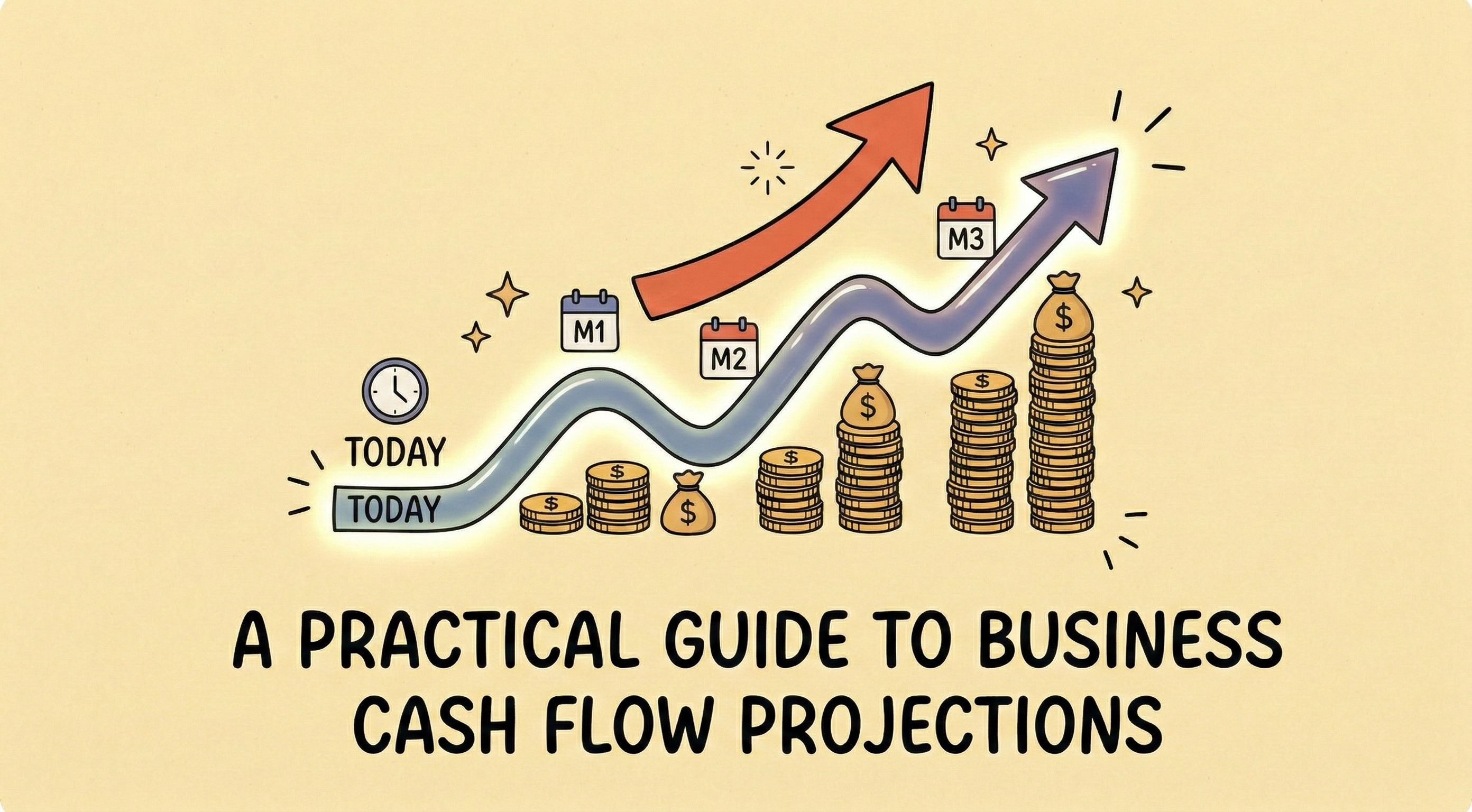
Imagine you have just finished a significant project. The client is pleased, and you have issued a professional invoice. On paper, your business is performing well. Then you check your bank balance. Your accounts receivable look strong. Your revenue is growing. But the actual cash available to pay software subscriptions, rent, or payroll is lower than expected — because that payment is still moving through a 30-day processing cycle. This is one of the most common financial traps in growing businesses: strong revenue, weak liquidity. A Cash Flow Projection exists to solve this problem. It is not just a spreadsheet exercise. It is a forward-looking control system that shows you — weeks or months in advance — whether your business will have the liquidity to operate smoothly. Profit is an accounting concept. Cash is a survival metric. Many profitable businesses do not fail because they lack clients. They fail because they run out of cash before payments arrive. In this article Distinguishing between paper profit and actual cash It is a common misunderstanding to assume that a “profitable” month automatically means a healthy bank account. You can be profitable — and still be unable to pay your bills on time. Cash Flow is the real-time movement of money into and out of your accounts. Profit is what remains after expenses are deducted from revenue — regardless of whether the money has physically arrived. The difference is timing. And in business, timing determines survival. To operate with stability, you must prioritize Liquidity. This means having sufficient cash on hand to cover recurring costs like software, rent, and taxes precisely when they are due. Managing the essentials of cash inflow and outflow A reliable cash flow projection is built on two categories: inflows and outflows. By tracking these accurately, you move from reacting to your finances to controlling them. Cash Inflow (The money entering your business) Record inflows based on when you expect the money to be available, not when you finish the work. Confirmed Payments: Only include revenue from signed contracts or completed milestones. The Payment Buffer: A practical best practice is to forecast payments arriving seven days later than the client’s stated due date. This accounts for bank processing times and administrative delays. Cash Outflow (The money leaving your business) Modern business expenses are increasingly digital and recurring. The Technology Stack: On average, professional freelancers and small agencies now spend 12–15% of their revenue on the software and tools required to stay competitive. The Tax Reserve: One of the most vital professional habits is allocating 25–30% of every incoming payment into a dedicated tax account. By documenting this as a mandatory “outflow” in your cash flow projection, you ensure that quarterly tax deadlines never disrupt your operations. Forecasting your monthly closing balance Once you understand your inflows and outflows, you can calculate your Closing Balance. This figure represents exactly how much cash you will have remaining at the end of the month. Closing Balance= (Starting Balance+Total Inflow) − Total Outflow A positive balance gives you flexibility to reinvest, build reserves, or absorb slow periods. A negative balance is not a crisis. It is an early warning signal. The purpose of a projection is not prediction; it is preparation. Implementation: Your cash flow projection template To help you move from theory to practice, we have provided a structured cash flow projection template below. Week Starting Balance Expected Inflow Planned Outflow Projected End Balance Week 1 $5,000 $1,200 ($800) $5,400 Week 2 $5,400 $0 ($1,500) $3,900 Week 3 $3,900 $3,500 ($400) $7,000 Week 4 $7,000 $500 ($2,000) $5,500 When you review this weekly, patterns begin to emerge: These patterns are where financial control begins. Financial health Q&A 1. Should I include “potential” leads in my forecast? No. To keep your projection accurate, only include projects where a contract is signed. Relying on a “potential” lead to cover fixed costs can lead to significant cash shortages. 2. How do I handle unpredictable monthly income?Build your projection based on your “Financial Floor”—your guaranteed retainers or your lowest historical monthly earnings. Anything earned beyond that is a bonus, but your essential bills should be covered by your most conservative estimate. 3. What if my projected balance turns negative?First, do not panic; the entire purpose of a projection is to give you time to adjust before the situation becomes an actual problem. Review variable costs such as marketing campaigns, new equipment, or discretionary spending. These can often be deferred. At the same time, use the projection as a prompt to follow up on overdue invoices to accelerate inflow. The earlier you see the dip, the more options you have. 4. How do I know if my business is “safe”?Aim to maintain a “Cash Floor” that can cover at least three months of your total outflows. Running out of cash is one of the top 5 reasons small businesses fail. This provides the security to navigate project delays or seasonal dips in work without compromising your operations. 5. What hidden outflows should I watch for? Commonly missed expenses include: Always forecast based on net cash received, not the gross amount invoiced. From Reactive Bookkeeping to Proactive Control Taking control of your cash flow is the most effective way to eliminate the “financial fog” that often leads to burnout. Projections move you away from the stress of wondering if a client payment will arrive in time to cover rent, allowing you to focus on the work that actually grows the business. Resilience isn’t built by hoping for a good month; it is built by seeing a potential dip sixty days out and having the clarity to adjust your spending or follow up on invoices before it becomes a crisis. When you master your cash flow, you stop being a passenger in your business and start being the pilot. About the Author Isabella Jones started her career at Deloitte, where she managed tax compliance for some of the country’s fastest-growing companies. She later joined Fynlo as Senior Financial Strategist, bringing that experience to freelancers and small business owners who need practical financial guidance without the corporate complexity. With an Accounting degree from Villanova University, Isabella focuses on making
My Client Wants Another Revision?! (And How I Survived)

Ugh, revisions. We’ve all been there. You nail the brief—a sleek new logo, a killer website mockup, a brochure that’s chef’s kiss—and then… the client comes back with a laundry list of “minor” tweaks. “Can we just make the logo a little bigger? And maybe try a different shade of blue? Oh, and could we see what it looks like with a completely different font?” It’s the dreaded revision cycle that never ends, especially when a client acts like “unlimited revisions” is in the contract, even if it totally isn’t. As graphic designers, we get it. You want happy clients. You want them to rave about your work. But endless revisions are a profit-killer, a creativity-drainer, and a direct path to burnout. It’s like being trapped in a never-ending PSD file of doom. So, how do you deal with clients who seem to think “just one more tweak” is their God-given right? How do you set boundaries without sounding like a jerk? And, most importantly, how do you get paid for the extra work you’re doing? Let’s break it down. Why Unlimited Revisions Are a Disaster “Unlimited” anything is a bad idea, especially in design. Here’s why: Why Clients Think They’re Entitled to Unlimited Revisions Now that we understand why unlimited revisions are problematic, let’s explore why clients may expect them. Setting Boundaries and Charging for Extra Iterations Here’s how to take back control of your time and creativity: Any requests for additional meetings or design rounds, exceeding what is defined in this contract, may necessitate a modification to the estimated price and timeline of this project. This clause sets the stage for fair boundaries. Combine it with these specific points: Detailed Proposals: Before finalizing the contract, your proposal should clearly define the project scope, deliverables, milestones, timeline, and revision policy. This helps set client expectations upfront and avoids misunderstandings later. Here’s a sample: This clear structure helps clients see where revisions fit in and keeps the project on track. “Just a friendly reminder, this revision goes beyond what was included in the original agreement. I’d be happy to proceed at my hourly rate of $50/hour. Would you like me to send over an updated estimate?” Expand the use of time-tracking tools like Toggl or Clockify to monitor all revisions, even the included ones. These tools not only help justify your fees but also refine your pricing for future projects by providing clear data on how long each revision takes. Stop letting endless revisions drain your creativity and earnings. By setting clear boundaries, using structured feedback rounds, and leveraging time-tracking tools, you can stay in control while delivering top-notch designs. You’ve got this!
How to Price Your Rates as a Freelancer (Even With Inflation!)
Finding the right balance between being a creative and a business owner is one of the hardest parts of freelancing. Most of us start out wanting to do great work, but eventually hit a wall when the cost of software, health insurance, and taxes begins to consume margins. If you have not adjusted your rates in the last twelve months, you are likely earning less in real terms, even if your nominal income has stayed the same. In the current 2026 economy, pricing is a core part of your business that must keep pace with the world around you. To move from simply surviving to building a sustainable career, you must shift your focus toward professional financial management. In this Article Calculating the Cost of Business Operations A professional rate must support your entire infrastructure. This includes obvious overhead like hardware and subscriptions, but also the invisible costs that traditional employees often overlook. In the U.S., for instance, freelancers are responsible for the full 15.3% self-employment tax. It is also vital to account for non-billable time. If you spend ten hours a week on administration, marketing, and pitching, your active work hours must be priced high enough to fund that unbilled labor. If your rate only covers the moments you are actively producing deliverables, you are effectively subsidising those administrative hours without compensation. The Distinction Between Living and Profiting There is a common trap in the freelance world: setting a rate that covers your bills but leaves nothing for the future. To move into a more secure financial position, your pricing should include a dedicated profit margin, ideally between 10% and 25%. Think of this margin as the research and development fund for your business. This capital pays for a new computer when yours crashes or covers expenses during a slow month. Without a dedicated profit margin, the business has no buffer for reinvestment or volatility, and operates more like a short-term contracting setup than a sustainable company. Purchasing Power and Inflation Inflation is a constant, quiet force that reduces real income over time if rates remain unchanged. With inflation in the U.S. in the mid-3% range in 2026, a project that cost $1,000 last year needs to be priced higher today just to maintain the same purchasing power. Reviewing your rates annually is standard professional maintenance. Most clients find it easier to accept a small, consistent increase each year, often adjusted in line with inflation or the Consumer Price Index, than a larger adjustment after several years of stagnation. Value-Based Communication The prospect of informing a long-term client that your prices are increasing can be stressful. The most effective strategy is to shift the conversation away from your personal expenses and toward the results you deliver. Instead of citing rising costs, focus on the return on investment (ROI) you provided over the last year. If you have helped a client grow their audience or improve their product, they are not paying for your time; they are paying for a specific outcome. Providing 30 to 60 days of notice is the professional standard for this transition, as it allows clients time to adjust their 2027 annual budgets. Freelance Pricing: Frequently Asked Questions How do I know if it is time to raise my rates? If you are constantly booked and turning away work, the market is indicating that your value has exceeded your price. Additionally, if a full year has passed without an adjustment, your real income has likely decreased due to inflation. What is the self-employment tax? In the U.S., the self-employment tax is 15.3%. This covers Social Security and Medicare. Because you are both the employer and the employee, you are responsible for the full amount. You should set this aside before calculating your actual take-home pay. What is a healthy profit margin? Most successful service-based businesses aim for a net profit margin of 10% to 25%. This is the amount remaining after you have paid yourself a fair salary and covered all business overhead. Should I lower my price if a client says I am too expensive? Rarely. If a client has a genuine budget limit, it is better to reduce the scope of the work rather than your rate. For example, if they cannot afford five blog posts, offer them three. This keeps your hourly value intact and maintains your professional standing. Is it better to charge by the hour or by the project? Hourly billing is a safe starting point, but project-based pricing is usually better for experienced professionals. As you become more efficient, hourly billing can actually penalize expertise. Project pricing allows you to be paid for the result and your experience. How do I handle legacy clients on outdated rates? You do not have to move them to your highest current rate immediately. You can offer a loyalty discount that sits between their old rate and your new market value. This acknowledges the relationship while moving the contract toward a sustainable price point. Taking Control of Your Financial Growth Setting professional freelance rates is not an aggressive act; it is a fundamental requirement for a lasting career. By accurately calculating your operational costs, building in a profit margin for reinvestment, and adjusting for economic shifts like inflation, you transition from a gig worker to a business owner. Begin by auditing your current expenses and comparing them against your income over the last twelve months. If your margins have thinned, now is the time to plan your next rate adjustment. Your expertise and the value you provide deserve to be supported by a pricing structure that allows your business to thrive, not just survive.