
When Should You Move from a Sole Proprietorship to an LLC or S-Corp?
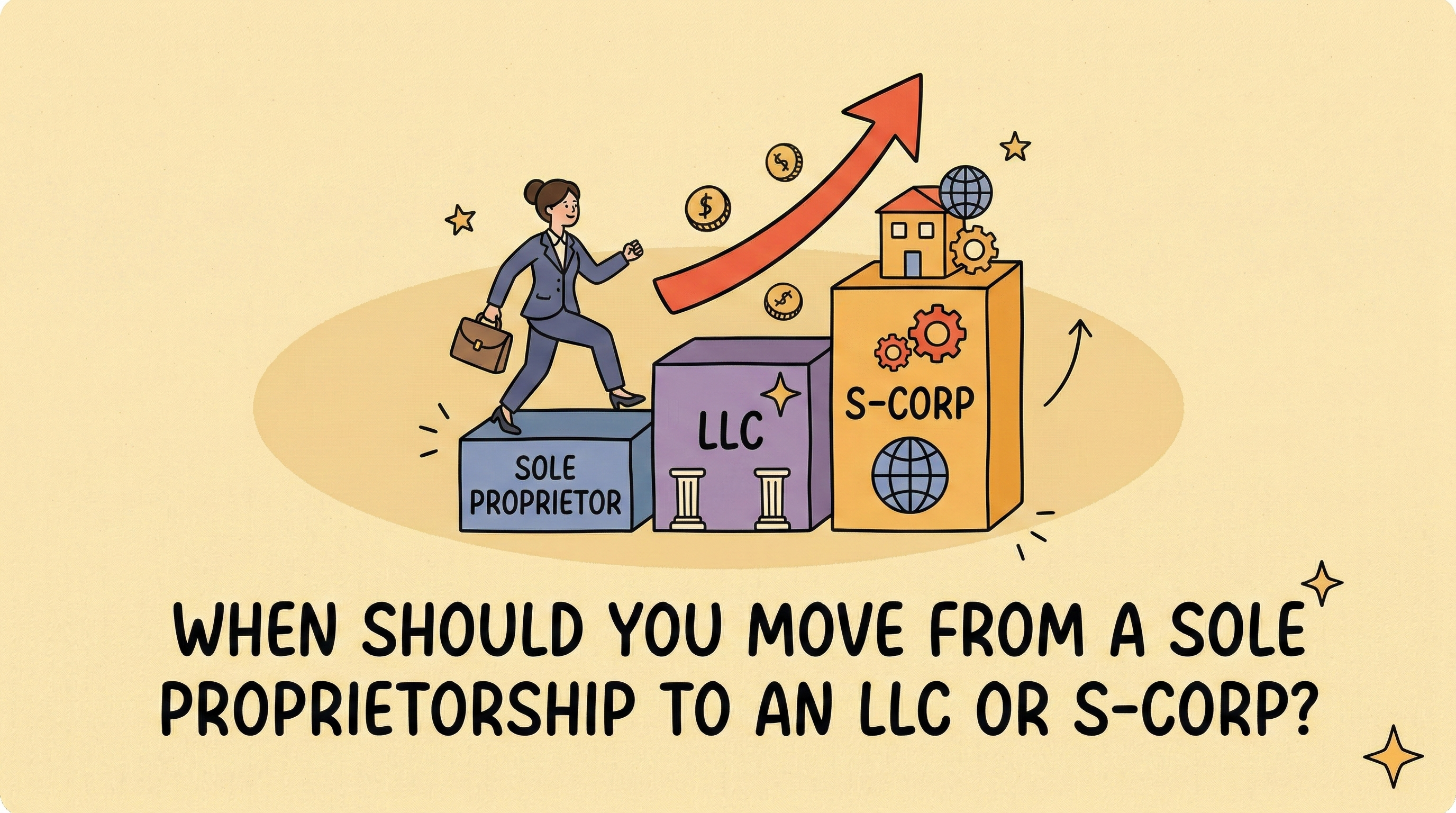
When you first go full-time as a freelancer, your focus is naturally on delivery—landing contracts, hitting deadlines, and refining your craft. Legal paperwork often feels like a secondary chore, a task to be addressed “eventually.” However, the structure you choose today determines how much of your hard-earned profit you actually keep and how well your personal life is protected if a project ever faces a legal challenge. If you are billing significant amounts without a formal entity, you may be unintentionally risking your personal savings for the sake of administrative convenience. Choosing a business structure is a trade-off between simplicity and security. For most freelancers, the transition from a Sole Proprietorship to an LLC or S-Corp is triggered by two specific milestones: reaching $50,000 in annual profit or taking on high-stakes contracts where a professional error could result in a personal lawsuit. In this article The Real-World Cost of Legal Exposure These risks are more than theoretical; without a legal bridge between your business and your personal life, a simple mistake can become a financial catastrophe. In both cases, an LLC would have acted as a circuit breaker, likely limiting the liability to the business’s assets rather than the freelancer’s life savings. Evaluating Your Structure Options Freelance Business Structures: A Quick Comparison Guide 1. The Sole Proprietorship This is the default setting for anyone who begins working for themselves without formal filing. It is the path of least resistance, but it offers the least protection. 2. The Limited Liability Company (LLC) An LLC is a registered entity that exists separately from you as an individual. It is the standard for professional freelancers who want to safeguard their personal finances. 3. The S-Corp Election An S-Corp is not a separate entity you register with the state, but a tax status you request from the IRS. It is the primary tool high-earning freelancers use to reduce their tax burden. Identifying the Financial Turning Point While the legal protection of an LLC is valuable at any stage, the tax benefits of an S-Corp become clear once you look at the math. Let’s compare the tax liability for a freelancer earning $100,000 in annual profit. S-Corp vs. LLC: Visualizing the Tax Savings Structure Self-Employment Tax (15.3%) Total FICA Tax Bill Standard LLC Paid on the full $100,000 $15,300 S-Corp Election Paid only on $60,000 (Salary) $9,180 Annual Tax Savings $6,120 The Milestone: As a general rule, once your annual profit clears $75,000, the tax savings of an S-Corp usually outweigh the $1,500–$2,000 cost of professional accounting and payroll software. Until you reach that mark, a standard LLC provides the most efficient balance of protection and simplicity. Maintaining Your Liability Protection Registering an LLC is only the first step. If you treat your business account like a personal fund, a lawyer can argue in court that the business and the individual are one and the same. To keep your protection intact, adopt these three habits: Common Q&A 1. Does an LLC protect me if I personally make a mistake on a project? An LLC is not a “get out of jail free” card for professional negligence. If you are personally responsible for a major error—like accidentally deleting a client’s database—you can still be held liable. This is why the most professional approach is a “two-tier” strategy: use a Business Structure for debt and contract protection, and Professional Liability Insurance for your actual work-product. 2. I am just starting out—can I change my structure later? Yes, and most freelancers do exactly that. It is common to start as a Sole Proprietorship for the first few months, register an LLC once contracts grow larger, and elect S-Corp status once profits stabilize above the $75,000 mark. Your legal structure should evolve alongside your income. 3. Do I need a lawyer to set this up? For a single-member LLC, many freelancers file directly with their Secretary of State or use a registration service. However, if you have business partners or are moving toward an S-Corp, a 30-minute consultation with a CPA is a wise investment to ensure you are meeting all federal and local tax requirements. 4. How does my structure affect my ability to get a mortgage? Lenders generally view S-Corp and LLC owners similarly as self-employed individuals. They typically look at your “net income” over the last two years. The main difference is that an S-Corp provides you with W-2s, which can sometimes make the application process feel slightly more traditional to a loan officer. [Try Fynlo to see exactly how much an S-Corp could save you]