
Beyond the Invoice: A Practical Guide to Business Cash Flow Projections
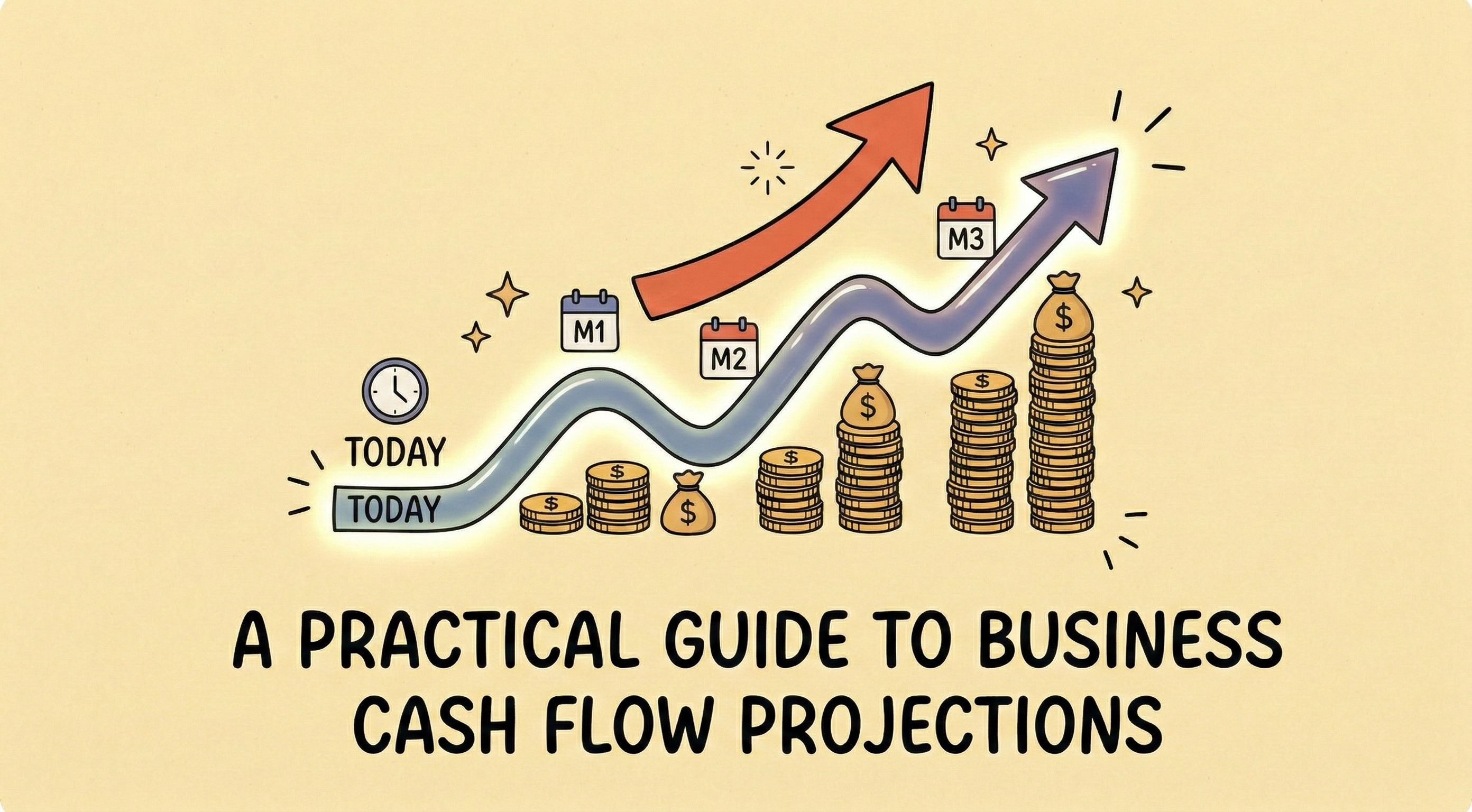
Imagine you have just finished a significant project. The client is pleased, and you have issued a professional invoice. On paper, your business is performing well. Then you check your bank balance. Your accounts receivable look strong. Your revenue is growing. But the actual cash available to pay software subscriptions, rent, or payroll is lower than expected — because that payment is still moving through a 30-day processing cycle. This is one of the most common financial traps in growing businesses: strong revenue, weak liquidity. A Cash Flow Projection exists to solve this problem. It is not just a spreadsheet exercise. It is a forward-looking control system that shows you — weeks or months in advance — whether your business will have the liquidity to operate smoothly. Profit is an accounting concept. Cash is a survival metric. Many profitable businesses do not fail because they lack clients. They fail because they run out of cash before payments arrive. In this article Distinguishing between paper profit and actual cash It is a common misunderstanding to assume that a “profitable” month automatically means a healthy bank account. You can be profitable — and still be unable to pay your bills on time. Cash Flow is the real-time movement of money into and out of your accounts. Profit is what remains after expenses are deducted from revenue — regardless of whether the money has physically arrived. The difference is timing. And in business, timing determines survival. To operate with stability, you must prioritize Liquidity. This means having sufficient cash on hand to cover recurring costs like software, rent, and taxes precisely when they are due. Managing the essentials of cash inflow and outflow A reliable cash flow projection is built on two categories: inflows and outflows. By tracking these accurately, you move from reacting to your finances to controlling them. Cash Inflow (The money entering your business) Record inflows based on when you expect the money to be available, not when you finish the work. Confirmed Payments: Only include revenue from signed contracts or completed milestones. The Payment Buffer: A practical best practice is to forecast payments arriving seven days later than the client’s stated due date. This accounts for bank processing times and administrative delays. Cash Outflow (The money leaving your business) Modern business expenses are increasingly digital and recurring. The Technology Stack: On average, professional freelancers and small agencies now spend 12–15% of their revenue on the software and tools required to stay competitive. The Tax Reserve: One of the most vital professional habits is allocating 25–30% of every incoming payment into a dedicated tax account. By documenting this as a mandatory “outflow” in your cash flow projection, you ensure that quarterly tax deadlines never disrupt your operations. Forecasting your monthly closing balance Once you understand your inflows and outflows, you can calculate your Closing Balance. This figure represents exactly how much cash you will have remaining at the end of the month. Closing Balance= (Starting Balance+Total Inflow) − Total Outflow A positive balance gives you flexibility to reinvest, build reserves, or absorb slow periods. A negative balance is not a crisis. It is an early warning signal. The purpose of a projection is not prediction; it is preparation. Implementation: Your cash flow projection template To help you move from theory to practice, we have provided a structured cash flow projection template below. Week Starting Balance Expected Inflow Planned Outflow Projected End Balance Week 1 $5,000 $1,200 ($800) $5,400 Week 2 $5,400 $0 ($1,500) $3,900 Week 3 $3,900 $3,500 ($400) $7,000 Week 4 $7,000 $500 ($2,000) $5,500 When you review this weekly, patterns begin to emerge: These patterns are where financial control begins. Financial health Q&A 1. Should I include “potential” leads in my forecast? No. To keep your projection accurate, only include projects where a contract is signed. Relying on a “potential” lead to cover fixed costs can lead to significant cash shortages. 2. How do I handle unpredictable monthly income?Build your projection based on your “Financial Floor”—your guaranteed retainers or your lowest historical monthly earnings. Anything earned beyond that is a bonus, but your essential bills should be covered by your most conservative estimate. 3. What if my projected balance turns negative?First, do not panic; the entire purpose of a projection is to give you time to adjust before the situation becomes an actual problem. Review variable costs such as marketing campaigns, new equipment, or discretionary spending. These can often be deferred. At the same time, use the projection as a prompt to follow up on overdue invoices to accelerate inflow. The earlier you see the dip, the more options you have. 4. How do I know if my business is “safe”?Aim to maintain a “Cash Floor” that can cover at least three months of your total outflows. This provides the security to navigate project delays or seasonal dips in work without compromising your operations. 5. What hidden outflows should I watch for? Commonly missed expenses include: Always forecast based on net cash received, not the gross amount invoiced. Securing Your Financial Future Taking control of your cash flow is one of the most effective ways to reduce the stress of business ownership. Once the numbers are organized, you can spend less time worrying about your bank account and more time focusing on high-value work. If you are still managing projections manually in spreadsheets, consider moving to a system that automatically tracks inflows, outflows, and real-time balances. When your financial data updates itself, you move from reactive bookkeeping to proactive decision-making. If you would like assistance setting up a structured cash flow projection system that gives you visibility weeks in advance, feel free to schedule a consultation with our team. We would be happy to help you build a resilient financial foundation.
Stop the 20% Profit Leak: Why 88% of Spreadsheet Budgets Struggle to Scale (+ Free Templates)
When you first start a business, financial oversight is natural. With a team of five, you likely see every receipt and approve every software subscription. But as you grow, that direct visibility begins to fade. You decentralize, giving credit cards to department heads and autonomy to managers. This transition often leads to what procurement professionals call “Maverick Spend”: purchasing that happens outside of agreed-upon budgets or central visibility. It isn’t usually the result of bad intentions; it is simply the result of a growing team moving faster than its financial systems. A 35-person SaaS company discovered they were paying for 214 SaaS licenses, but only 147 were active users. The excess cost them $4,800 per month. No one intended the waste. It accumulated silently. Most founders don’t lose control because they’re reckless. They lose control because their systems were built for 5 people—and they’re now managing 50. In this guide, we explore how to regain control of this “profit leak” and provide a practical blueprint for departmental financial health. In this article What is a Departmental Budgeting? At its core, a departmental budget is a financial roadmap for a specific segment of your business. It is a document, typically a spreadsheet or dashboard, that forecasts revenue and expenses for a set period—usually a month, quarter, or year. Core Elements: The Spreadsheet Risk Multiplier While decentralization causes visibility issues, the tools we use to manage that growth often introduce their own risks. Most scaling companies rely on a master spreadsheet—a file with dozens of tabs and thousands of rows. The danger here is rarely a single massive catastrophe; it is the accumulation of small, invisible mistakes. Imagine a manager accidentally hard-coding a $5,000 monthly expense into a cell rather than using a dynamic formula. At a small scale, you might spot the discrepancy. Yet in a complex file, that static number remains unchanged while your actual costs triple. By the time the error is caught six months later, you have over-allocated $60,000 based on a single “broken cell.” In a landscape where research by Professor Ray Panko shows that 88% of spreadsheets contain significant errors, these minor technical slips are often the hidden reason runways disappear faster than expected. Top Free Budgeting Templates If you aren’t ready for software, a template is a solid starting point. The right choice depends on your team’s bandwidth, your comfort with formulas, and whether you need basic tracking or in-depth departmental ROI analysis. Microsoft Office Templates: SlideTeam Presentation Templates: Liveflow SaaS Templates: Smartsheet Budget Templates: Your 5-Step Implementation Guide If you’re ready to move from a single consolidated budget to departmental accountability, follow this path: Step 1: Assign Departmental Leads Identify your primary departments (e.g., Marketing, Sales, Product, Ops). Assign one leader to each who is responsible for their team’s spending accuracy. Step 2: Conduct a 3-Month Look-Back Gather the last 90 days of transactions and categorize them by department. You will likely find expenses that “belong” to everyone (like Slack seats) and expenses that should be isolated (like specific LinkedIn ad spend). Step 3: Define Your Fixed Monthly Costs Work with leads to determine their fixed monthly costs—salaries and essential software. This is their “Baseline.” Any spend above this must be linked to a specific growth target. Step 4: Establish the Request Protocol Create a process for new expenses. If Marketing wants a new $200/month tool, they must identify which “Baseline” expense they are cutting to make room for it, or prove how it increases their specific ROI. Step 5: Monthly Performance Comparison On the 5th of every month, sit down with your leads for 15 minutes. Compare what they planned to spend vs. what they actually spent. This creates a culture of transparency where numbers aren’t a surprise. The Strategic Blueprint for Advanced Control 1. The Zero-Based Variance AuditMany companies take last year’s figures and add 5%. This often makes wasteful spending permanent. A more robust method is the Zero-Based Audit, where once a year, every department must justify their expenses from $0 up. This is the most effective way to identify “ghost subscriptions” for tools your team no longer uses. 2. Aligning Budgets with Contribution Margins Rather than simply assigning a “pot of money,” consider setting budgets based on Contribution Margin targets. This means every dollar allocated to a department should be tied to an efficiency metric. For instance, you might authorize a budget that fluctuates based on the team’s ability to keep the Customer Acquisition Cost (CAC) within a certain range. 3. Decentralizing Responsibility through LERTrue financial control happens when department heads feel ownership. One way to foster this is by tracking the Labor Efficiency Ratio (LER). By asking managers to monitor how much gross profit their specific team generates for every dollar spent on their payroll, you shift their focus from “spending” to “value creation.” 4. Implementing “Soft-Close” VisibilityWaiting for a formal “Month-End Close” is often too slow. Implementing a Soft-Close dashboard allows you to see “committed spend” (money promised to vendors) alongside “actual spend” (money that has already left the bank). This prevents the surprise of a large, unforecasted vendor bill hitting your books on the 30th. Achieving Financial Accuracy While spreadsheets are an essential starting point, they eventually reach a breaking point. If you find yourself spending more time fixing broken formulas than analyzing your margins, it might be time to consider an integrated approach. Fynlo was designed to help growing companies move away from manual tracking and toward automated clarity. By integrating directly with your existing financial tools, Fynlo provides: The moment you stop reconciling spreadsheets and start reviewing alerts is the moment finance shifts from reactive to strategic. [Explore how Fynlo can support your growth – Let’s connect]