
Most founders start their journey with a focus on top-line growth, but as the business matures, the focus shifts to the bottom line. In 2026, where your business “lives” is just as important as what it sells. Between state-level taxes, franchise fees, and administrative overhead, your choice of location can change your net profit by thousands of dollars annually.
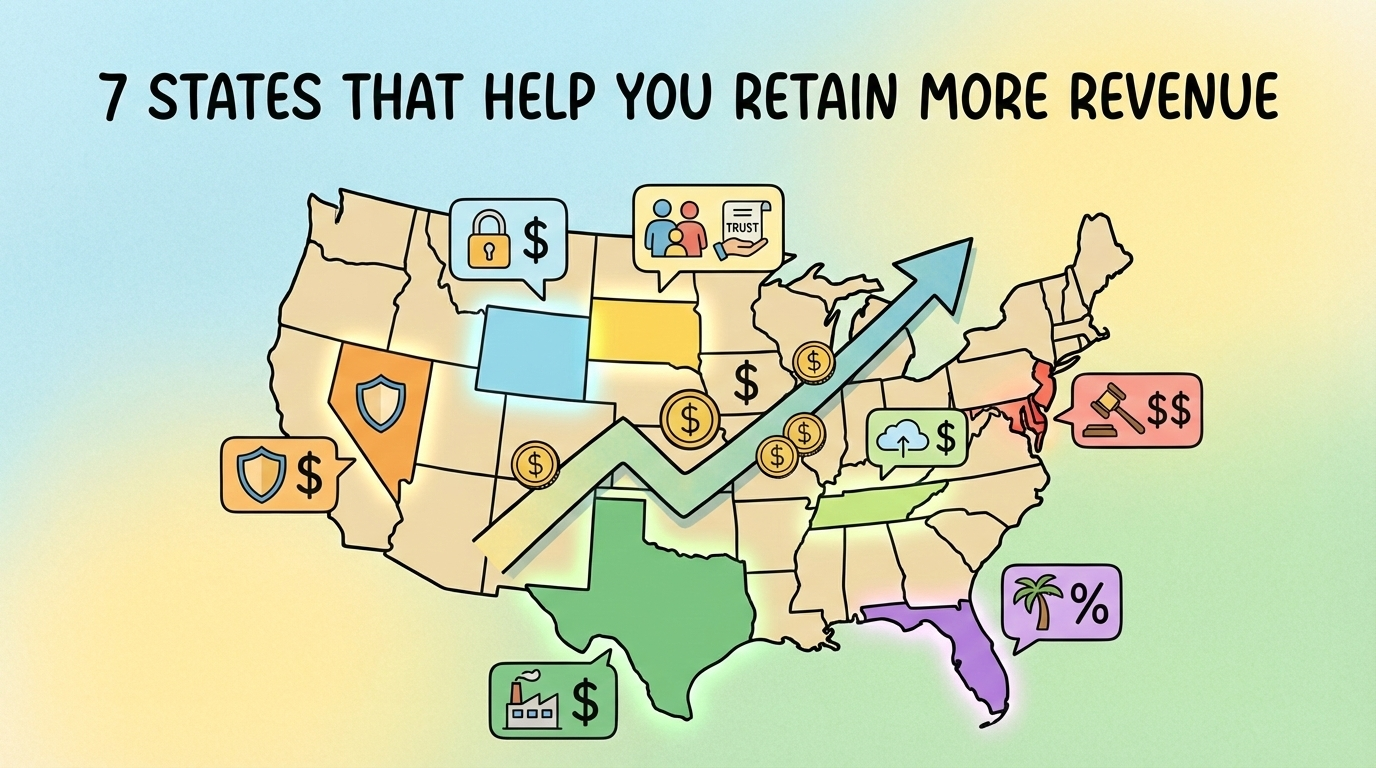
With the 2026 economy favoring remote-first structures, you have more flexibility than ever to choose a home base that aligns with your financial goals. Here is a detailed look at seven states designed for high retention and low friction.
In this article
- Quick Comparison: 2026 Top Tax-Friendly States
- Wyoming: The Efficiency Leader
- Delaware: The Global Standard for Scaling
- Florida: The Strategic Hub for Growth
- Nevada: Advanced Protection for Business Assets
- Texas: The Choice for Large-Scale Operations
- South Dakota: Privacy for Long-Term Wealth
- Tennessee: The Incentive for Remote Innovation
- 2026 Business Location Checklist
Quick Comparison: 2026 Top Tax-Friendly States
Selecting the right home for your business in 2026 requires balancing immediate fees against long-term strategic goals. Use the decision matrix below to identify your path, then verify the technical thresholds in the comparison table.
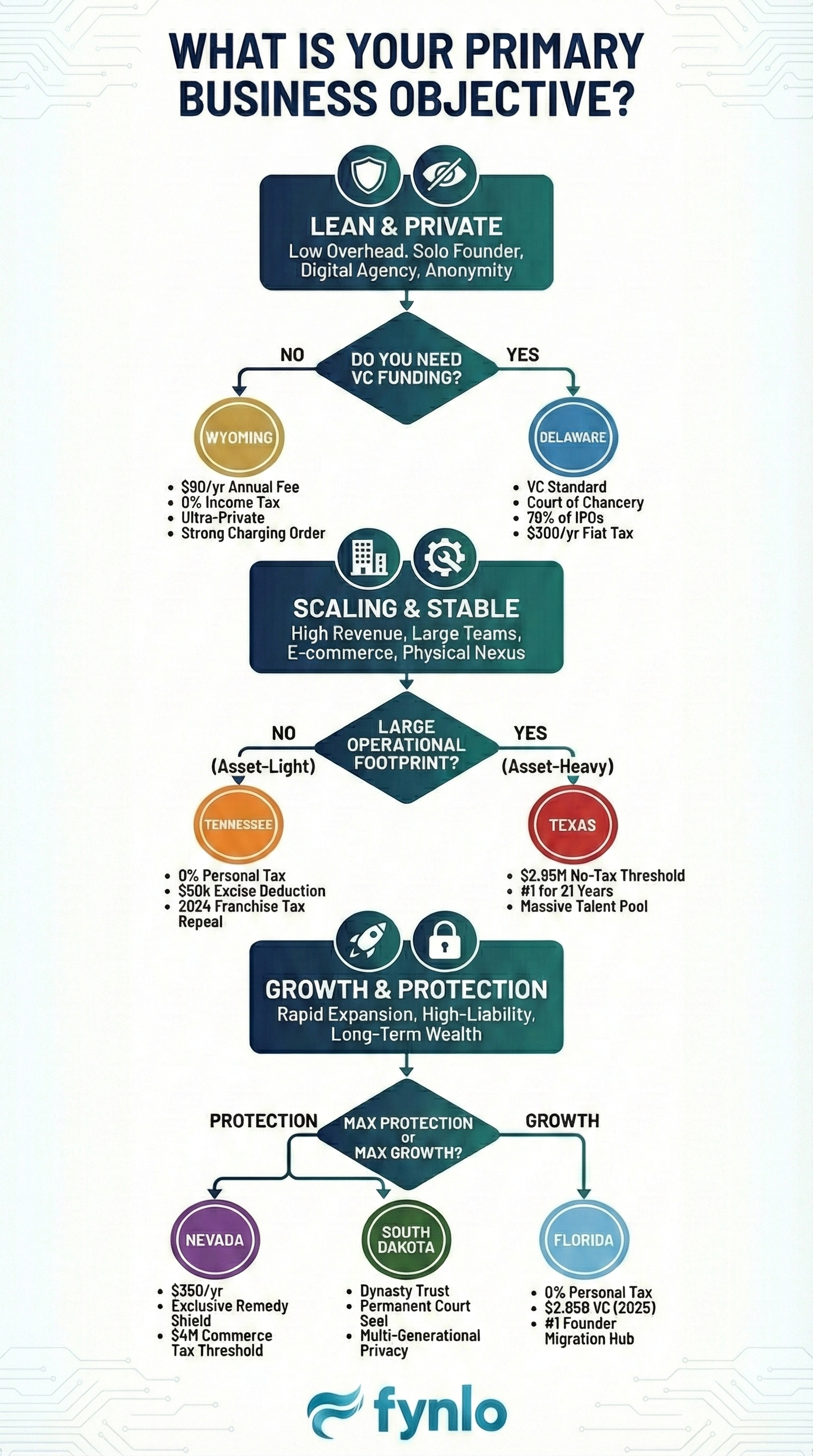
| State | Annual Base Fee | Tax-Exempt Threshold (2026) | Privacy & Asset Protection | Primary Strategic Advantage |
| Wyoming | $60 | 100% Tax-Free | Elite: No member names in public records; strong charging order. | The “Lean” Leader: Lowest combined maintenance and setup costs in the U.S. |
| Delaware | $300 | 100% Tax-Free (Non-DE income) | Standard: Member names are generally private; expert court system. | VC/IPO Ready: The mandatory standard for institutional investment. |
| Texas | $0 | $2,650,000 (Revenue threshold) | Standard: Publicly accessible officer names; stable pro-business courts. | Scale Hub: Massive infrastructure and labor pool for large operations. |
| Florida | $138.75 | 100% Tax-Free (Personal income) | Moderate: High transparency; aggressive business-first legislation. | Growth Epicenter: Top migration destination for tech founders in 2025-2026. |
| Nevada | $350 | $4,000,000 (Revenue threshold) | Ultra: Strongest “Exclusive Remedy” charging order protection in the U.S. | Maximum Shield: Preferred for high-liability professional or real estate assets. |
| S. Dakota | $55 | 100% Tax-Free (No income/capital gains) | Dynasty Tier: Permanent court seal for trusts; generational privacy. | Legacy Focus: Designed for multi-generational wealth and asset management. |
| Tennessee | $300+ | $50,000 (Excise deduction) | Moderate: Standard corporate disclosure; business-friendly climate. | Remote Incentive: Asset-light agencies benefit from 2024 franchise tax repeal. |
1.Wyoming: The Efficiency Leader
Wyoming maintains a regulatory environment centered on administrative simplicity and established legal precedent. As the first state to codify the LLC structure in 1977, it has a long-standing history of prioritizing legislative stability for business entities. In 2026, Wyoming continues to hold the #1 rank on the Tax Foundation’s State Tax Competitiveness Index, a position it retains due to its lack of complex entity-level taxes.
- Financial Advantage: Wyoming continues to levy 0% state corporate and personal income tax. Beyond tax savings, the state’s fee structure is built for capital retention; there is no franchise tax or gross receipts tax. The primary mandatory state-level filing is the annual report, which carries a modest $60 minimum fee, making it the least expensive state to maintain over a multi-year horizon.
- Operational Context: The state is recognized for its “Privacy by Design” approach. Wyoming does not require the names of LLC members or managers to be listed in public state records, allowing founders to maintain a clear boundary between their personal identities and their business entities. This “Anonymity by Default” has led to a significant surge in new business formations as of 2026, particularly among remote founders who value data security and professional privacy.
- The Charging Order Advantage: Wyoming provides some of the strongest “Charging Order” protections in the country, even for single-member LLCs. This legal shield is designed to prevent personal creditors from seizing business assets or forcing the company’s dissolution. For a solo entrepreneur, this provides a level of security that many high-tax jurisdictions simply do not offer.
- Ideal For: Solo founders, digital consultants, and e-commerce brands seeking a low-friction, private base of operations without the recurring “entity taxes” found in states like Delaware or Nevada.
2. Delaware: The Global Standard for Scaling
Delaware remains the definitive ecosystem for companies with national or international ambitions. It is the legal home for over 65% of the Fortune 500 and approximately 79% of all U.S. initial public offerings (IPOs). Its reputation is anchored by the Court of Chancery, a specialized court that has spent over 200 years refining the case law that governs modern corporate life.
- Financial Advantage: For LLCs that do not conduct physical business in Delaware and earn no Delaware-source income, there is no state income tax. Yet, all Delaware LLCs must pay a flat $300 annual Franchise Tax, due by June 1 each year. This is a “privilege tax” for the right to remain in good standing, regardless of company revenue or activity.
- Operational Context: The true value of Delaware is legal predictability. Unlike other states where business disputes might be decided by a jury of peers, Delaware cases are heard by “Chancellors”—judges who are experts in complex corporate law. This leads to faster, more consistent rulings that allow boards of directors to take calculated risks under the “Business Judgment Rule.” For founders, this translates to lower legal uncertainty during high-stakes maneuvers like mergers, acquisitions, or shareholder disputes.
- Investor Readiness: In 2026, Delaware incorporation is often a non-negotiable requirement for institutional investors. Most venture capital term sheets are built on Delaware law, and international startups seeking U.S. funding frequently perform a “Delaware Flip”—reorganizing as a Delaware entity to satisfy investor due diligence.
- Ideal For: High-growth tech companies, startups seeking venture capital, and founders who prioritize legal scalability and the ability to exit via acquisition or IPO.
3. Florida: The Strategic Hub for Growth
Florida has moved beyond its reputation as a retirement destination, recently overtaking traditional tech hubs like Austin and Seattle as the primary destination for founders. This shift is backed by massive state investment in high-speed connectivity and a “Business-First” legislative agenda that has matured significantly by 2026.
- Financial Advantage: Florida maintains 0% personal income tax and currently ranks #4 on the State Business Tax Climate Index. Beyond the lack of income tax, the state’s corporate tax structure remains highly competitive, with a standard 5.5% rate that frequently sees exemptions for small-to-mid-sized LLCs.
- Operational Context: The state’s venture scene is more than just headlines; it currently ranks 6th in the U.S. for venture deal value, having raised $2.85 billion in the first half of 2025. This activity is increasingly centered on AI, with Miami-based firms securing $830 million in six months—nearly matching their entire 2024 total. To ensure the infrastructure keeps pace with this influx, a $1.1 billion BEAD program allocation is currently deploying high-speed fiber across tech corridors, specifically targeting the connectivity needs of remote-first operations.
- The Network Effect: Cyberstates projects that tech occupation employment in Florida will grow by 10.7% by 2026. This consistent expansion—fueled further by the need to backfill roles due to retirements—ranks Florida among the top five states for tech job creation. This trajectory offers founders access to a deepening local talent pool and professional network without the higher operational costs typical of hubs like San Francisco or New York.
- Ideal For: Founders who want to live and work in the same location while benefiting from a robust, rapidly expanding local talent pool and modern digital infrastructure.
4. Nevada: Advanced Protection for Business Assets
Nevada is often compared to Wyoming, but its positioning in 2026 is distinct: it is the jurisdiction of choice for high-liability industries or founders seeking the most aggressive legal “shield” available in the U.S. While Wyoming leads in efficiency, Nevada leads in asset defense.
- Financial Advantage: Nevada has no state personal or corporate income tax. It is important to note that the state’s entry cost is higher than its neighbors. In 2026, LLCs are required to maintain a state business license ($200/year) and an annual list filing ($150/year). These recurring compliance costs total $350 per year ($425 for the initial setup), a significant administrative step up from Wyoming’s $60 fee.
- Operational Context: Nevada’s legal reputation is built on its “Exclusive Remedy” Charging Order protection. In many states, a personal creditor might eventually find a way to “pierce the corporate veil” or force a foreclosure on an owner’s interest. Nevada law explicitly states that a charging order is the sole remedy available to a creditor. This prevents them from seizing business assets or interfering with the company’s operations to satisfy an individual member’s debt. In 2026, Nevada remains one of the few states to extend this level of protection to both multi-member and single-member LLCs.
- The Commerce Tax Threshold: For scaling companies, Nevada offers a unique “wait-and-see” tax structure. While there is no corporate income tax, the state utilizes a Commerce Tax on gross revenue. However, in 2026, this tax only applies once your Nevada-source revenue exceeds $4 million. This allows mid-sized businesses to scale significantly before triggering state-level tax liabilities.
- Ideal For: Real estate investors, medical professionals, and founders in high-risk sectors who prioritize ironclad asset protection over lower annual maintenance fees.
5. Texas: The Choice for Large-Scale Operations
Texas has moved beyond its reputation for traditional industry to become a global hub for technology and high-volume logistics. For founders planning to scale from a lean startup to a significant enterprise, the state offers a predictable fiscal environment designed to support high-growth operations.
- Financial Advantage: Texas is one of the few states with no personal or corporate income tax. In place of traditional income tax, the state utilizes a Franchise Tax (commonly known as the Margin Tax). However, the state has consistently adjusted its thresholds to protect small and mid-sized businesses. In 2026, the no-tax-due threshold is set at $2,650,000 in total revenue. This means the vast majority of small businesses pay $0 in state entity-level taxes while benefiting from the state’s massive infrastructure.
- Operational Context: Texas provides an exceptionally stable economic base, with Texas being ranked the Best State for Business for the 21st year in a row by Chief Executive magazine. This stability is critical for businesses with physical requirements—such as e-commerce warehouses or R&D facilities—as the state offers a vast, skilled workforce and a regulatory environment that prioritizes speed-to-market.
- The Talent Magnet: The “Texas Triangle” (Houston, Dallas-Fort Worth, and Austin) creates a unique geographic advantage. These hubs are currently home to a high concentration of Fortune 500 headquarters, providing a mature ecosystem of B2B vendors and a steady influx of professional talent seeking a lower cost of living and high growth potential.
- Ideal For: Scaling teams, e-commerce brands with heavy logistics, and founders who want a stable, long-term home base capable of supporting rapid headcount growth.
6. South Dakota: Privacy for Long-Term Wealth
South Dakota is a powerhouse for financial privacy and generational wealth preservation, often favored by founders whose strategy involves multi-generational longevity rather than a short-term exit. In 2026, it remains a global leader in trust and asset protection laws, frequently compared to international hubs like Switzerland for its commitment to confidentiality.
- Financial Advantage: South Dakota is one of the most tax-efficient jurisdictions in the U.S., imposing no state corporate or personal income tax, no capital gains tax, and no estate tax. For businesses, the annual maintenance is among the lowest in the nation, with a mandatory annual report fee of only $50 (online) or $65 (paper).
- Operational Context: The state’s primary differentiator is its “Dynasty Trust” legislation. South Dakota was a pioneer in abolishing the “Rule Against Perpetuities,” allowing trusts to last indefinitely. This means business assets placed in a South Dakota trust can grow and be managed across generations without being forced into distribution or subject to federal transfer taxes for centuries.
- The Privacy Standard: South Dakota uniquely provides an automatic total seal on court trust records in perpetuity. Unlike other states where judges use discretion, these statutes ensure that sensitive details such as succession plans and distributions remain permanently confidential from the public.
- Asset Protection: South Dakota statutes limit a personal creditor’s remedy to a charging order, which acts only as a lien and prevents the seizure of business assets or forced dissolution. This “outside-in” protection is notably robust, applying to both single-member and multi-member LLCs.
- Ideal For: Founders focused on building a multi-generational legacy, high-net-worth individuals requiring maximum financial privacy, and owners in industries where long-term asset security is paramount.
7. Tennessee: The Incentive for Remote Innovation
Tennessee has become a favorite for the creative and tech-heavy remote workforce, particularly after completing the full repeal of its final income tax on interest and dividends in 2021. As of 2026, it is one of only nine states with no personal income tax of any kind.
- Financial Advantage: Tennessee has 0% tax on earned personal income. While businesses are subject to a 6.5% corporate excise tax, the state provides a $50,000 standard deduction for tax years ending on or after December 31, 2024. This effectively exempts many small businesses from excise tax liabilities entirely.
- Franchise Tax Reform: In 2024, Tennessee repealed the “property measure” of its franchise tax, which previously taxed businesses based on their physical assets. In 2026, the tax is calculated solely on apportioned net worth at a 0.25% rate (minimum $100). This overhaul significantly reduces the tax burden for capital-intensive companies and remote startups with high-value physical equipment.
- Operational Context: Tennessee continues to attract remote founders and growing firms due to its consistent pro-business ranking, recently placing in the Top 5 for Business in national 2025 rankings. This momentum is visible in tech hubs like Nashville, Chattanooga, and Knoxville, where job growth continues to outpace national averages.
- Ideal For: Creative professionals, remote agencies, and founders seeking a high quality of life with a streamlined tax code that no longer penalizes physical investment.
2026 Business Location Checklist
Before finalizing your choice, ensure you have addressed these three critical factors:
- Verify Physical Nexus Requirements: If you reside in a high-tax state (like California or New York), that state may still require you to pay local taxes even if your business is registered elsewhere. This “Foreign Qualification” can increase your costs by 30% or more.
- Account for Registered Agent Fees: Most “tax-friendly” states require you to have a physical address in that state. Budget for a professional Registered Agent service to handle your legal mail and maintain compliance.
- Monitor State-Specific Deadlines: Delaware and Nevada have strict filing windows. Missing a deadline by even one day can result in penalties exceeding $200.
Disclaimer: This guide is for informational purposes only and does not constitute legal, tax, or financial advice. While we strive to provide the most current data as of early 2026, tax laws and state fees are subject to change. Always consult with a qualified professional before making business formation or tax-related decisions.
About the Author
Isabella Jones started her career at Deloitte, where she worked on tax compliance for some of the country’s fastest-growing companies. She later joined Fynlo as Senior Financial Strategist, bringing that experience to freelancers and small business owners who need practical financial guidance without the corporate complexity.
With an Accounting degree from Villanova University, Isabella focuses on making financial planning easier to understand and apply in day-to-day business. She works closely with freelancers and small businesses on areas like taxes, cash flow, and building more stable financial systems.