
The 30-Second Summary
Revenue represents the total volume of sales your business generates, while income is the actual profit remaining after all obligations—including operating costs, taxes, and interest—are met.
High revenue indicates market demand, but only high income ensures long-term business sustainability. To grow effectively in 2026, founders must prioritize their efficiency ratio over top-line sales figures.
In this Article
- Why Looking at General Expenditure Is Not Enough
- The Three Layers of Financial Diagnosis
- Common Misconceptions About Financial Growth
- How to Maximize Your Actual Profit
- The Shift from Growth to Efficiency
Why Looking at General Expenditure Is Not Enough
It is a common mistake to look at expenses as one large bucket. While tracking total expenditure tells you how much you spent, it doesn’t tell you where the business is failing. By breaking income into three distinct layers, you can diagnose the specific health of your business model.
If you only look at the bottom line, you might see a loss and assume you need to cut staff. However, a three-layer analysis might reveal that your staff is efficient, but your raw material costs have risen, meaning you actually need to raise your prices, not reduce your headcount.
The Three Layers of Financial Diagnosis
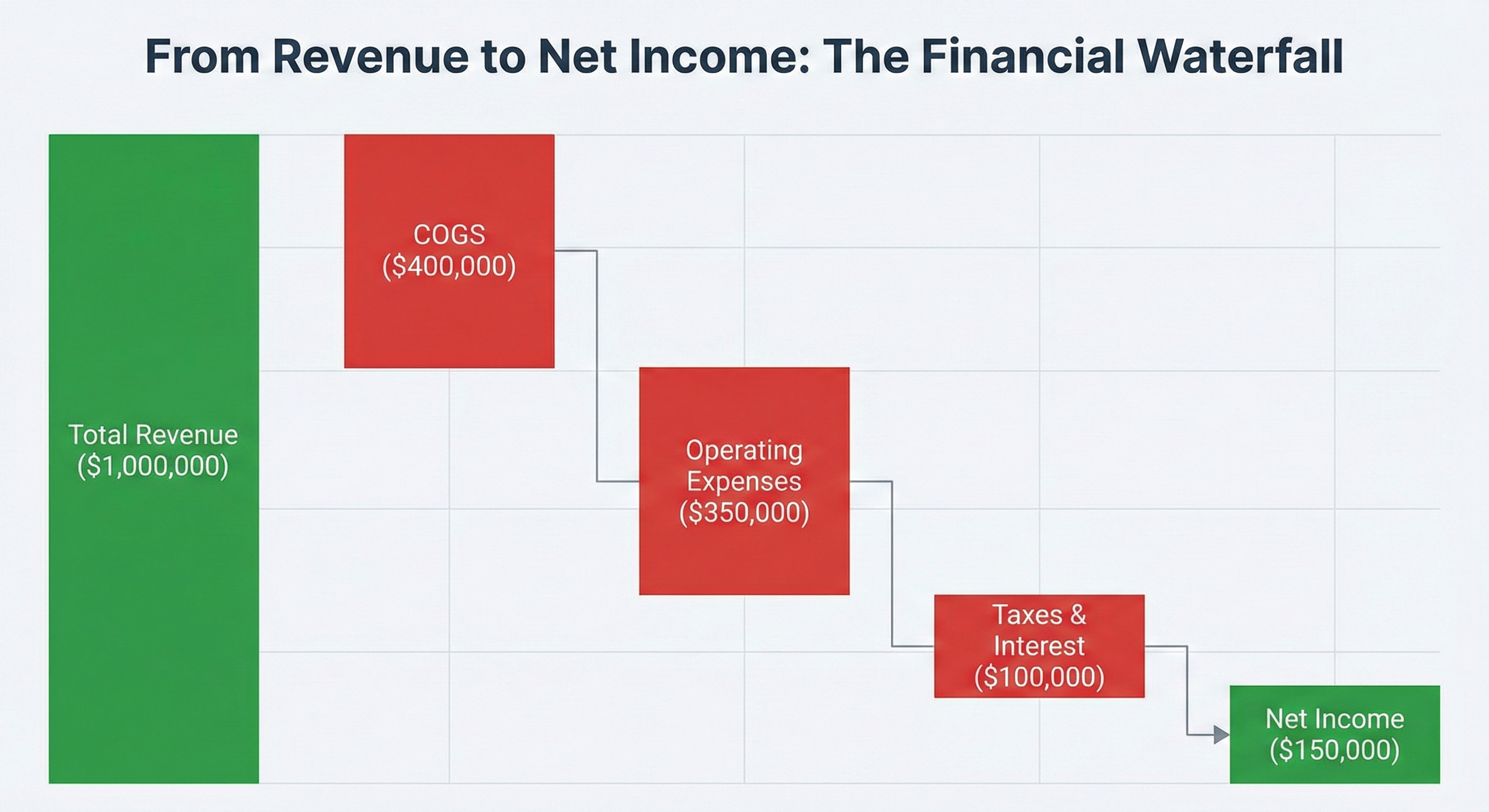
1. Gross Income (The Product Filter)
Formula: Revenue – Cost of Goods Sold (COGS)
This measures how much profit you make on the actual item or service sold before any overhead is considered.
- High-Ratio Industry: Retail and E-commerce. In these sectors, the Gross layer is the most critical. If a clothing brand sells a shirt for $50 but it costs $30 to manufacture and ship, their gross margin is tight. Any slight increase in global shipping costs in 2026 immediately threatens the entire business.
- Diagnostic: If this number is low, your unit economics are broken. You are either paying too much for your product or charging too little.
2. Operating Income (The Management Filter)
Formula: Gross Income – Operating Expenses (OPEX)
This accounts for the costs of staying in business: rent, payroll, software, and marketing.
- High-Ratio Industry: SaaS (Software) and Professional Services. These businesses often have very high Gross Margins (it costs almost nothing to sell one more software subscription), but very high operating costs (expensive developers and sales teams).
- Diagnostic: If your Gross Income is high but your Operating Income is low, the business is bloated. You likely have excessive overhead or an inefficient team structure.
3. Net Income (The Owner Filter)
Formula: Operating Income – Taxes and Interest
This is the final residue, the money that actually belongs to the shareholders. In professional reporting, the terms Income, Profit, and Net Income are used interchangeably to mean exactly this: what remains after every single expense is paid.
- Diagnostic: If this is the only layer that is struggling, your problem isn’t the business – it’s your capital structure. You may have too much high-interest debt or an outdated tax strategy.
Common Misconceptions About Financial Growth
- Can more sales fix a lack of profit?
Not necessarily. This is known as scaling an inefficiency. If your business loses $10 for every $100 of revenue due to poor margins, doubling your sales simply doubles your losses. Doubling sales on a broken model is one of the top 5 reasons small businesses fail. Growth is a magnifier; it makes good businesses better and bad businesses fail faster.
- Is high revenue the best indicator of business valuation?
Only in specific venture capital scenarios. In a stable 2026 market, valuation is almost always based on a multiple of EBITDA (Earnings Before Interest, Taxes, Depreciation, and Amortization). Think of EBITDA as your raw operational profit – it strips away non-business costs like taxes and debt interest to show what the company actually earns from its core activity. A company with $2M in revenue and $100k in EBITDA is significantly less valuable than a company with $800k in revenue and $200k in EBITDA, because the latter is far more efficient at turning sales into usable cash.
- Does a high bank balance mean the business is profitable?
No. This is Bank Balance Accounting. You might have high revenue sitting in your account because you haven’t yet paid your quarterly taxes or your vendors. Profit is a mathematical reality, not a visual check of your checking account.
How to Maximize Your Actual Profit
To drive profitability in the current economic climate, consider these advanced financial levers that move beyond basic cost-cutting.
1. Prioritize High-Quality Revenue
Not all sales are equal. Sophisticated founders track the Contribution Margin by Customer to identify which clients are actually driving profit. You may find that your top 10% of customers produce 80% of your income, while the bottom 20% actually cost you money in support and custom work. Scaling your bottom line often involves parting ways with low-margin clients to focus on high-efficiency revenue.
2. Test Your Pricing Elasticity
Many businesses leave significant income on the table by failing to test price increases. Because a price increase has zero associated production costs, it flows directly to your net income. Even a small 5% increase in price can often lead to a 20–30% boost in profit, yet it is the lever founders are most afraid to pull.
3. Optimize Your Working Capital Cycles
Profitability is often choked by the gap between paying your suppliers and getting paid by customers. By shortening your Days Sales Outstanding (DSO) – the time it takes to collect payment – you increase your liquid income without needing a single new sale. Even a five-day improvement in collections can significantly stabilize your cash position.
4. Monitor Your Labor Efficiency Ratio
Instead of just looking at total payroll, calculate your Labor Efficiency Ratio (LER): your Gross Profit divided by your Total Labor Cost. This tells you exactly how much gross profit every dollar of salary produces. If your LER is dropping while you hire, your management overhead is likely outstripping your production.
5. Audit Subscription Creep and Shadow IT
Industry benchmarks suggest that an average 30% reduction in software expenses can be achieved by eliminating underutilized or redundant tools, a phenomenon often called Shadow IT. Perform a zero-based tech audit: review every recurring subscription. You will frequently find you are paying for licenses for tools your team abandoned months ago or for multiple platforms that perform the same function.
The Shift from Growth to Efficiency
In the earlier stages of a business, it is natural to obsess over revenue. High sales figures feel like validation that your idea works. However, as a business matures, the focus must shift from how much you can sell to how much you can keep.
Financial health is not found in the total volume of money passing through your accounts, but in the efficiency of the “filters” you have built. By diagnosing your business through these three layers, you stop guessing where your money is going and start making data-driven decisions. Whether you need to raise your prices, trim your software stack, or restructure your taxes, the path to a sustainable 2026 starts with looking past the top line.
About the Author
Isabella Jones started her career at Deloitte, where she worked on tax compliance for some of the country’s fastest-growing companies. She later joined Fynlo as Senior Financial Strategist, bringing that experience to freelancers and small business owners who need practical financial guidance without the corporate complexity.
With an Accounting degree from Villanova University, Isabella focuses on making financial planning easier to understand and apply in day-to-day business. She works closely with freelancers and small businesses on areas like taxes, cash flow, and building more stable financial systems.